Insight
Activity Passes for Progress
Everything on the report is green and nothing in the business is better. Both statements are true, and the review that produced the first one was never built to notice the second.
Look at the two lines
Consider a review where the status looks healthy but the intended result has stalled. Put last quarter’s status reports next to the outcome measure they were supposed to serve. Retention, cycle time to a customer, revenue from the new line, cost per claim, whatever the initiative was funded to move. The status line is a run of green with the occasional amber that recovered. The outcome line is flat.
Nobody lied on the status reports. The items really closed. The milestones really passed. Velocity charts went up and value delivery stayed flat, and the two facts sat on adjacent slides for a year without anyone treating their disagreement as the finding.
The false read
The first explanation reaches for the people. Teams are slow, so push harder. Teams are working on the wrong things, so tighten prioritization. Both diagnoses have the same shape: they locate the fault below the review and leave the review itself unexamined.
Look at what the review is able to ask. It asks whether work is done, whether the date held, whether the color is green. It does not ask what changed for a customer because of the work, and it cannot, because that evidence does not exist on the day of the review. The outcome arrives weeks or quarters after the item closed, if anyone is measuring it at all. The review is an instrument, and this instrument can only detect motion. If the report you read is a rollup of many teams, Portfolio Fog explains what the summary preserved or omitted before it reached you.
The mechanism: instruments shape what they measure
The Counterfeit Signals mechanism explains how a review teaches people to produce the signal it rewards. In a status review that rewards completion alone, work can be sized to finish inside the reporting period while its intended result goes unchecked. The practical change is to make that result and its evidence date part of the review.

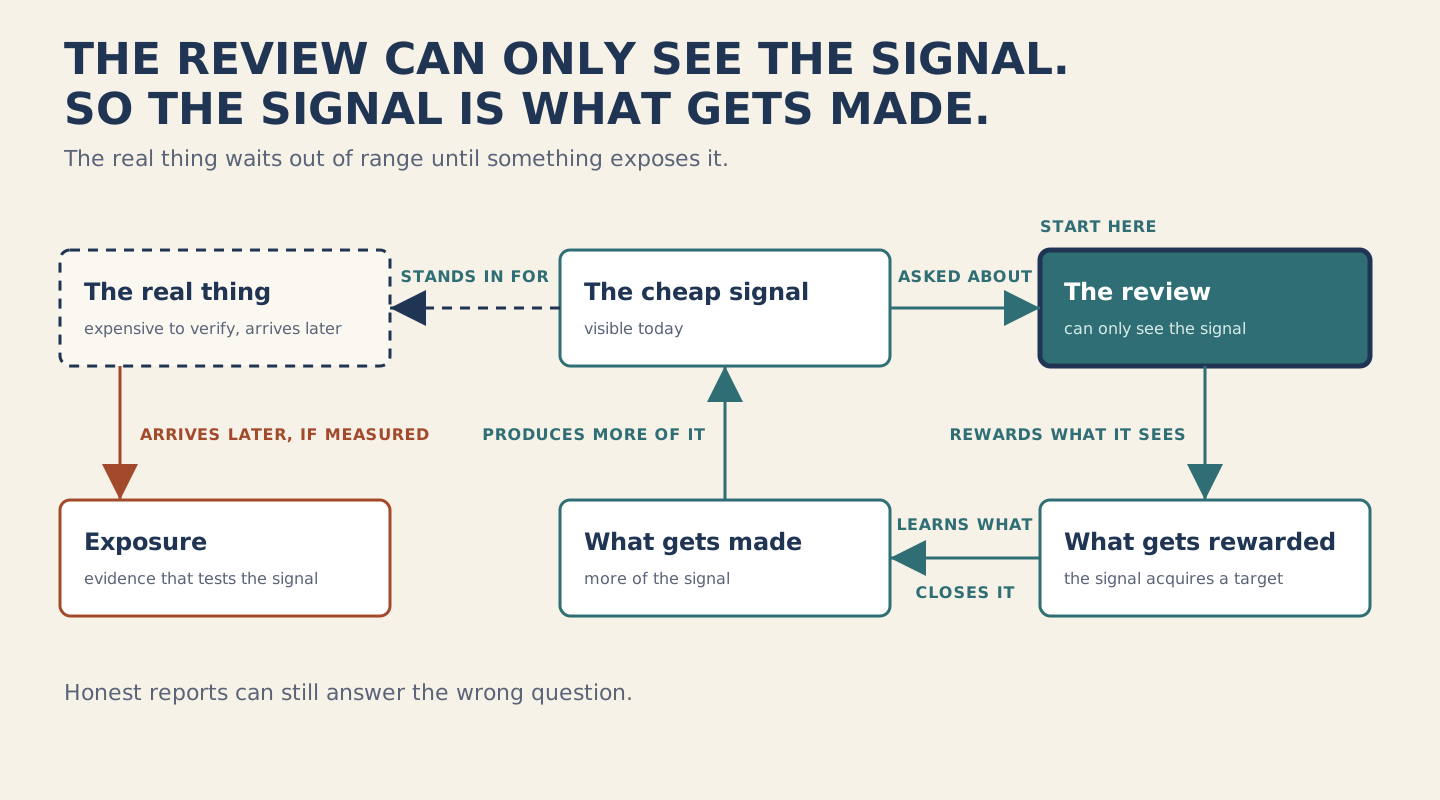
Distance Creates Certainty explains what makes this stable: summaries can remove the evidence needed to assess a customer outcome before the status slide reaches the reviewer.
What it costs
The visible cost is the flat line: money and quarters spent producing outputs that changed nothing measurable. The larger cost is what the organization stops learning. Applied End-to-End Flow: Enterprise defines learning as the rate at which evidence changes behavior, and draws the line plainly: an organization that runs experiments but does not change course based on the results is not learning. It is just busy. Without outcome evidence, the review cannot tell which changes worked or use those results to choose what happens next. That breaks the connection between completed work and learning.
There is a quieter cost too. People learn that effort is what gets recognized, so effort gets performed. Status decks grow. Demos multiply. Time that could have produced an outcome goes into producing evidence of activity, and the people doing it are not cynical. They are answering the question they were asked.
What changes when the review asks a different question
Change the question before you change the people. For every item a review marks done or green, require one sentence stating what changed for a customer or in a named outcome measure because of it. What shipped is not an answer to that question.
Three things happen. Items that cannot produce the sentence become visible as activity, which is the first time most reviews have been able to see the distinction. Items that can produce it get their outcome measure attached, so the next review can check whether the claim held. And the people building the report start sizing work by whether it can earn the sentence, which is the reward loop running in the right direction for once.
The sentence will often say “nothing yet, the measure reads in six weeks.” That is a legitimate answer. It puts a date on the real thing, which is exactly what a green dot never did.
The review can only see activity, so activity is what the organization makes. Change what the review can see, and the organization changes what it makes.
Applied Test: count the activity share
Take one recent status report and identify the items marked done, on track, or green. For each, record the intended outcome and the evidence available so far. Distinguish an observed result, an outcome still awaiting evidence, and an item with no defined outcome or follow-up.
Count the activity-only items: those reported as progress without either evidence of the intended outcome or an explicit plan to obtain and review it. Divide by all eligible items examined. An outcome marked pending with a named evidence source and review date is not in that numerator. If there are no eligible items, do not calculate a fraction.
For each activity-only item, define the intended outcome or assign the missing evidence and review date. For pending items, return on the agreed date. For observed outcomes, use the result to decide what continues or changes. The fraction describes the reporting gap in this sample, not the value of the work. The general mechanism, the register of other counterfeits, and the series that walks through them live on the Counterfeit Signals concept page.
Sources and validation
This Insight applies the Counterfeit Signals concept, developed for the What Passes for Progress series, and draws on Applied End-to-End Flow: Enterprise: the Motion-as-Progress gap in the Alignment Drift barrier, where output counts and outcome does not, the definition of learning in the book’s opening, and the velocity-versus-value observation in its first chapter. The two-line recognition scene and the reporting examples are illustrative constructions. The activity share is a reader-computed fraction; the page states no expected value for it.
Curtis Hibbs and Joshua Barnes are co-creators of Effective Enterprise AI and Applied End-to-End Flow, and co-authors of Applied End-to-End Flow: Enterprise. Their work combines enterprise diagnosis, value-delivery mechanics, and practical intervention patterns across strategy, portfolios, value streams, and teams.