Foundational Gap
Project-Funding Trap
The deliverables survive project closure. The working group often does not. When related work begins, the organization can find itself rebuilding context, relationships, and ownership it already paid to create.
Definition
The Project-Funding Trap is the funding-and-staffing pattern in which work is organized as temporary projects, people are assembled or fractionally allocated, and the working group disperses at project boundaries. The pattern can force recurring team formation, recontextualization, ownership transfer, and reconstruction of accumulated working knowledge.
The budget label is not the test. A project-funded initiative can preserve a stable team, durable ownership, and accessible knowledge. The trap appears when temporary staffing and dissolution repeatedly break that continuity.
The recognition pattern
Look for the operating pattern across related initiatives:
- Staffing begins as a new negotiation, even when the domain and systems are familiar.
- People hold fractional assignments across several initiatives and repeatedly reload context.
- A new working group must rediscover system edge cases, stakeholder history, and earlier decision logic.
- The project closes and the people who built the result return to functional pools or unrelated work.
- Operational ownership transfers to people who did not make the original trade-offs.
- Documents remain, but nobody can quickly explain why the solution works as it does.
- A later initiative rebuilds relationships and practical knowledge that existed during the earlier work.
One signal may have an ordinary explanation. The trap is the repeated sequence.
How the reset cycle works
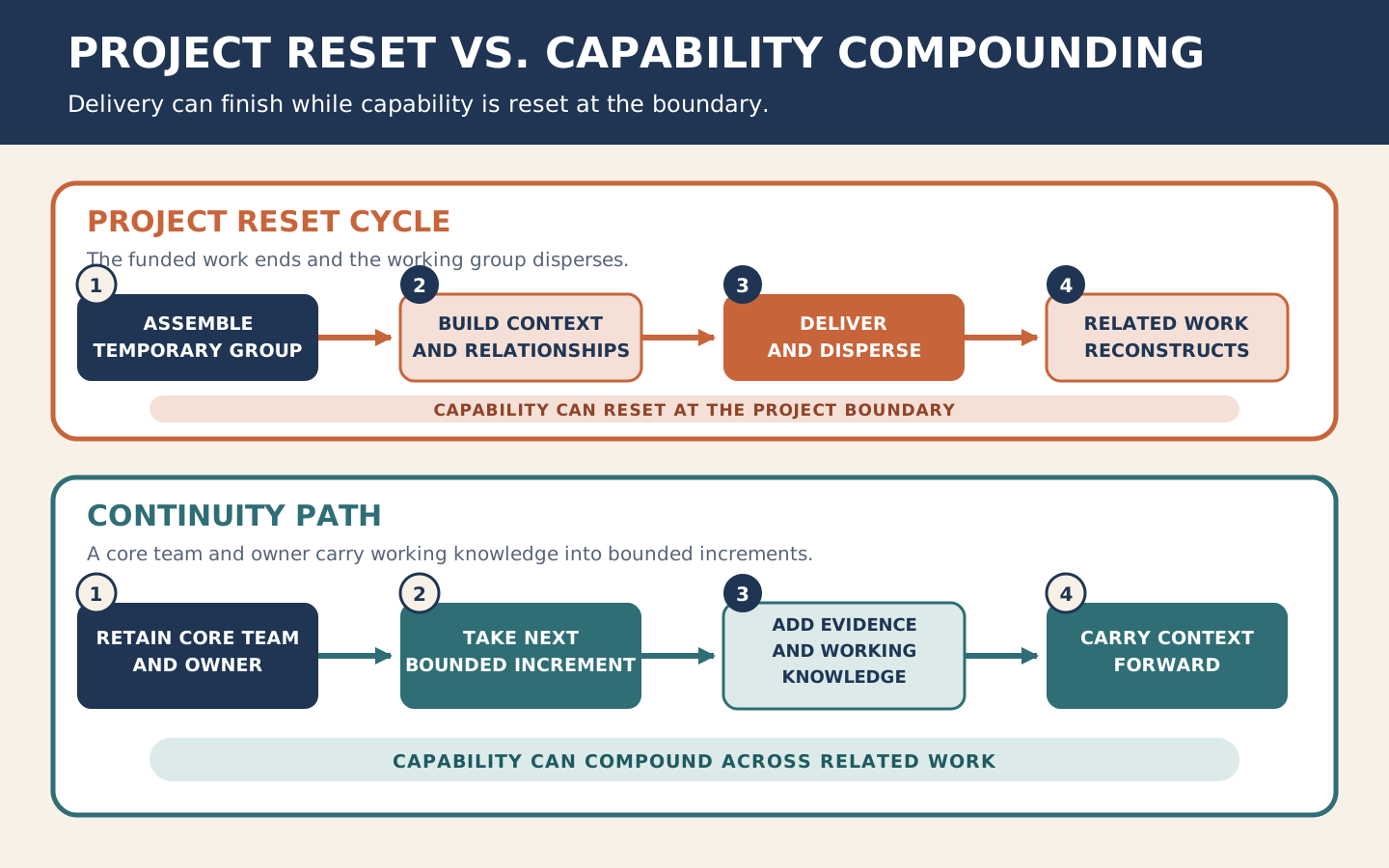
Temporary project structures can turn learning into a disposable input.
Assembly. People are borrowed, assigned part time, or collected around an approved scope. They establish working relationships and learn the domain, systems, constraints, and stakeholders.
Delivery. The group produces the planned result. It also develops working knowledge that rarely fits completely into a handoff packet.
Dissolution. The funding boundary closes. People disperse, ownership transfers, and access to the group’s accumulated judgment weakens.
Reconstruction. Related work appears later. A new group rebuilds enough context, trust, decision history, and system understanding to proceed.
That reconstruction is the amnesia bill. The organization is not buying identical work twice. It is paying again to restore capability that its staffing model allowed to fragment.

Working knowledge is more than documentation
Documentation can preserve requirements, designs, decisions, procedures, and known issues. That matters. It still does not automatically preserve the judgment used to interpret those artifacts.
Working knowledge includes:
- domain context and exceptions;
- system behavior and edge cases;
- stakeholder relationships and trust;
- the history behind important trade-offs;
- practical knowledge of who owns what after delivery.
Records can carry part of that knowledge across a boundary. The rest remains usable only when people are available to interpret the reasoning and apply it in changed conditions. The Project-Funding Trap weakens both forms when it disperses the group and leaves no durable steward.
What the trap is not
It is not every project. A bounded initiative can have a beginning and an end without dismantling the team or orphaning the result.
It is not ordinary turnover. People leave stable teams too. The trap is a systematic design that makes discontinuity recur at funding boundaries.
It is not Funding Boulders. A large investment package can retain a stable group. A sequence of smaller investments can still churn people. Investment-unit timing and team continuity can fail together or separately.
It is not Latency Load. Latency Load is the additional work generated while actionable work waits. The Project-Funding Trap creates reconstruction work after continuity is broken. Recontextualization can appear in both, but the initiating conditions differ.
It is not proof that stable teams will perform well. Continuity can preserve context and let capability compound. It does not remove turnover, new-domain learning, poor decisions, or weak operating practices.
A compact continuity check
Choose three related initiatives and inspect the boundaries between them:
- Who continued into the next body of work?
- Which domain, system, relationship, and decision knowledge remained accessible?
- Who owned the delivered result after the project closed?
- What did the next group have to reconstruct before it could move?
The pattern matters more than a manufactured percentage. Paying for Amnesia provides the complete Team Continuity Ledger and turns the diagnosis into one bounded continuity decision.
Sources and lineage
The Project-Funding Trap is an Applied End-to-End Flow gap developed by Curtis Hibbs and Joshua Barnes. Its framework treatment comes from the Choked Flow chapter of Applied End-to-End Flow: Enterprise. This entry describes assembly, dissolution, ownership, and capability that fails to compound across related work. It makes no claim about a universal productivity loss, a fixed team-development timeline, or an inevitable reset at every project boundary. Browse the Applied End-to-End Flow Library for the wider concept and Insight corpus.
Curtis Hibbs and Joshua Barnes are co-creators of Effective Enterprise AI and Applied End-to-End Flow, and co-authors of Applied End-to-End Flow: Enterprise. Their work combines enterprise diagnosis, value-delivery mechanics, and practical intervention patterns across strategy, portfolios, value streams, and teams.