Operating Concept
Hoshin Kanri
Hoshin Kanri is the strategy-deployment discipline of the Lean tradition. It translates a small number of strategic priorities into concrete initiatives at every level of the organization. At each level, targets and means are negotiated rather than dictated. Progress is reviewed against strategy on a regular cadence. The name is usually rendered as policy deployment or direction management.
The practical consequence: an organization running Hoshin can trace any significant initiative to a strategic priority, and can name the next scheduled review or usable exception path through which evidence can change the commitment. If your organization funds work through annual project approvals, try producing either answer for one live initiative; the Applied test below shows you how.
The gap this page fills
If your Lean formation came through mainstream Western books and training, there is a fair chance you have never met Hoshin Kanri, whatever your seniority. That gap is structural, and its history is worth two minutes.
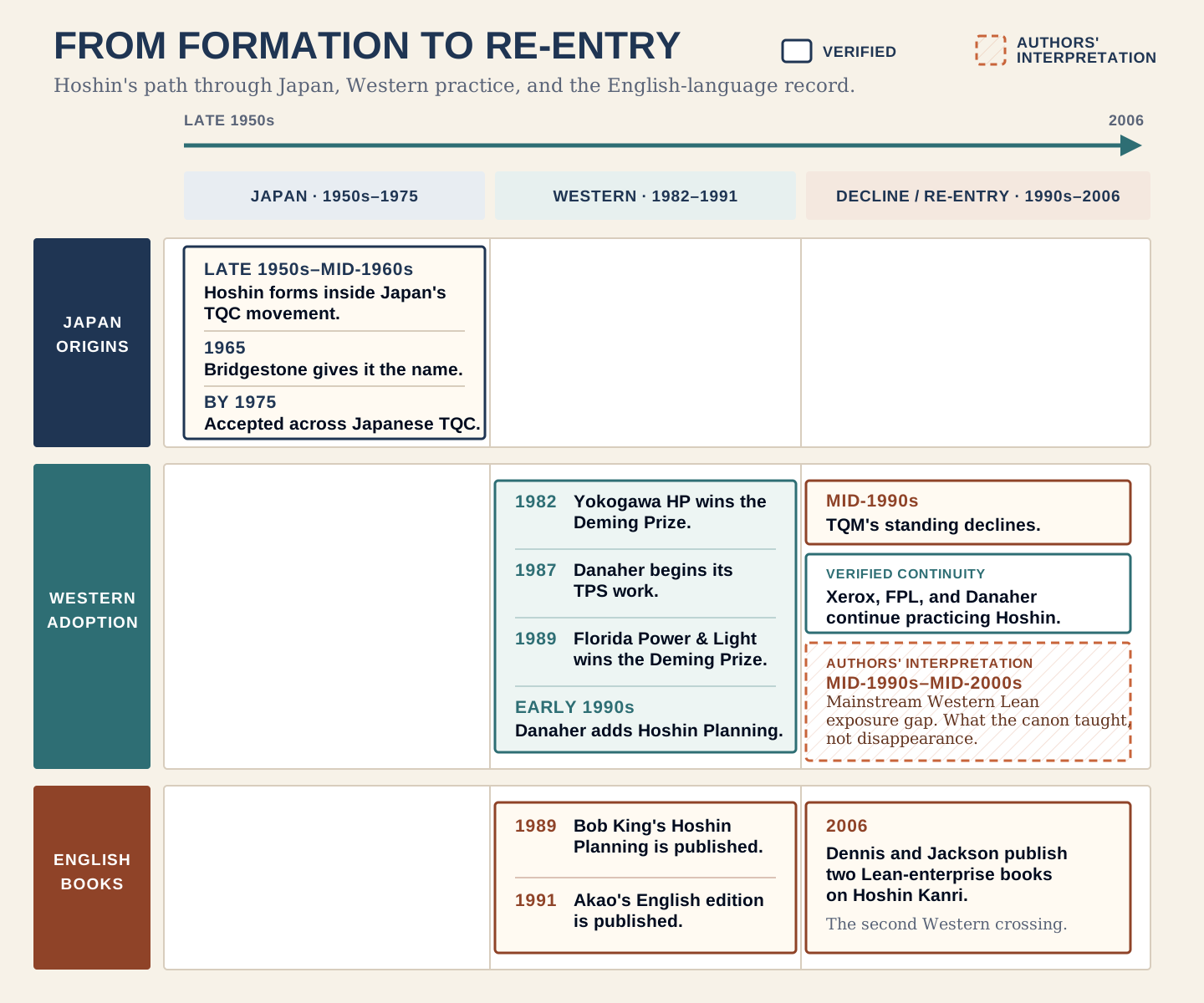
Hoshin crystallized in Japan between the late 1950s and the mid-1960s, inside the Total Quality Control movement, drawing on Deming’s PDCA training and Juran’s 1954 lectures on management’s role in quality. Bridgestone Tire gave it the name in 1965 after analyzing how Deming Prize-winning companies planned. By 1975 it was widely accepted practice in Japanese TQC companies.
It crossed to the West twice. The first crossing came in the early 1980s through Japanese subsidiaries and partners: Hewlett-Packard’s Yokogawa HP division, which won the Deming Prize in 1982, Fuji-Xerox feeding policy deployment into Xerox, and Texas Instruments’ Oita plant. Florida Power & Light became the first Deming Prize winner outside Japan in 1989. The first English-language books followed: Bob King’s Hoshin Planning: The Developmental Approach in 1989 and the English edition of Akao’s Hoshin Kanri: Policy Deployment for Successful TQM in 1991. That wave rode the TQM movement, and as TQM’s standing declined in the mid-1990s, the first Western Hoshin wave receded with it.
Meanwhile the books that formed the mainstream Western Lean canon in the 1990s centered on the shop floor: value streams, waste, flow, pull. Strategy deployment was not central to them. Peer-reviewed reviews of Lean’s evolution describe the 1990s phase as tool-focused, with the strategic dimension arriving later. Hoshin re-entered Western Lean vocabulary through the lean-enterprise wave, notably Pascal Dennis’s Getting the Right Things Done and Thomas Jackson’s Hoshin Kanri for the Lean Enterprise, both published in 2006, and through operator-to-operator spread of business systems in the Danaher tradition. Danaher began its TPS work in 1987 and added Hoshin Planning in the early 1990s, building what became the Danaher Business System.
Our reading of that record is an interval from the mid-1990s through the mid-2000s in which a practitioner could absorb mainstream Western Lean books and training and never encounter Lean’s own strategy layer. This is the authors’ interpretation of publication and transmission patterns, not a claim that Hoshin disappeared from every Western company; Xerox, Florida Power & Light, and Danaher were practicing it through those years. The gap is about what the mainstream canon taught.

How the mechanism works
Hoshin runs on an annual cycle. Leadership selects a small number of breakthrough priorities, few enough to be real. Each level of the organization translates the level above’s priorities into its own objectives and proposed means. It then negotiates those objectives and means upward and downward until targets and means agree.
That negotiation is called catchball: a structured, two-way feedback loop on strategy, designed in the 1960s.
Progress reviews run through the year against the deployed priorities, conventionally organized on an X-matrix that keeps priorities, initiatives, targets, and owners on one page. At year end the cycle repeats.
Judge that design against an annual project-funding process, where work connects to strategy once, at approval time, and execution is then measured against plan until the next cycle. Hoshin keeps the connection alive all year, negotiates means with the people who will do the work, and schedules moments where evidence is allowed to speak. If that describes a stronger linkage than your organization runs today, the practice deserves your respect before your critique.
Where it sits on the funding trajectory

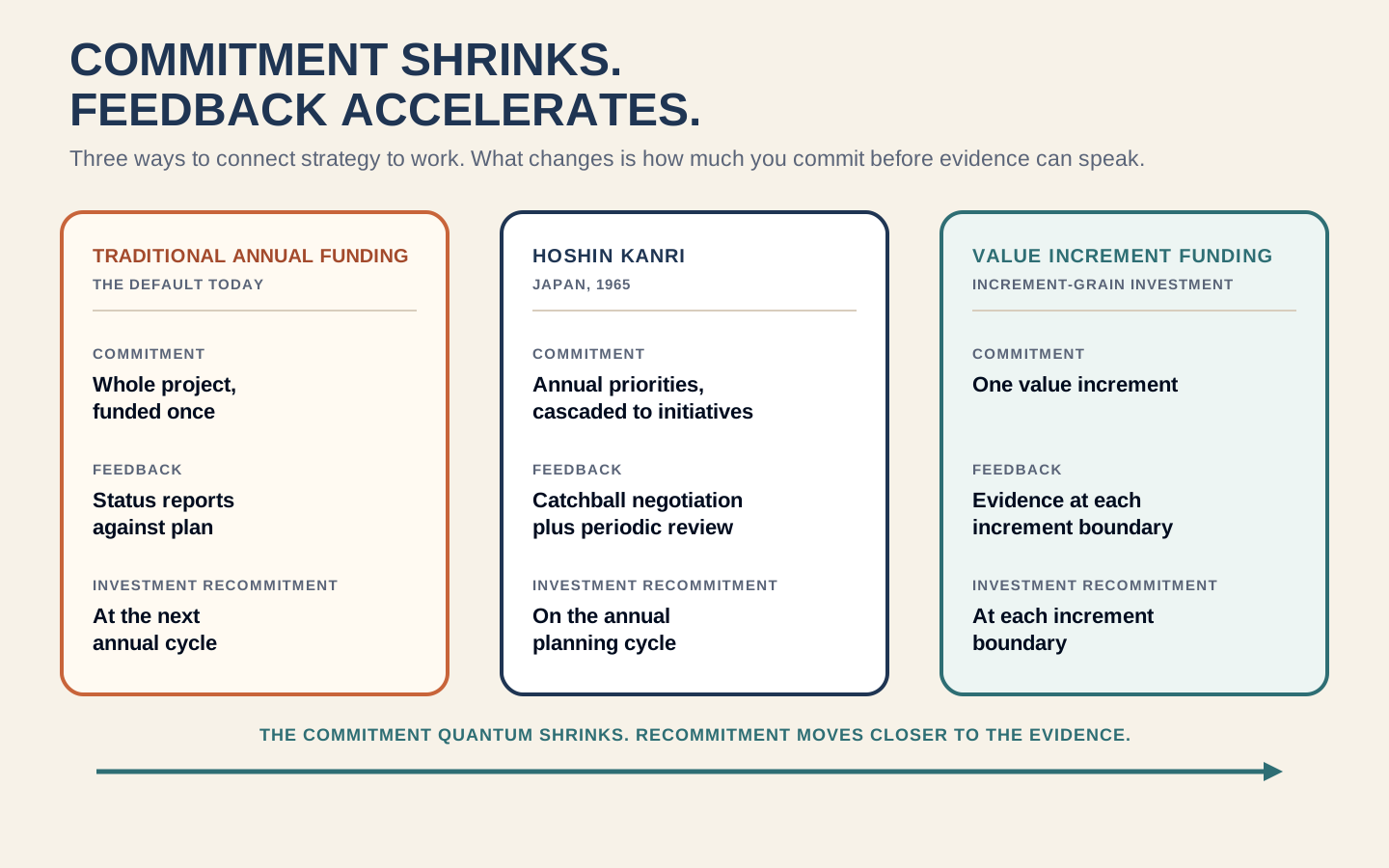
Takeaway: Hoshin holds the strategy-to-work linkage. Value increment funding changes the grain of the investment decision. On smaller screens, scroll horizontally.
| Dimension | Traditional annual funding | Hoshin Kanri | Value increment funding |
|---|---|---|---|
| Commitment quantum | Whole project or program | Annual priorities cascaded to initiatives | One value increment |
| Feedback mechanism | Status reporting against plan | Catchball negotiation plus periodic review | Evidence at each increment boundary |
| Review cadence | Annual | Annual cycle with in-cycle reviews | Continuous, increment-bounded |
| Strategy-to-work linkage | Decays after approval | Explicit and maintained | Explicit and re-validated per increment |
| Investment recommitment | At the next annual cycle | On the annual planning cycle | At each increment boundary |
Hoshin organizes commitment through an annual planning cycle, with catchball and periodic review keeping alignment and feedback active inside it. Value increment funding changes the grain of the investment decision itself: commitment shrinks to a single increment of demonstrable value, and recommitment happens at each increment boundary, where evidence arrives while the decision is still cheap to change.
We say the lineage plainly. The value increment approach inherits Hoshin’s central achievement, a live, negotiated connection between strategy and work, and changes the investment grain. Value increment funding is this framework’s mechanism, not Hoshin’s historical endpoint; one practice built the linkage, the other shortens the distance between commitment and evidence.
Boundaries and distinctions
This page defines Hoshin Kanri and locates it historically. It does not teach Hoshin implementation, X-matrix construction, or catchball facilitation; the 2006 texts named above do that well. It also does not carry the value increment funding mechanism, which has its own resources.
Do not confuse Hoshin with conventional management-by-objectives implementations. The practices differ along several dimensions: whether means are negotiated rather than only targets cascaded, whether objectives deploy across organizational levels rather than down reporting lines, whether review centers on a small set of strategic priorities rather than individual attainment, and whether a mechanism like catchball is an explicit part of the operating system. Particular MBO implementations may share some of these traits; Hoshin is defined by their combination.
Applied test: the Strategic Recommitment Trace
Pick one live strategic initiative. Build a commitment record from planning and decision artifacts.
-
When was the commitment made?
-
When is the next scheduled opportunity to revise that commitment based on evidence?
-
How much work sits between those two dates?
-
If material evidence changes before that review, what usable exception path permits an earlier decision? Record who can authorize it.
Record the scheduled review and any usable exception path together. If neither provides a timely decision, use the Cadence Mismatch Audit to examine the gap. This trace examines the selected commitment’s ability to respond to evidence; it does not establish whether the organization has adopted Hoshin.
Sources and lineage
Verified record. Deming’s 1950 training, Juran’s 1954 lectures, Bridgestone’s 1965 naming, and Japanese acceptance by 1975: the MCTS Hoshin Kanri history timeline. Yokogawa Hewlett-Packard’s 1982 Deming Prize: Hewlett-Packard’s corporate history archive. Florida Power & Light’s 1989 Deming Prize: contemporary press coverage and JUSE’s prize records. Publication dates for King (1989), Akao (1991), Dennis (2006), and Jackson (2006): publisher records. Danaher’s 1987 start and early-1990s addition of Hoshin Planning: Art Byrne’s firsthand account.
Interpretation. The exposure-gap framing, the reading that the first Western wave receded with TQM’s decline, and the characterization of the 1990s mainstream canon as shop-floor-centered are the authors’ analysis of that record, the last supported by the peer-reviewed Lean-evolution literature (Hines, Holweg, and Rich, 2004).
Framework source
The increment-based investment approach this page compares against appears in Applied End-to-End Flow: Enterprise. This Knowledge Base page defines an external practice and its lineage; the framework’s own funding mechanism is canonical at Value Increments.