Diagnostic Frame
Altitude Error
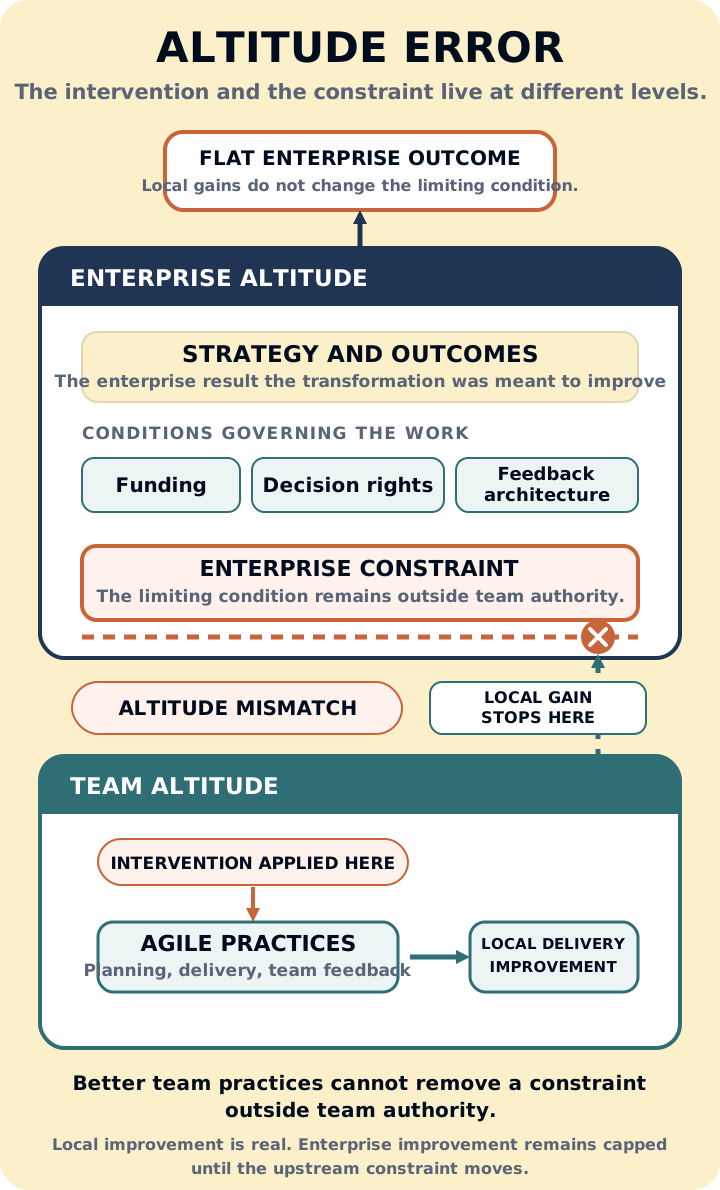
Improving a team’s work does not, by itself, change a funding rule or approval path controlled elsewhere. When teams improve and enterprise outcomes stay stuck, the intervention may be aimed at the wrong altitude.
Definition
Altitude Error is the mismatch between the level where an intervention is applied and the level where the constraint limiting results actually operates.
The intervention can work exactly as intended. A team may plan better, shorten feedback inside an iteration, reduce defects, and finish work faster. Those gains remain local when the system above the team still delays funding, fragments priorities, hoards decisions, or measures delivery without measuring value.
The improvement was real; the unchanged constraint limited its effect on the enterprise result.
The recognition pattern
Altitude Error usually appears as a contradiction:
- Teams report better practices and faster local delivery.
- Leaders see little movement in time-to-market, customer outcomes, or strategic execution.
- The organization concludes that adoption is incomplete or the teams need more coaching.
- Another intervention targets the teams while the surrounding constraint remains untouched.
Together, these signals show a loop: the organization treats limited enterprise movement as evidence that the teams need another intervention, while the limiting condition remains above their authority.
How the error works
Every intervention carries an implied theory of the constraint.
Team coaching assumes the constraint is team capability. A new planning method assumes the constraint is how the team organizes work. A delivery tool assumes the constraint is visibility or execution discipline.
Those may be accurate diagnoses. When they are, the intervention belongs at the team altitude.
The diagnosis fails when the actual constraint lives elsewhere:
- Strategy arrives as slogans rather than outcomes teams can act on.
- Funding locks work into oversized projects before learning begins.
- Decision rights force routine choices through distant approval chains.
- Dependencies and governance queues consume more time than the work.
- Feedback measures activity while customer value remains unknown.
A team can expose these conditions. It can collect evidence, reduce the damage locally, and propose a better path. It usually cannot redesign enterprise funding, reassign decision authority, or change what senior leaders reward. Those interventions require a different altitude.

A simple example
Consider an illustrative delivery path with three stages:
| Stage | Before team improvement | After team improvement |
|---|---|---|
| Build and test | 10 days | 4 days |
| Approval queue | 15 days | 15 days |
| Release wait | 10 days | 10 days |
| End-to-end time | 35 days | 29 days |
The team cut its own work by 60%. End-to-end time improved by about 17% because the approval and release constraints did not move.
Calling the team slow would be wrong. Calling the team improvement useless would also be wrong. The team improved the part it controlled, while most of the delay lived elsewhere.
That is Altitude Error in operational form. The organization expected a local intervention to remove a system constraint.
Match the intervention to the constraint
The right altitude follows authority and mechanism, not the organization chart.
Team altitude
Use team-level interventions when the team can change the condition directly:
- Work slicing
- Engineering quality
- Planning discipline
- Local work-in-process
- Team feedback and coordination
Enterprise altitude
Use enterprise-level interventions when the condition crosses teams or requires leadership authority:
- Strategic outcomes and portfolio priorities
- Funding structures
- Decision rights
- Cross-organizational dependencies
- Governance and risk policy
- Customer and business feedback architecture
Some constraints span both altitudes. That does not erase the distinction. It means the intervention needs coordinated changes at each level rather than a team program carrying the whole burden.
Boundaries and distinctions
Teams still have agency. Teams are often the first to see the constraint and the best source of evidence about its cost. They can make local improvements, test workarounds, and signal what requires escalation.
Diagnosis still comes first. Weak team practices are real. So are poor technical quality, unclear local ownership, and ineffective coordination. A stalled transformation is not automatically an altitude problem.
Agile practices retain their proper job. Agile was designed to improve how teams work under uncertainty. The error appears when those practices are treated as sufficient to redesign enterprise funding, governance, decision rights, and feedback systems.
Altitude describes scope. It identifies the reach of the constraint and the authority required to change it. It says nothing about status, importance, or who has the better view.
Applied Test: find the constraint above the team
Choose one initiative where a capable team is working hard but the enterprise result remains slow, expensive, or uncertain.
- Name the result that is not moving. Use an outcome such as time-to-market, customer adoption, decision latency, or value realized.
- Name the improvement already applied. Training, a new framework, better tooling, added coaching, or a local process change.
- Locate the remaining constraint. Ask what the team cannot change without authority from elsewhere.
- Identify the required altitude. Team, value stream, portfolio, or enterprise.
- Test one change at that altitude. Move one decision closer to the work, shorten one approval path, clarify one outcome, or expose one missing feedback signal.
The test is complete when it produces evidence. Did moving the intervention closer to the constraint change the result?
If the remaining constraint is still too broad to act on, use The Three Barriers to locate it in alignment, flow, or feedback.
Sources and lineage
Altitude Error is an Applied End-to-End Flow concept developed by Curtis Hibbs and Joshua Barnes. Its primary treatment appears in Chapter 1 of Applied End-to-End Flow: Enterprise and in the Enterprise Executive Summary Edition. The concept also anchors the jointly authored April 16, 2026 LinkedIn article The Great Agile Lie: Why Enterprise Agility Keeps Failing.
Curtis Hibbs and Joshua Barnes are co-creators of Effective Enterprise AI and Applied End-to-End Flow, and co-authors of Applied End-to-End Flow: Enterprise. Their work combines enterprise diagnosis, value-delivery mechanics, and practical intervention patterns across strategy, portfolios, value streams, and teams.