Diagnostic Frame
Counterfeit Signals
The report is green. The calendar is full. The team followed the process and the sponsor sounded sure. Two quarters later the outcome number has not moved, and nobody can say which of those signals was the real thing.
Definition
A Counterfeit Signal is a cheap, observable stand-in for an expensive, delayed truth, managed in the truth’s place. Activity stands in for progress. Following the process stands in for competence. Confidence stands in for being right. Each pair has the same shape: the first thing can be seen today, the second thing needs evidence that arrives later, if anyone collects it at all.
The consequence follows from the shape. The review can only see the signal, so the signal is what gets made. Without a deliberate outcome check, the review can miss deterioration until an outside event reveals it.
The recognition pattern
Counterfeit Signals show up in what a review can and cannot ask. Look for these fingerprints:
- Status is reported as color and completion. Nobody is asked what changed for a customer or in an outcome measure.
- The organization can state its maturity level, certification count, or ceremony attendance faster than it can state what it learned last quarter.
- The most confident voice in the room is treated as the best-informed one, and no one checks the two against each other.
- Teams hit their commitments and customers do not get what they need, because commitment was defined as shipping on schedule.
- When an outcome finally arrives, the surprise is total. Every signal along the way had said it was fine.
These observations are reasons to examine what the review rewards. They do not, by themselves, establish that a stand-in has replaced the outcome.
What to examine: whether the review treats activity, compliance, or confidence as proof of a result it has not checked. That is the substitution to establish before changing the review.
How the mechanism works
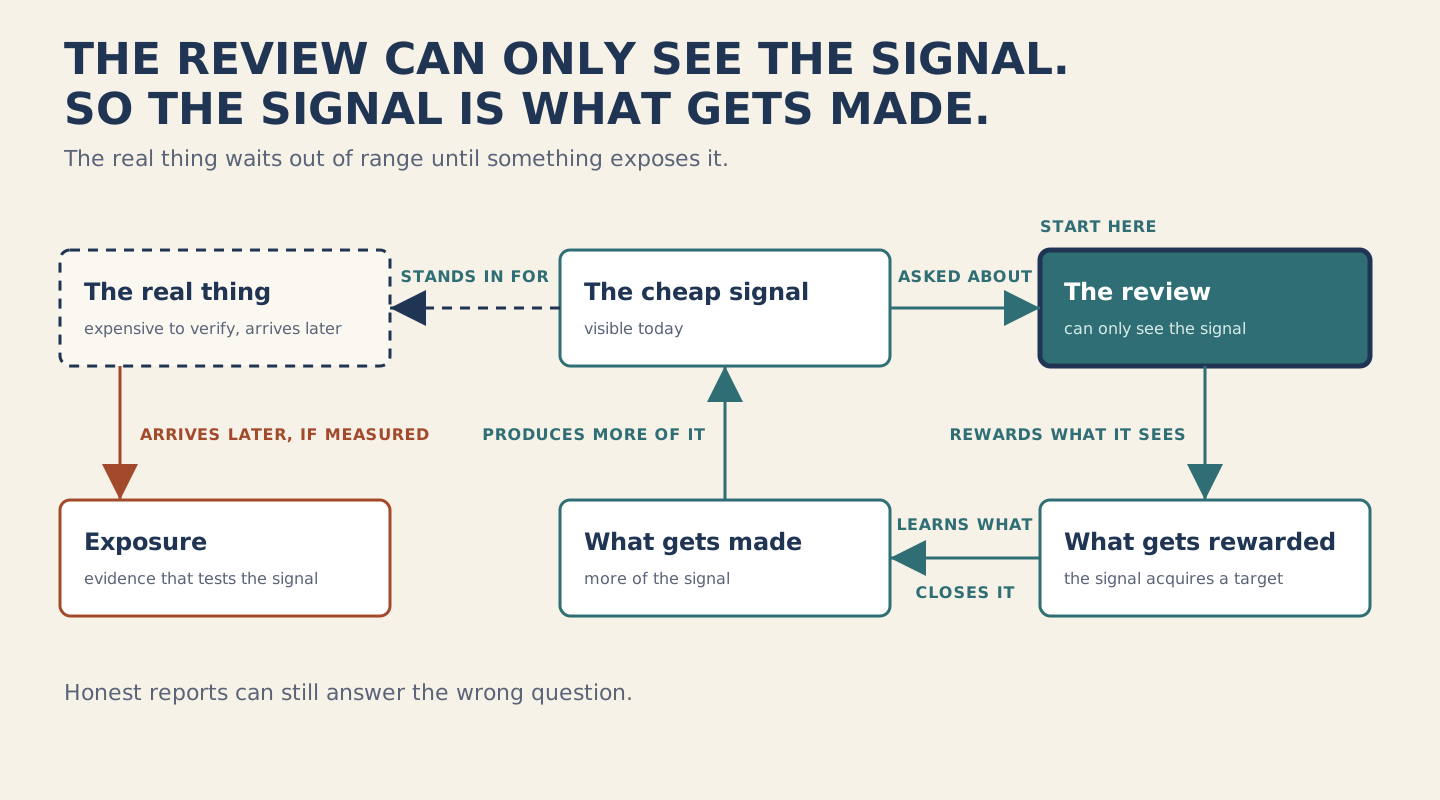
The mechanism has five steps. The last four form the loop in the figure below; the first is the real thing waiting outside it, and the delay between them is what makes the loop stable.
The real thing is expensive to see. Progress needs an outcome measure and time for the outcome to occur. Competence shows only when the situation leaves the script. Being right waits for reality to answer. None of these is available at the next review.
A cheap signal is available now. Work items closed, ceremonies held, certifications earned, a plan modeled and locked, a leader who speaks without hedging. Each is visible today, and each correlates with the real thing often enough to feel like evidence.
Distance leaves only the cheap signal in view. Customer Distance explains how the real thing gets summarized away before it reaches authority, and the same happens to every signal a review consumes.
The cheap signal gets managed. Because it is the only thing the review can see, it becomes the thing the review asks about, praises, and escalates on. It acquires a target. The target acquires a bonus.
The organization learns to make the signal. Teams learn what closes the review cleanly and produce that. Boards fill and ceremonies run on schedule. Estimates become political artifacts. The stand-in gets easier to produce and less connected to what it stood for.
The exit from the loop is an exposure event: a delivery that changes nothing, a crisis the process was never written for, a market that answers the confident bet. Without a deliberate check against the outcome, that exposure may be the first feedback the review receives.

The register of counterfeits
The register grows as new counterfeits are named. Each row pairs a stand-in with the evidence it can displace and an illustrative event that could reveal the difference.
| Counterfeit | The cheap signal | The real thing | Possible exposure event |
|---|---|---|---|
| Activity passes for progress | Items closed, boards moving, throughput rising | A named outcome changed because of the work | The expected outcome fails to appear at its review date |
| Process passes for competence | Certifications, ceremonies held, maturity scores | The ability to act well when the situation leaves the script | Under pressure, when the mechanics get reverted |
| Confidence passes for being right | The assured voice in the room | A decision that reality later confirms | A market result contradicts the original claim |
| Consensus passes for alignment | Everyone using the same words | Everyone building the same thing | Teams deliver conflicting interpretations |
| Planning passes for control | A modeled, scoped, locked annual plan | The ability to change course when the evidence changes | Material evidence changes while commitments remain fixed |
| Measurement passes for understanding | A comprehensive real-time dashboard | Knowing what a customer experienced | When a customer does what the dashboard could not see |
The timing depends on when the relevant outcome becomes observable and whether anyone checks it. The table illustrates possible exposure events, not a fixed sequence or schedule.
Boundaries and distinctions
Counterfeit Signals is about instruments, not dishonesty. Signals can be reported truthfully while the review asks for the wrong thing.
Customer Distance is the precondition, not the same mechanism. Distance explains why the real thing gets summarized away before it reaches authority. Counterfeit Signals explains what the review does with what is left, and what the organization then produces. See Customer Distance.
Portfolio Fog is a specific instrument. A rollup dashboard can compress different team states into one status. That is one way a review comes to see only the cheap signal. See Portfolio Fog.
Counterfeit Signals belongs to no single barrier. Applied End-to-End Flow: Enterprise records two Alignment Drift gaps that match the first rows of the register, Motion-as-Progress and Delivery-as-Success: output counted as progress, and shipping counted as success. Customer Distance, in Broken Feedback, is where the confidence counterfeit was first described. Counterfeit Signals is the mechanism underneath all of them, and the register extends it to signals no gap names. See the gap table in The Three Barriers.
Vanity Velocity is the team-scope instance. When customer validation is absent, a team optimizes for the one signal that remains. Applied End-to-End Flow: Team treats that pattern at team altitude. This page treats the general shape at every altitude.
A stand-in is not useless. Activity does correlate with progress and confidence does correlate with knowledge, often enough that treating them as evidence feels reasonable. The counterfeit begins when the stand-in is managed instead of the real thing, and the correlation is what makes that hard to notice.
Example
An illustration, by construction. A portfolio review covers twelve initiatives. Each is reported as a color, a percent complete, and a next milestone. Ten are green. The two ambers have recovery plans. The review runs forty minutes and ends with congratulations. Nobody asks what any initiative has changed for a customer, because that is not a field on the slide. Six weeks later the outcome measure the portfolio was funded to move posts flat for the fourth quarter running. The review has been managing percent complete for a year. Every number on every slide was accurate.
Applied Test
Pick one signal reported green at a recent review. Record the outcome it is being used to represent, the evidence needed to assess that outcome, and when that evidence should become available. Then check how the review treats the gap. Does it label the outcome as pending and arrange to revisit it, or treat the green signal as proof that the outcome occurred? Delayed evidence alone does not establish substitution. If the review treats the stand-in as proof, add the missing outcome field and arrange a decision when evidence becomes available. If the outcome is already marked pending with a follow-up, preserve that distinction.
The What Passes for Progress series
Each article in the series takes one counterfeit from the register, shows how to recognize it in the reader’s own organization, and gives one test to run this cycle. The series is open-ended; new counterfeits enter the register above as they are named, and the articles follow.
- Activity Passes for Progress. How to distinguish observed outcomes, pending evidence, and activity-only reporting in one recent status report.
- Process Passes for Competence. How to examine a process’s purpose and the reasoning people use when its steps do not fit.
- Confidence Passes for Being Right. Why a decision forum rewards the sure claim on the day and rarely scores it when reality answers, and a test that counts the documented comparisons in one forum’s year-old record.
Sources and lineage
Counterfeit Signals is an Applied End-to-End Flow concept developed by Curtis Hibbs and Joshua Barnes. It generalizes a pattern recorded in two places in Applied End-to-End Flow: Enterprise: the Motion-as-Progress and Delivery-as-Success gaps in the Alignment Drift barrier, and the Customer Distance mechanism in the Broken Feedback barrier. The name, the five-step loop, the register, and its illustrative exposure events are the authors’ synthesis, developed for the What Passes for Progress series.
Curtis Hibbs and Joshua Barnes are co-creators of Effective Enterprise AI and Applied End-to-End Flow, and co-authors of Applied End-to-End Flow: Enterprise. Their work combines enterprise diagnosis, value-delivery mechanics, and practical intervention patterns across strategy, portfolios, value streams, and teams.