Foundational Gap
Customer Distance
Executives debate customer needs. None of them talked to a customer this quarter. The debate proceeds anyway, at full confidence, on summaries of summaries.
Definition
Customer Distance is the structural condition in which customer reality reaches decision-makers only through successive layers of filtering and summary, so the people with the most authority to change the customer experience have the least direct contact with it.
The consequence follows directly. Strategy gets set by people whose picture of the customer is an abstraction assembled by other people, and nothing in the decision process reveals how much was lost on the way up.
The recognition pattern
Customer Distance shows up in how decisions get made, not in what anyone believes about customers. Look for these fingerprints:
- Strategic product decisions happen in conference rooms with no customer present and no recent customer contact in the room.
- “Customer says” statements cite aggregated reports, not conversations anyone in the room actually had.
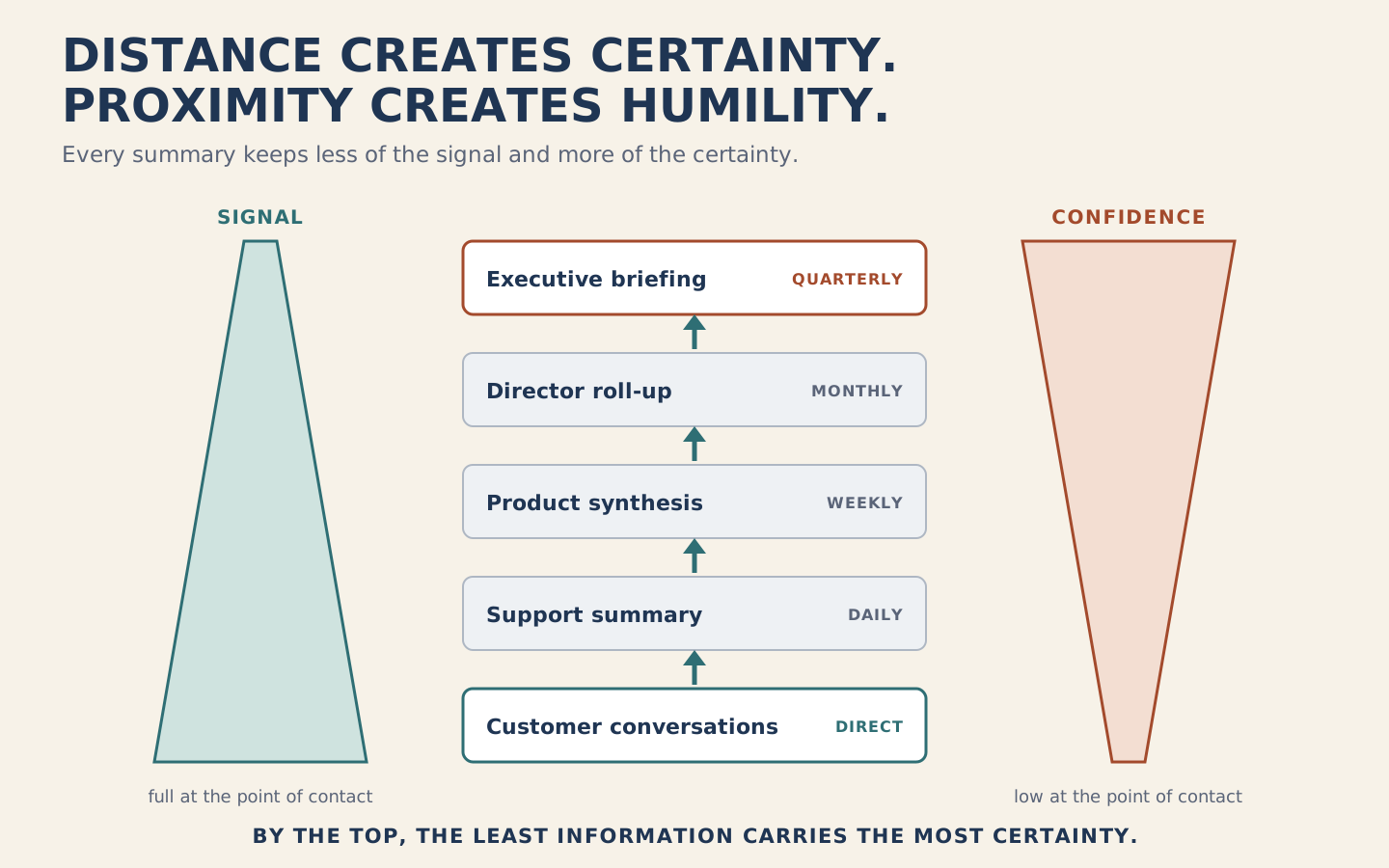
- Customer insight arrives through multiple filtering layers: support to product to director to executive summary.
- One frustrated power user becomes “customers want faster performance” by the time the finding reaches leadership.
- The executive team has not observed relevant customer behavior within the period the decision concerns.
- The people closest to customers hedge their generalizations. The people furthest from customers do not.
Any one signal can have an innocent explanation. Together they mean the organization is steering by abstraction.
How the mechanism works
Organizations summarize customer reality because they must. Field teams see thousands of customer interactions, and no executive can read every support ticket, so each layer writes a shorter account for the layer above. The summarizing is necessary. It is also where the loss happens: every shorter account drops the texture that reveals whether a pattern is signal or noise.
The filtering is not neutral. Each layer applies judgment about what matters. Support spots patterns in tickets, product managers interpret them through strategy, and directors aggregate across products into the roll-up that reaches the executive. Three layers of interpretation stand between a customer’s actual frustration and the decision it is supposed to inform. Each layer thought they were clarifying. Collectively they destroyed the signal: a specific complaint about slow mobile load times arrives at the top as a strategic imperative to “improve customer experience.”
Distance also compounds with altitude. Junior people touch customers daily. Managers review summaries weekly, directors monthly, executives quarterly. The cadence of customer exposure falls as decision authority rises. Nobody designed that inversion and nobody is acting in bad faith; executive time simply fills with board meetings, investors, and planning until direct customer contact feels like a luxury.

What it costs
Confident misreads. When leadership believes it understands customer needs from filtered reports, it commits serious money to solutions that sound right in the room and fail in the market. The confidence itself blocks the questions that would catch the error, because the nuance that would justify doubt was filtered out three layers down. Leadership builds for the customer they imagine, not the customer that exists.
Slower learning. Teams in direct contact run tight loops: talk to the customer, build, validate. Teams working from reports run loops that include a surprise, because the mismatch between the report and the customer only appears after the investment. The mismatch then requires another round of investigation and recovery work.
Boundaries and distinctions
Customer Distance is about filtering, not dishonesty. The signal can degrade even when every layer reports truthfully.
Portfolio Fog is the sibling mechanism on the delivery side. It smooths team status into summary dashboards. Customer Distance does the same to customer signal, and then adds a second-order effect: the filtered picture changes how confident its consumers feel. See Portfolio Fog.
Data Illiteracy is about interpretation capacity. An organization can put telemetry in front of executives who cannot read it. Customer Distance operates earlier: the signal is reshaped before anyone tries to interpret it.
The team-level consequence has its own name. When customer validation is absent, teams optimize for the only signal that remains, which is activity. That pattern, Vanity Velocity, is treated at team scope in Applied End-to-End Flow: Team.
Example
An illustration, by construction. A support queue logs a recurring complaint: the mobile checkout takes too many taps and customers abandon it. Support summarizes the week as “friction complaints trending up.” Product reads the summary and reports “customers are asking for a smoother experience.” The director’s quarterly roll-up says “customer experience is a top theme.” By the business review, the finding is “customers want us to invest in experience,” and the funded response is a redesign of the desktop dashboard. Every layer reported honestly. The checkout stays broken.
Applied Test
Select five recent strategic decisions. For each decision, identify the people who made it and the date of their most recent direct customer contact relevant to that decision, as of the decision date. Record what they learned and which other customer evidence they used. Mark missing dates as unknown.
Applied End-to-End Flow: Enterprise uses thirty days as a diagnostic calibration. Treat it as a prompt to investigate, not a validated cutoff proving that a decision was abstract or wrong. Examine the individual records before any average: recent but irrelevant contact and older, well-supported evidence need different interpretations. The companion Insight shows how to use this contact record in the decision forum.
Sources and lineage
Customer Distance is an Applied End-to-End Flow concept developed by Curtis Hibbs and Joshua Barnes. Its framework treatment comes from Applied End-to-End Flow: Enterprise, in the Broken Feedback barrier, where it connects to Data Illiteracy, Leadership Absence, and the Opinion Drift and Wrong Work arcs of the Vicious Cycle.
Curtis Hibbs and Joshua Barnes are co-creators of Effective Enterprise AI and Applied End-to-End Flow, and co-authors of the Applied End-to-End Flow book series. Their work combines enterprise diagnosis, value-delivery mechanics, and practical intervention patterns across strategy, portfolios, value streams, and teams.