Operating Concept
Latency Load
Latency Load is the additional work generated while the original work waits. It is separate from the original item being delayed.
Definition
Latency Load is the additional work, complexity, coordination, recontextualization, and risk created while actionable work waits.
Completing the original item uses capacity. The coordination, rechecking, and recovery generated while it waits consume additional capacity. The amount depends on the work and its surrounding system. It may be minor when little changes during a short wait, or material when assumptions, dependencies, people, and priorities keep moving.
This is different from the value lost by delivering late. Cost of Delay concerns the economic consequence of later delivery. Latency Load concerns the additional operational work created during the wait.
When Latency Load grows, the system can spend more of its capacity governing the queue instead of completing value-adding work.
Different sources, similar forms of load
Three useful categories describe why actionable work waits or what changes while it waits.
Chosen latency. Actionable work is deliberately deferred because something else matters more. Prioritized queues and delayed decisions create chosen latency.
Imposed latency. A dependency, approval cycle, funding decision, or platform constraint blocks the work.
Environmental latency. The market, codebase, organization, or customer need changes while the work waits.
The distinction matters because each category may require a different intervention. It does not remove the need to count the secondary work. A deliberate deferral, blocking condition, or changing environment can generate additional bookkeeping, coordination, recontextualization, or recovery work.
The components
Latency Load is not a single cost. It is a family of costs that delay can generate.
Bookkeeping work. Maintaining the queue itself: prioritizing, refining, reporting, and defending work in stakeholder meetings.
Recontextualization work. Picking up delayed work after its environment has shifted: rereading specifications, verifying assumptions, rechecking dependencies, and revising scope.
Coordination work. Stakeholder updates, expediting calls, status reporting, escalation paths, and workarounds other teams build around the delay.
Decay work. Documentation, code, knowledge, skills, and tooling that become stale during the wait and require refresh work later.
Defect-amplification work. A defect discovered after downstream work has accumulated can require more repair than the same defect found earlier.
Switching work. The cognitive effort required to reload context when paused work resumes.
Recovery work. Firefighting, escalation management, and rush coordination when long-deferred items become urgent.
Decision-replay work. Reconfirming that the item is still worth doing, reprioritizing it against newer work, and re-estimating after conditions change.
Compounding-queue work. As more items compete for the same completion capacity, the system needs more sequencing, status, coordination, and recovery work. That effort can further reduce the capacity available to complete the queue.
These nine components are an Applied End-to-End Flow taxonomy. They are not an exhaustive list, and a given delayed item may generate only some of them.
The self-reinforcing loop
Applied End-to-End Flow models Latency Load as a reinforcing loop under a specific operating condition: leaders load more concurrent work into a completion system whose capacity has not changed.
More concurrent work creates more work in process. More work competes for the same capacity, queues deepen, and delays stretch. Those delays create more Latency Load. The load consumes effort that could otherwise complete the original work. Delivery falls further behind demand, pressure to push utilization higher returns, and the loop closes.

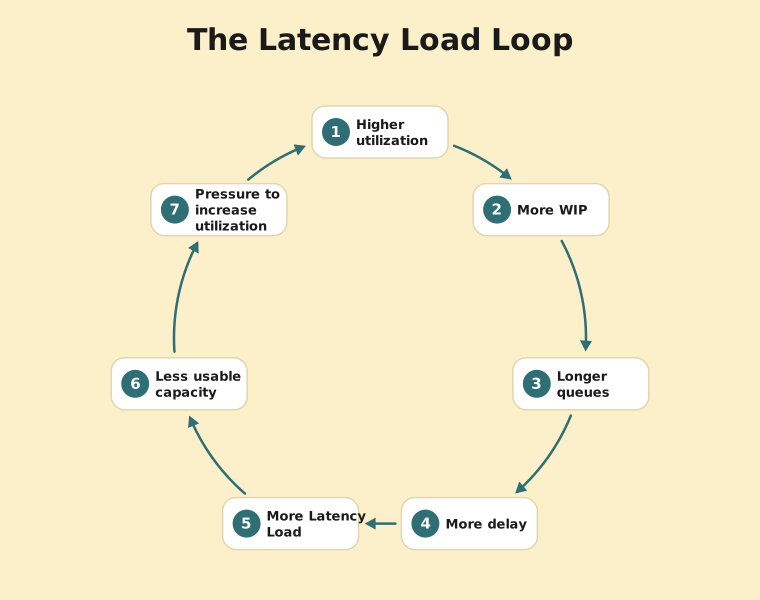
This seven-stage loop is an authored Applied End-to-End Flow synthesis. Queueing, flow, systems, and service-management sources inform parts of the model, but none of the cited authors named Latency Load or published this exact loop.
The system is consuming its own capacity carrying Latency Load.
Intellectual lineage
Latency Load is an Applied End-to-End Flow term. It connects several established bodies of work without claiming that they are identical.
Taiichi Ohno provides the production-system treatment of flow and waste.
W. Edwards Deming provides the system-level view of performance and management responsibility.
John Seddon names failure demand in service systems: demand created by failing to do something, or do it right, for the customer.
Eliyahu Goldratt contributes constraint management and protective-capacity thinking.
Donald Reinertsen provides product-development treatments of Cost of Delay, queues, work in process, batch size, and flow economics.
See Citations & References for the source record.
Why it matters for practice
Target the time between when work becomes actionable and when it is complete. Identify which wait generates the most secondary work, what causes that wait, and which reversible action could shorten it.
Depending on the cause, useful moves may include lower work-in-process limits, smaller batches, fewer governance gates, clearer decision rights, or funding work as value increments rather than large projects. Match the action to the cause of the wait. When approval itself imposes the wait, Governance Drag provides the narrower diagnosis and a six-part gate audit.
Cleaning up one visible component can still help. A shorter status meeting costs less. Better documentation reduces switching effort. If the generating delay remains, however, the system can keep producing secondary work around it.
The lever is latency. Reduce a specific wait, and the workload generated by that wait can shrink with it.
At strategic altitude, The Strategic Cadence Trap applies this mechanism to the gap between material evidence and the next authorized opportunity to change a commitment.
Useful distinctions
Cost of Delay. The same item can carry both costs. Cost of Delay tracks economic value lost or deferred by later delivery, while Latency Load tracks the additional operational work created during the wait.
Work-in-process limits. A practical intervention when too much concurrent work is deepening queues. They are not the answer to every chosen, imposed, or environmental delay.
Value Increments. Consumable packages of known value. Appropriate sizing can shorten exposure to changed assumptions and delayed learning without pretending that smaller work automatically removes every constraint.