Insight
The Strategic Cadence Trap: When the Calendar Outlives the Evidence
Tuesday's evidence says the strategic commitment should be reconsidered. The next authorized decision window is still weeks away. The evidence waits. The commitment keeps moving.
Tuesday’s evidence says change. The quarter says stay
A portfolio made a reasonable commitment using the evidence available at the time. Since then, customer behavior shifted, an assumption failed, a dependency changed, or a better sequence became visible.
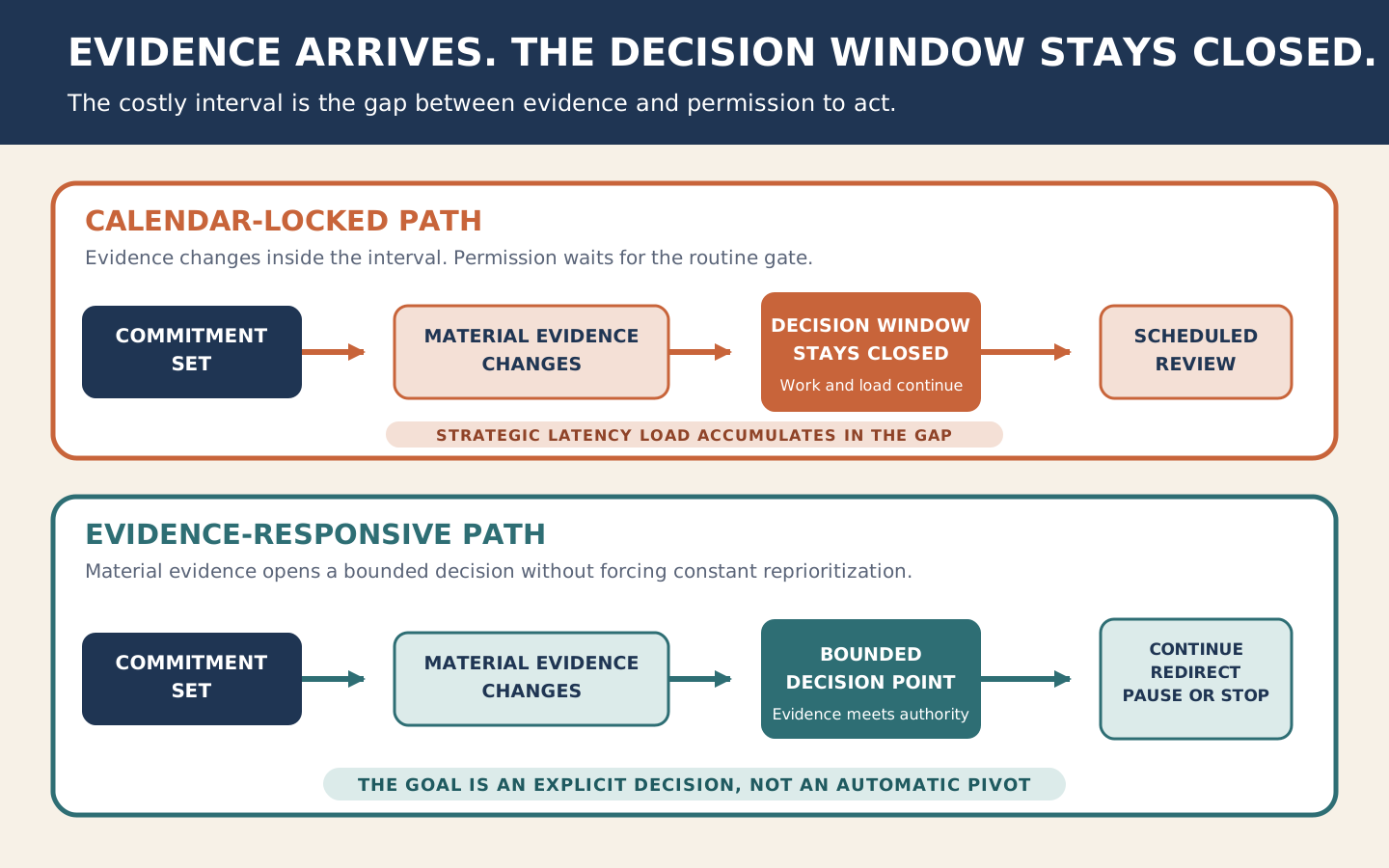
The evidence is material. It deserves a decision.
The organization has no ordinary way to make that decision now. The commitment belongs to the annual plan, the quarterly review, the approved roadmap, or another fixed window. Leaders can document the change. Teams can add a risk. Analysts can refresh the forecast. The commitment itself remains closed until the calendar permits reconsideration.
Work continues against an aging assumption because the plan is still authorized and the new evidence is not.
Applied End-to-End Flow calls this the Strategic Cadence Trap: opportunities to alter a strategic commitment occur less often than material evidence or context changes, leaving the organization bound to an aging assumption until a calendar gate opens.
The calendar interval is not inherently defective. Boards, finance, customers, regulators, partners, and delivery groups all need commitments with usable time horizons. A cadence becomes a trap when evidence can change inside the interval and no proportionate path exists to reconsider the commitment.
Two clocks create the gap
The first clock tracks evidence. It moves when the organization learns something material about value, feasibility, risk, capacity, or context.
The second clock tracks permission. It moves when the organization is authorized to continue, redirect, pause, or stop the commitment.
When those clocks remain close enough, the cadence can provide useful stability. When evidence changes and the permission clock stays fixed, an evidence-to-decision gap opens.
The original commitment is only one cost inside that gap. The wait can generate Latency Load: status updates, revised assumptions, forecast maintenance, stakeholder defense, escalation, workaround coordination, resequencing, and eventual recovery or rework. People can spend capacity governing the aging commitment while the decision it needs remains unavailable.

Three ways the trap appears
The same evidence-to-decision gap can produce different strategic consequences.
Strategic wrong work. Evidence weakens the case for the commitment, but authorized work continues because stopping or redirecting it requires a later planning event.
Strategic wrong sequence. The commitment may still be valuable, but new information changes what should happen first. The approved sequence remains fixed while a dependency, risk, or more valuable opportunity waits.
Strategic overload. New obligations enter without an authorized way to remove or reduce existing commitments. The portfolio absorbs the addition, fragments capacity, and increases the reporting and coordination needed to keep every promise apparently alive.
These are three useful manifestations, not an exhaustive taxonomy. They can occur together. A stale commitment can remain active, block a better sequence, and add to a portfolio that already exceeds its completion capacity.
Faster meetings do not create authority
The obvious response is to review strategy more often. That may shorten the interval between observations. It does not necessarily shorten the interval between evidence and action.
A monthly review can repeat a quarterly decision if nobody in the room can reopen the commitment. A weekly dashboard can display fresher evidence while the funding, roadmap, or executive promise remains untouchable. A standing meeting can become another place to maintain the commitment rather than decide its future.
Ask, “When material evidence changes, who can make which decision, using what evidence, before the next routine planning window?”
That question preserves stability without treating the calendar as the only source of permission. It also avoids the opposite failure: constant reprioritization in response to every weak signal. Material evidence should create a decision opportunity, not an automatic pivot.
Run a Cadence Mismatch Audit
Choose one active strategic commitment whose assumptions, evidence, or context have materially changed. Do not score the whole portfolio. Inspect one gap.
Record six fields:
- Evidence change. What changed, and when did it become material enough to merit a decision?
- Decision window. What is the earliest point at which the organization is actually permitted to continue, redirect, pause, or stop the commitment?
- Gap work. What delivery, reporting, defense, coordination, resequencing, workaround, or recovery work continues before that decision?
- Decision owner. Who can act now, and which part of the decision sits outside that person’s authority?
- Bounded path. What reversible exception path, delegated threshold, or mid-cycle decision point could test a shorter evidence-to-decision gap for this commitment?
- Learning signal. At the next decision point, did the path produce an earlier explicit choice, reduce secondary work, or reveal a different constraint?
The audit is a diagnostic, not a validated score or benchmark. It does not assume the commitment should change. “Continue” is a legitimate result when leaders make it explicitly with the changed evidence in view.
Make the calendar serve the decision
Set decision timing to the evidence and the commitment being made. The first intervention should match the gap the audit exposes.
If evidence exists but nobody owns the decision, clarify authority.
If leaders can decide but receive unusable information, repair the evidence path.
If a consequential commitment can be changed only at the next routine planning event, test a bounded exception path.
If every update causes churn, define what makes evidence material enough to reopen the decision.
A stable decision in a stable context may deserve a long interval. A reversible commitment in a volatile context may need an earlier decision opportunity. The operating requirement is not constant change. It is the ability to act before useful evidence ages into next cycle’s explanation.
The calendar should organize decisions while allowing commitments to be reconsidered when material evidence changes.
Hoshin Kanri provides the historical strategy-deployment context and a Strategic Recommitment Trace for identifying routine reviews and exception paths.
Sources and lineage
This Insight is derived from the Horizon Collapse and Alignment Drift treatments in Applied End-to-End Flow: Enterprise, the published Latency Load concept, and an internal strategic-side synthesis developed by Curtis Hibbs and Joshua Barnes. The Strategic Cadence Trap name, three-manifestation frame, Cadence Mismatch Audit, and paired decision-path visual are Applied End-to-End Flow synthesis. No planning-frequency benchmark, capacity-loss percentage, or universal calendar prescription is asserted.
Curtis Hibbs and Joshua Barnes are co-creators of Effective Enterprise AI and Applied End-to-End Flow, and co-authors of Applied End-to-End Flow: Enterprise. Their work combines enterprise diagnosis, value-delivery mechanics, and practical intervention patterns across strategy, portfolios, value streams, and teams.