Insight
The Great Agile Lie
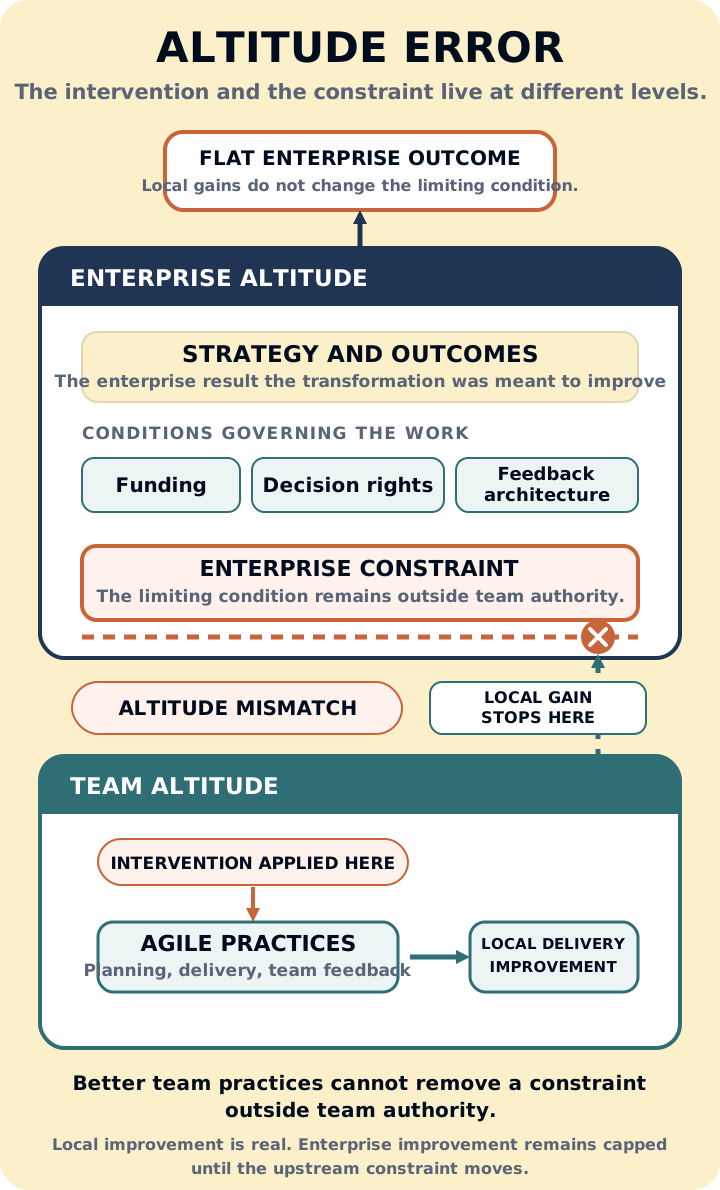
Your teams are moving faster. Your strategy is still stuck. The contradiction is not proof that Agile failed. It is evidence that the intervention and the constraint may be operating at different altitudes.
Local progress, flat enterprise outcomes
The transformation appears to be working.
Teams plan in shorter cycles. Work is more visible. Retrospectives expose recurring friction. Defects fall. Delivery inside the team becomes more predictable.
Then someone asks the question that matters: Did the enterprise become better at turning strategy into customer outcomes?
The answer is often much less convincing. Priorities still change without tradeoffs. Funding still arrives through annual project decisions. Work still waits for approvals outside the team. Customer evidence still reaches decision-makers months after the decision that needed it.
Both observations can be true. The team improved, and the enterprise did not improve enough.
Organizations usually respond by pushing harder at the same level: adding coaching, increasing adoption, standardizing ceremonies, training more people, or replacing one scaling framework with another. These actions may improve team practice, but they do not automatically change the conditions governing the work.
That is the category error at the center of the Great Agile Lie.
What the lie was, and what it was not
The lie was not that Scrum, Kanban, or iterative delivery could help teams. They can.
The lie was the enterprise promise attached to those practices: deploy Agile to enough teams, and enterprise agility will emerge.
That promise treated a team-level intervention as an enterprise-level cure. It implied that better delivery practice could repair funding structures, decision rights, strategic ambiguity, cross-organizational dependencies, and weak outcome feedback. Those conditions sit largely outside normal team authority.
The misrepresentation was rarely malicious. It was commercially convenient and structurally incomplete. Frameworks were packaged, training was scalable, certifications were countable, and transformation activity was easy to display. The operating system around the teams was harder to confront because leaders themselves controlled much of it.
Agile practices were asked to do a job they were not designed to do. When enterprise results disappointed, organizations often blamed adoption quality or team capability. The diagnosis protected the surrounding system from examination.
The practices were not the lie. The promise was.
The outcome gap is visible
Large transformation studies do not prove that Altitude Error caused every disappointing result. They do show a persistent gap between declared transformation success and realized outcomes.
Bain reported in 2024 that only 12% of business transformations in its survey of more than 400 executives and senior leaders achieved their original ambition.
BCG’s research with 127 companies found that 66% described their Agile transformations as successful. In BCG’s 2024 study, under its separate criteria of target realization and lasting change, 53% were classified as successful and 47% as operating under an illusion of agility.
Those findings establish an outcome problem, not a single universal cause. Altitude Error supplies a diagnostic explanation for one recurring pattern: organizations changed how teams worked while leaving the enterprise constraints around those teams substantially intact.
Why local improvement stops traveling
Enterprise value delivery crosses more boundaries than any one team controls.
A team can reduce its internal cycle time, yet completed work can still wait in a release queue controlled elsewhere.
The team improvement and the unchanged boundary interact as follows:
- The intervention improves practice inside the team.
- The work reaches a boundary controlled elsewhere.
- An unchanged enterprise condition delays, redirects, or devalues the work.
- Local delivery measures improve while the end-to-end outcome moves little or not at all.
This is why velocity, utilization, training completion, and ceremony compliance are weak proxies for enterprise agility. They can confirm that activity changed at the team altitude. They cannot establish that strategy reaches customers faster or that the organization learns sooner.
The teams were not necessarily slow. An unchanged enterprise constraint capped what their faster delivery could achieve.

The constraint sits in leadership territory
Consider five common conditions:
- Outcome definition: Teams receive features or projects without a testable customer or business result.
- Funding: Money is committed to temporary scope before evidence can change the investment decision.
- Decision rights: Choices escalate through approval chains because authority is remote from the work.
- Flow across boundaries: Completed work waits in release, dependency, or coordination paths outside the team.
- Feedback architecture: Delivery data arrives quickly, but outcome evidence arrives late or never.
Teams can expose these conditions and show where evidence or time is being lost. Team agency is real, but it is not enterprise authority. The Altitude Error boundaries separate what teams can improve from what requires authority elsewhere.
When the limiting constraint lives in one of these conditions, another team workshop is not a proportionate response. The next intervention must reach the altitude where the condition can be changed.
From sponsoring agility to architecting flow
Most transformation programs assign senior leaders the role of sponsor. Sponsors approve budgets, announce priorities, remove visible obstacles, and ask for progress reports. That support helps, but it leaves the central operating conditions treated as background.
An architect takes responsibility for those conditions.
A sponsor asks, “Why are the teams still slow?” An architect asks, “What in our system makes valuable work slow?”
A sponsor funds the transformation program. An architect changes how investment decisions respond to evidence.
A sponsor asks teams to collaborate. An architect removes decision structures and incentives that punish collaboration.
A sponsor waits for a green dashboard. An architect verifies that the measures connect delivery activity to customer and business outcomes.
Architect is not a new executive title. It is a posture toward the system. Leaders stop treating agility as something delivered to teams and start treating flow as something shaped through their own choices.
The scope follows the constraint. A recurring approval delay may call for one decision-rights change; a funding constraint may require a broader investment decision.
Applied Test: find one constraint the team cannot remove
Take one strategically important initiative you sponsor, fund, or govern that is still producing disappointing end-to-end results.
Ask the team one question:
What condition outside your authority most limits your ability to produce the intended outcome?
Require a concrete answer. “Leadership” is too broad. An answer such as “A routine decision waits until the architecture council’s next monthly meeting” is useful.
Classify the condition:
- outcome definition
- funding
- decision rights
- flow across boundaries
- feedback architecture
Then identify the leader who has authority to change it. That leader owns the next experiment. The team can supply evidence and participate in the design, but the intervention belongs at the altitude of the constraint.
Do this before buying more training, changing frameworks, or launching another adoption campaign.
The next diagnosis
Recognizing Altitude Error tells you that the intervention is misplaced. It does not yet tell you which upstream condition is limiting results or how the conditions reinforce one another.
The Three Barriers diagnostic provides that next step. It examines whether enterprise flow is being constrained by Alignment Drift, Choked Flow, or Broken Feedback. Use it to move from a broad altitude mismatch to a specific place where leadership action can change the system.
Sources and lineage
This Insight is derived from Applied End-to-End Flow: Enterprise, Chapter 1; the Enterprise Executive Summary Edition; and the jointly authored April 16, 2026 LinkedIn article, The Great Agile Lie: Why Enterprise Agility Keeps Failing. Outside evidence from Bain and BCG documents the transformation outcome gap. Altitude Error and the sponsor-to-architect shift are Applied End-to-End Flow concepts and synthesis.
Curtis Hibbs and Joshua Barnes are co-creators of Effective Enterprise AI and Applied End-to-End Flow, and co-authors of Applied End-to-End Flow: Enterprise. Their work combines enterprise diagnosis, value-delivery mechanics, and practical intervention patterns across strategy, portfolios, value streams, and teams.