Insight
Paying for Amnesia: When Project Closure Erases Capability
The project closes green. Its scope is accepted, its budget is reconciled, and its people move on. Then related work begins and the organization discovers that the deliverables survived better than the capability that produced them.
The project ended. The learning left
The closeout report says the initiative succeeded. The planned result was delivered. The project team is released. Specialists return to their functions. Contractors leave. The product, service, or system transfers to an operational owner.
Later, a related need enters the portfolio. The new group finds the artifacts from the earlier project. It still has to answer questions the artifacts cannot settle by themselves.
Why was this trade-off made? Which exception forced that design? Which stakeholder will reject the obvious option? Who knows the operational workaround? Who can change the result without reopening a failure the first group already encountered?
The organization bought those answers once. Its staffing model did not keep them accessible.
That is what it means to pay for amnesia.
Deliverables survive better than working knowledge
Project governance is built to preserve visible outputs: approved scope, requirements, designs, code, contracts, procedures, training, and closeout records. Those artifacts are necessary. They are also incomplete representations of the capability used to create and operate the result.
Working knowledge includes domain context, system edge cases, stakeholder relationships, decision history, and practical ownership. It lives partly in documents and partly in people who can interpret those documents when conditions change.
When a temporary group disperses, the files remain easier to locate than the judgment behind them. The next group can read what was decided without understanding what alternatives failed, what constraints mattered, or which relationships made delivery possible.
The result is not total memory loss. It is fragmented access. Enough knowledge survives to create confidence that the organization already knows the territory. Too little survives to avoid rebuilding the map.
The next startup bill
The visible cost of a new project is its approved work. The less visible cost is rebuilding the operating context required to do that work safely.
A new group must establish relationships, learn domain language, trace system behavior, rediscover decision rights, and determine who owns the result after delivery. Fractional assignments can add coordination work and repeated context rebuilding because people divide their attention across several initiatives.
None of that means the people are slow or resistant. They are reconstructing the conditions needed to make sound decisions.
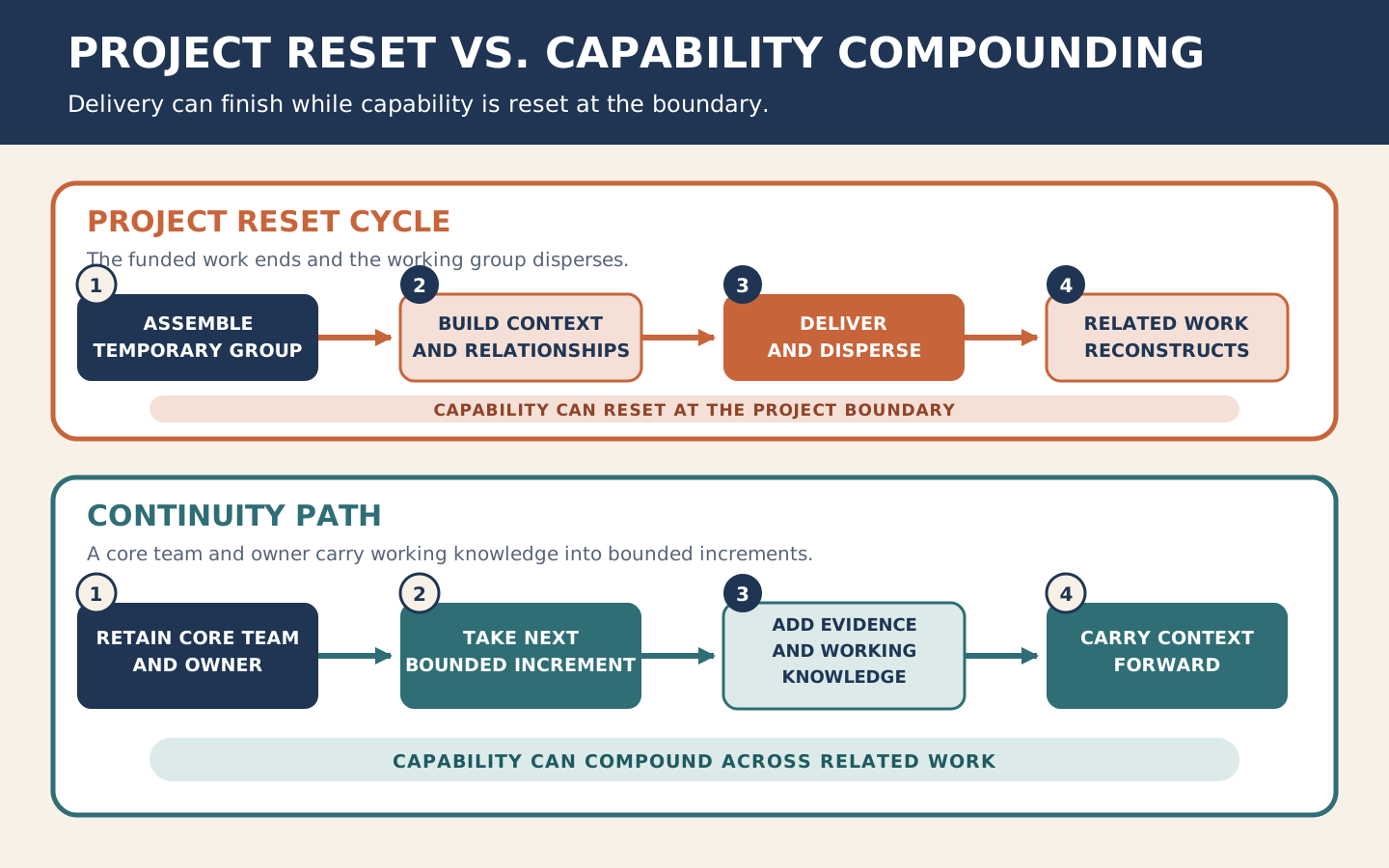
The Project-Funding Trap turns that reconstruction into a recurring feature of the operating model. Each project may deliver. The organization still fails to retain the capability needed for the next related increment.

Continuity is not permanence
The alternative is not to freeze an organization chart or keep every specialist assigned forever.
Continuity means preserving enough people, ownership, and accessible decision history that the next body of related work begins from accumulated capability rather than a cold reconstruction. The form can vary:
- a stable core group that draws specialists when needed;
- durable product or service ownership beyond project closure;
- an overlap period between outgoing and incoming owners;
- decision records with named stewards who remain available;
- the next bounded increment funded through an existing team.
Stable teams still onboard people, enter new domains, make mistakes, and change shape. Continuity does not guarantee performance. It makes learning available to compound instead of forcing the organization to keep buying back access to it.
This is separate from Funding Boulders. The investment unit shapes when value, learning, and choice can arrive. The staffing model shapes whether the capability behind those decisions survives.
Run a Team Continuity Ledger
Choose the last three related initiatives, releases, or major bodies of work. Inspect what knowledge, ownership, and capability crossed each boundary. If related work has not begun after an item, mark reconstruction as not yet observable.
For every initiative, record six fields:
- People and roles. Who continued into the next body of related work, and which critical roles disappeared?
- Working knowledge. Which domain context, system edge cases, stakeholder relationships, and decision history remained accessible?
- Transfer. What was deliberately handed over, and what had to be reconstructed later?
- Ownership. Who owned the delivered result after project closure, with authority to act when conditions changed?
- Reconstruction work. What setup, relearning, relationship-building, or coordination appeared at the next start?
- Continuity decision. What is one practical change that could preserve more capability across the next boundary?
Use the ledger to identify the continuity pattern in these cases, not to estimate a universal productivity loss. Where the record shows reconstruction, use the intervention below that addresses what was lost.
Fund the work without unfunding the memory
The first intervention should match the break the ledger exposes.
If ownership becomes orphaned, name a durable owner before closeout.
If decision history survives only in files, retain a steward who can explain it.
If every related initiative starts with a new staffing negotiation, preserve a core group for the next bounded increment.
If fractional allocation is the dominant problem, reduce concurrent assignments before restructuring the portfolio.
Begin with one boundary where the organization is about to disperse capability it will soon need again.
Projects can deliver output. Teams can build capacity. A sound operating model knows whether it retained both.
Sources and lineage
This Insight is derived from the Project-Funding Trap and Choked Flow treatments in Applied End-to-End Flow: Enterprise. The working-knowledge distinction, Team Continuity Ledger, and project-reset-versus-capability-compounding visual are Applied End-to-End Flow synthesis. No productivity percentage, ramp-up duration, performance curve, or universal stable-team outcome is asserted.
Curtis Hibbs and Joshua Barnes are co-creators of Effective Enterprise AI and Applied End-to-End Flow, and co-authors of Applied End-to-End Flow: Enterprise. Their work combines enterprise diagnosis, value-delivery mechanics, and practical intervention patterns across strategy, portfolios, value streams, and teams.