Insight
Distance Creates Certainty, Proximity Creates Humility
A customer researcher describes a limited finding. By the strategy review, it has become a confident statement about what customers want. The reporting chain can make a claim sound more settled as its original evidence becomes harder to see.
Listen to who hedges
Sit in a product strategy review and listen for qualifiers. The researcher who ran last month’s usage sessions says “the customers we observed” and “we don’t know yet whether this generalizes.” The support lead talks about specific tickets. Then the senior leadership in the room states what customers want, flatly, with no hedge at all, speaking from a picture built entirely of other people’s summaries.
The room treats the flat statements as seniority and the hedged ones as inexperience. Read it the other way. In this example, the qualifiers preserve what the direct contact actually established. The people who talked to customers this month know exactly how messy the picture is. The people who read a two-page summary of a forty-page synthesis of a thousand tickets received a picture with the mess removed, and clean pictures produce clean convictions.
Why a listening tour can leave the decision unchanged
The usual diagnosis is personal: our executives are out of touch, and the fix is a listening tour or a customer-advisory board slot on next quarter’s calendar. That reading blames individuals for a condition the structure manufactures. Executive calendars fill with board meetings, investors, and planning because that is what the role demands. Direct customer contact loses that scheduling contest by default, so exposure falls precisely as authority rises. Swapping the executive changes nothing; the next one inherits the same calendar and the same summaries.
The mechanism: filtered pictures feel finished
Summarizing is necessary. Nobody at the top can read every ticket or attend every session, so each layer writes a shorter account for the one above. The problem is what the shorter account leaves out. A summary can omit contradictions, outliers, context, or sample sizes that would justify doubt. A useful summary preserves the distinctions needed for the decision. Each layer hands upward a picture that is smaller, cleaner, and more coherent than the one it received.
By the top of the ladder, the picture contains no visible reason to hesitate. So nobody hesitates.

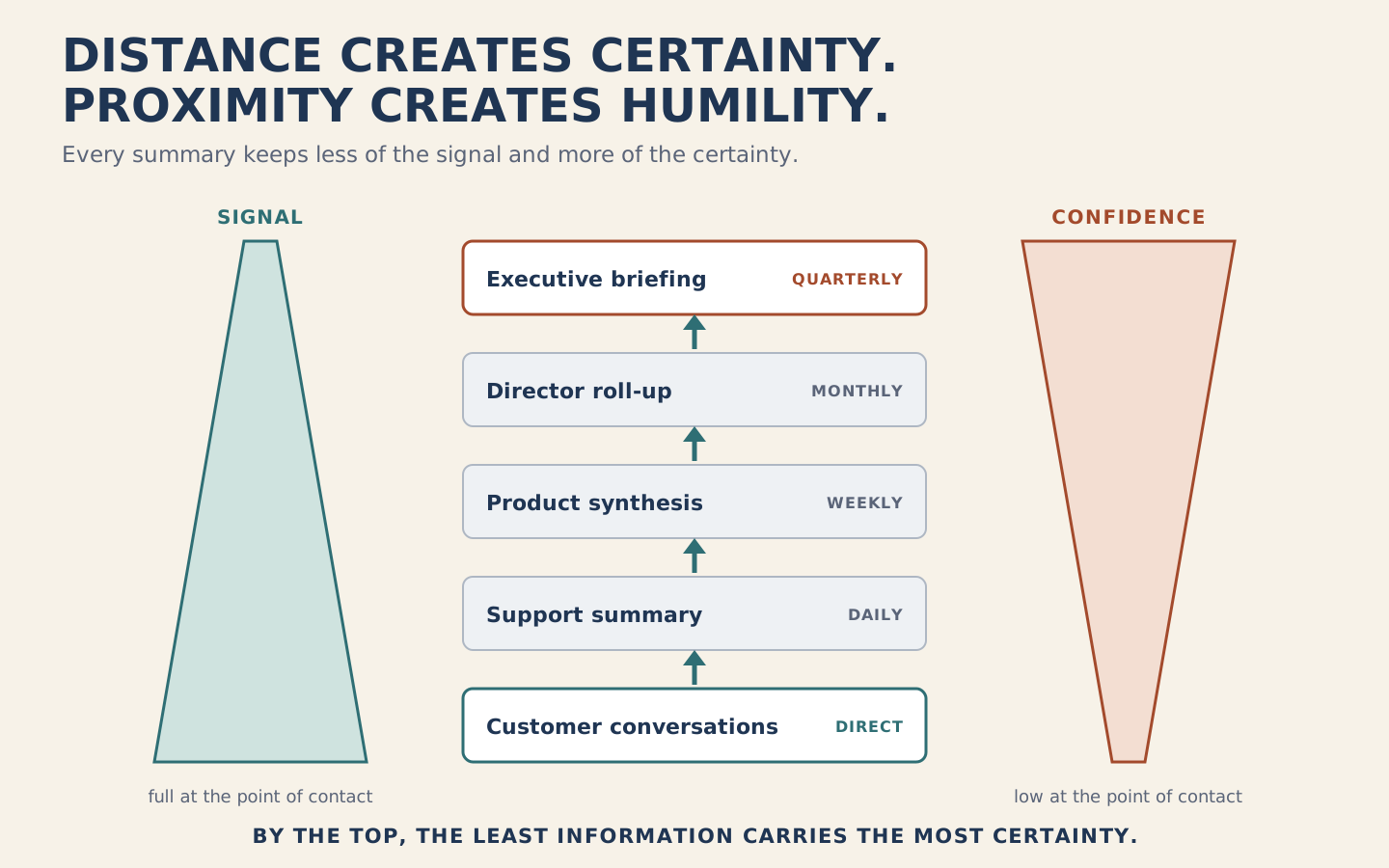
The book illustrates the inversion with two leaders. A leader who talked with ten customers yesterday speaks carefully, because they met the mess firsthand: they know what those ten said and they know it might not generalize.
A leader briefed on a thousand customers speaks with total assurance. What they actually possess, as the book puts it, is what one analyst thought after reading fifty support tickets. The confidence is real. The knowledge behind it is not.
This illustration is generous to the organization because it assumes the summary was even accurate.
What the certainty costs
The expensive failures are the confident ones. Doubt triggers validation: a prototype, a test, another round of customer conversations. Certainty skips straight to commitment. When the certainty came from filtered reports, the organization makes its largest bets on its thinnest evidence. It discovers the mismatch only after launch, when the market delivers the feedback the reporting chain could not. Leadership builds for the customer they imagine, not the customer that exists, and pays twice: once for building the wrong thing, and again for a recovery cycle that earlier relevant contact might have reduced.
The subtler cost is cultural. When flat certainty reads as executive presence and hedging reads as weakness, people learn to strip the qualifiers from what they pass upward. The organization starts selecting for confidence at exactly the altitude where confidence is least earned.
Put the customer claim against its evidence
Before a customer claim settles a significant decision, trace it to its supporting contact, research, or summary. Identify which customers and circumstances the evidence covers, any contrary examples, and the limits that matter to this decision. If the claim goes beyond that evidence, narrow the commitment or obtain the missing evidence before deciding.
Then shorten the distance for the decisions that matter most. The durable form is a standing rule: the people making a strategic product decision have recent, direct, unfiltered customer contact relevant to that decision, before they make it. A quarterly listening tour does not clear that bar.
Applied Test: examine one customer decision
Use the Customer Distance contact record for five recent decisions. At the next review, choose one claim that materially influenced a decision and examine the supporting contact, research, and summary. Which relevant limits survived into the discussion, and which were lost?
Ask the forum to state what the evidence supports, what remains uncertain, and what additional observation could change the decision. Use the concept page’s explanation of the thirty-day calibration when interpreting the contact record.
Sources and validation
This Insight applies the Customer Distance concept from Applied End-to-End Flow: Enterprise, in the Broken Feedback barrier. The ten-customer and thousand-customer contrast and the reporting-chain examples are illustrative constructions from the book, not empirical studies. The thirty-day threshold is the book’s diagnostic calibration.
Curtis Hibbs and Joshua Barnes are co-creators of Effective Enterprise AI and Applied End-to-End Flow, and co-authors of the Applied End-to-End Flow book series. Their work combines enterprise diagnosis, value-delivery mechanics, and practical intervention patterns across strategy, portfolios, value streams, and teams.