Operating Concept
Governance Drag
A control earns its place when its decision value and risk reduction justify the work, waiting, batching, and delayed learning it creates. When that relationship disappears, governance becomes drag.
Definition
Governance Drag is the structural condition in which governance and approval mechanisms add waiting, batching, and decision cost without proportional risk reduction.
Necessary controls have real purposes. A control may satisfy a legal obligation, protect against a rare but severe failure, enforce separation of duties, or create a decision that only senior leadership can make.
Drag appears when the control’s purpose, cost, and evidence fall out of alignment. Its owner cannot show what the control changes, what it catches, how long work waits, or how the cost of passing through the gate changes people’s behavior.
The recognition pattern
Governance Drag is recognizable through operating signals, not a gate’s age or formality. Look for these fingerprints:
- The same evidence is reformatted for several reviewers.
- Routine and consequential decisions follow the same path.
- Items wait longer for review than they spend under review.
- Teams hold work until a larger batch justifies the approval effort.
- Rejections are rare, but nobody knows whether the gate prevents bad submissions before they arrive.
- The control has no owner responsible for measuring or improving it.
Any one signal can have an innocent explanation. Together they justify an audit.
How a gate creates drag
A recurring gate can impose four operating costs beyond the review itself.
Preparation. People assemble packets, translate evidence, rehearse decisions, and answer predictable questions before the reviewer sees the work.
Queue time. A finished item sits until the next meeting, available reviewer, or escalation window. The queue can dwarf the decision time.
Batching pressure. Expensive crossings reward larger, less frequent submissions. A team combines changes so it does not pay the gate cost repeatedly.
Delayed learning. Evidence arrives later because release, testing, customer contact, or the next decision waits behind the gate.
The costs can reinforce one another. Larger batches take more preparation and demand broader review. Broader review creates more scheduling friction. Longer waits increase the chance that assumptions, dependencies, or priorities change before the decision lands.
Together, these costs can create Latency Load, the additional work generated while an actionable item waits.
Necessary control or Governance Drag?
The answer depends on the risk and the decision, not the age or formality of the process.
A necessary control can state:
- the risk, obligation, or decision it owns;
- which item classes require its level of scrutiny;
- what evidence the reviewer needs;
- how quickly the decision should occur;
- what outcomes show the control is working;
- who is accountable for improving the process.
Drag occurs when the control’s decision value and risk reduction do not justify its full operational cost.
Low decision yield, meaning few items materially changed, stopped, or rerouted, does not by itself prove waste. A gate may deter poor submissions, improve work during preparation, or protect against rare high-impact exposure. Decision yield belongs beside intended risk, detected escapes, wait time, preparation effort, and induced behavior.
Match control rigor to risk
Control rigor should rise with consequence, irreversibility, novelty, and obligation. Sending every item through one path obscures that proportional relationship and consumes attention needed for consequential decisions.
The design question is concrete: Which item class needs this gate, and which item class needs a cheaper control that protects the same intent?
Applied Test: audit one recurring gate
Choose one recurring approval gate and review recent items that crossed it, starting with the last twenty.

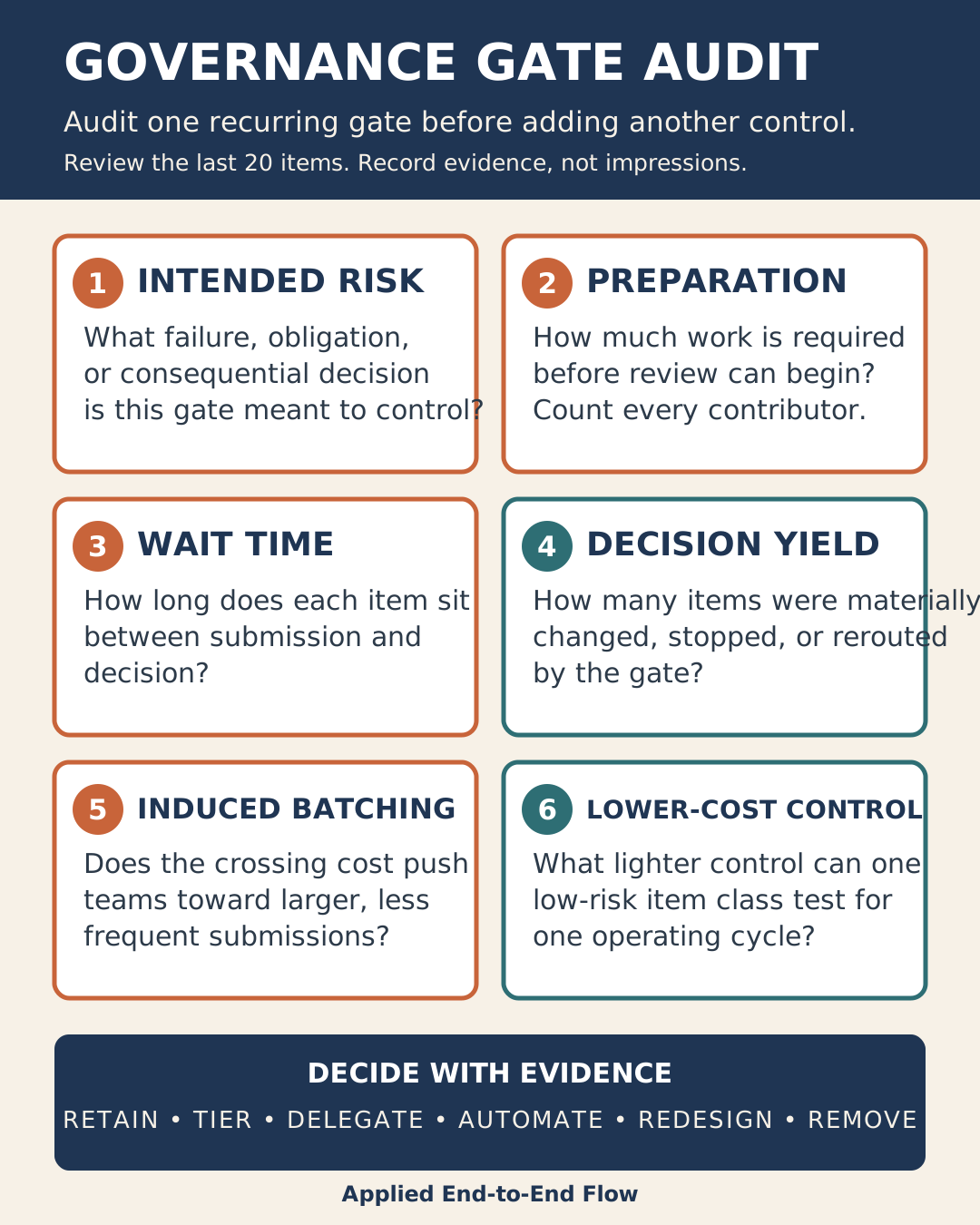
Record six fields:
- Intended risk. What failure, obligation, or consequential decision is the gate meant to control?
- Preparation effort. How much work is required before review can begin?
- Wait time. How long does each item sit between submission and decision?
- Decision yield. How many items were materially changed, stopped, or rerouted?
- Induced batching. Does the crossing cost push teams toward larger, less frequent submissions?
- Lower-cost control. What lighter control could you test with one low-risk item class for one operating cycle?
The worksheet establishes a baseline and identifies a lower-cost control worth testing. The Governance Tax shows how to run that alternative, compare risk and flow signals, and decide the gate’s disposition. The audit is a diagnostic worksheet, not a validated scoring instrument, and it carries no universal pass threshold.
Boundaries and distinctions
Governance Tax is the argument. Governance Drag names the structural condition. The Governance Tax makes the executive case for measuring the bill.
Decision-Rights Fog is about authority. Governance Drag can exist even when authority is perfectly clear. A known decision-maker can still sit behind an expensive, low-value gate.
Latency Load is generated work. Governance Drag can impose the wait. During that wait, the item can generate coordination, recontextualization, decay, and recovery work.
Compliance is a requirement, not a process design. A requirement may be fixed. The path used to satisfy it often is not. Preserve the obligation and test the implementation.
Sources and lineage
Governance Drag is an Applied End-to-End Flow concept developed by Curtis Hibbs and Joshua Barnes. Its framework treatment comes from Applied End-to-End Flow: Enterprise, especially Choked Flow, and the Enterprise Implementation Guidelines. The gate-audit treatment was rebuilt from the jointly authored April 2026 Governance Tax article with its evidence boundaries corrected. DORA’s software-delivery research informs the bounded change-approval example in the companion Insight; it does not define the concept.
Curtis Hibbs and Joshua Barnes are co-creators of Effective Enterprise AI and Applied End-to-End Flow, and co-authors of Applied End-to-End Flow: Enterprise. Their work combines enterprise diagnosis, value-delivery mechanics, and practical intervention patterns across strategy, portfolios, value streams, and teams.