Insight
Confidence Passes for Being Right
Leaders are paid to decide before the evidence arrives. That part is the job. The trouble starts when the certainty a claim was made with gets treated as evidence that the claim was right, and nobody in the room goes back to find out.
The job, and where it turns
Every strategy review, funding meeting, and steering committee runs on a calendar, and the calendar does not wait for the evidence. Applied End-to-End Flow: Enterprise puts it plainly: when the inputs a decision needs have not arrived, opinion fills the gap, and the book is careful to add that this is not in itself a dysfunction.
A conviction stated in that room is a bet. It has a stated certainty, whether or not anyone wrote it down, and it has a date on which reality will say whether it was right. The counterfeit begins when the room treats the certainty as evidence and, having decided, does not return to the bet once the date has passed. Nothing about the bet needs to change. What is missing is the record of it, and the moment when someone reads the record back.
An illustration from the book, by construction, and extended here. A subscription business holds its annual content review. Viewership data exists but lags by quarters, the satisfaction survey measures the wrong thing, and the competitive picture is anecdotal. The chief content officer has strong opinions about what subscribers want, built over two decades in the industry. The data is ambiguous and the opinions are confident, so the strategy follows the opinions. When the subscriber data finally arrives, most of a year later, it points somewhere else, and by then the next season is already in production. The extension is what happens at the following year’s review. The retention numbers are on a slide. They are explained by the market, by a competitor’s launch, by marketing spend. Nobody in the room connects them to the conviction that set the strategy, and the same conviction, delivered with the same assurance, carries the next decision too.
What the room can weigh on the day
On the day a forum decides, what is in the room is a plan, a forecast, the assumptions under the forecast, a few numbers that reached the table through several layers of summary, and the people asserting them. For a decision about a future market response, the result cannot be known on the day the decision is made. The forum can still examine what the forecast rests on, what would have to be true for the plan to work, how the number on the slide was made. A forum that does that work is weighing evidence, and this page is not about that forum.
The forum this page is about weighs how each claim is delivered instead. A claim made without qualifiers reads as knowledge, and a claim made with them reads as doubt. The sure claim carries the decision and the hedged one loses it, and the person who made the sure claim leaves the meeting read as the best-informed one there. That is not foolishness. Delivery is the one signal in the room that is always available, costs nothing to read, and never has to be argued about, and a forum under time pressure reaches for it. The book’s description of Broken Feedback names the result as the barrier’s signature: the answer to “how do we know this matters?” is a confident assertion instead of observable data. The concept page records the same fingerprint from the room’s side. The most confident voice is treated as the best-informed, and no one checks the two against each other.

Why the answer rarely teaches
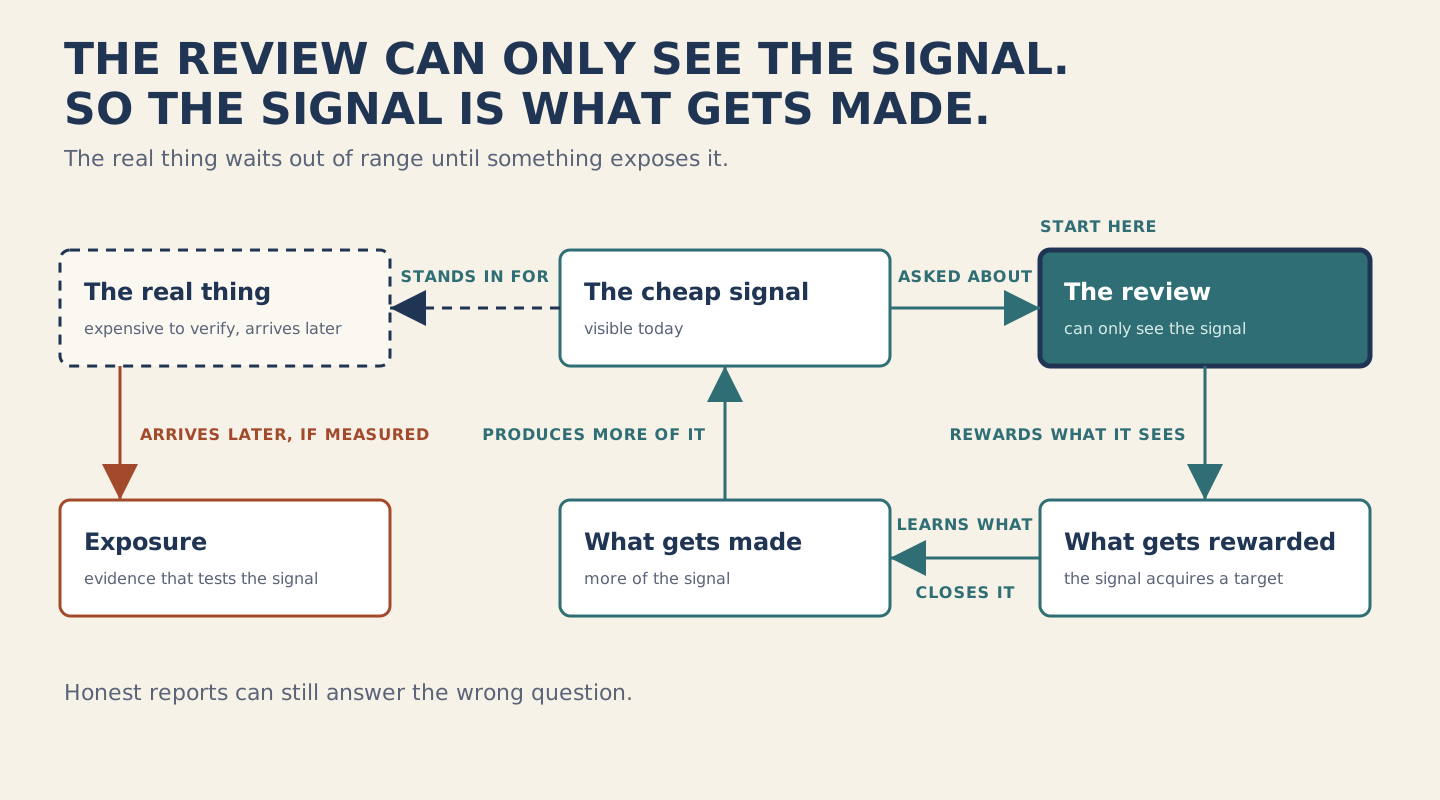
An outcome may become observable after the forum has moved to another decision. The delay varies with the claim; the important question is whether anyone brings the result back for comparison.
The record of the decision, where one exists, holds the decision. It rarely holds the claim that carried it, or the certainty the claim was made with, or the date by which the claim could be checked. When the outcome comes in, it comes in as a number on a later slide, with a ready explanation attached: execution, conditions, timing, a competitor. The person who made the claim may hold a different role by then. None of it is dishonest, and in a forum that keeps no record of its claims, none of it produces a comparison between what was asserted and what happened.
So the answer arrives, and in that forum it teaches nothing. Nobody compares it with the claim, so the claim is never marked right or wrong. A forum that does not mark its confident people right or wrong has no way to learn which of them are usually right. Confidence keeps its value in that room because nothing there counts against it. Without a return path, a result can arrive after the people who made the decision have moved to other roles.
What the organization learns to produce
Here the missing connection is the return path from a result to the forum that made the claim. If the result arrives after that forum has moved on, someone must bring it back for comparison. Whatever a forum weighs, the people who present to it learn to supply, and in this forum nothing ever teaches them otherwise.
We hold, and it is a position rather than a finding, that a forum which rewards confidence on the day tends to teach assurance to everyone who prepares for it. Qualifiers get dropped in the room, because the version with qualifiers lost last time. Estimates turn into commitments, because a leadership that demands a fixed date for fixed scope is, as the book says, forcing its teams to lie to it. Dissent goes quiet, because challenging a senior conviction feels career-limiting and the room defers. Each of these makes sense as an answer to what the forum rewards, each removes information the decision needed, and the forum reads the resulting chorus of assurance as convergence. The book’s chapter on the Vicious Cycle draws the longer consequence: when opinion substitutes for evidence repeatedly, the organization stops looking for evidence.
A different question from distance
Distance Creates Certainty, Proximity Creates Humility explains where unearned confidence about customers comes from and applies the customer-contact record to one decision. That question belongs to that page and to the Customer Distance concept behind it.
This page takes the confidence as given, from any source. A filtered summary, a long career, a deadline that left no room for a range, a board that wants one number: each produces a sure voice in the room, and the forum treats all of them the same way. Closing the distance improves what walks in the door and is worth doing on its own terms. It does not by itself give the forum a way to check a claim against its answer, and a forum whose leaders spoke to customers last week can still run this loop if it does not score its claims.
What changes
The practical change is a line in the record, made at the moment of decision. For each claim that settles what the forum decides, write down who made it, what they asserted, how sure they said they were, and what reality would have to show, by when, for the claim to count as confirmed or contradicted. Then, when the date arrives, put the answer on the same forum’s agenda beside the claim and read the two together, in front of the people who were there. Some answers will be inconclusive, and the record should say so rather than force a call.
The record makes comparison possible without delaying the original decision. We expect repeated comparison to influence what the forum rewards; that is a proposition to test over time. Record uncertainty alongside the claim so later reviews can examine whether confidence was justified across several decisions. What changes immediately is that someone returns to the claim.
Applied Test: count the documented comparisons
Pick one decision forum and find its records from about a year ago: minutes, a decision log, a deck, or pre-reads. The work required depends on the size and quality of those records.
- Check whether the records contain the claims behind the decisions. If they mostly contain decisions alone, ask two participants whether any claim was revisited. An incomplete record cannot establish that no comparison occurred.
- Sort the identifiable claims. Separate results not yet available, results available without a documented comparison, and claims with a documented comparison. Count the last group.
- Read the count within the records searched. Zero means no comparison was documented there for that period. A higher count shows recorded checking; inspect whether the original certainty and confirmation condition were also preserved. Neither count grades anyone’s judgment.
- Close the missing return path. For current claims, record what would confirm or contradict them and when to return. For an available result not yet compared, put that comparison on the forum’s agenda.
For the general mechanism and the other counterfeits, see Counterfeit Signals.
The forum rewards confidence on the day it decides, and rarely goes back to score it when reality answers. The record you have just made is where that starts to change.
Sources and validation
The Counterfeit Signals concept is applied here to the third counterfeit in its register. From Applied End-to-End Flow: Enterprise it draws on the Opinion Drift arrow in the chapter on the Vicious Cycle, where opinion fills the gap that missing evidence leaves and the substitution, repeated, stops the organization from looking for evidence; the Priority Collision gap in the chapter on Alignment Drift, where the room defers to senior conviction; the observation in the first chapter that a fixed date for fixed scope forces teams to lie; and the recognition line for Broken Feedback, in the chapter that introduces the three barriers, about confident assertion in place of observable data. Customer Distance, in the Broken Feedback barrier, is where the confidence counterfeit was first described, and the Distance Insight owns the argument about where unearned confidence comes from. The content-review scene is the book’s illustrative construction, extended here with the following year’s review; its time markers are scale details of the illustration, not measurements. The decision forum as the instrument, the missing return path, the in-room learning of assurance, the claim record, its expected effect on what the forum rewards, and the documented-comparisons test are the authors’ own positions, stated as such and not as measured findings.
Curtis Hibbs and Joshua Barnes are co-creators of Effective Enterprise AI and Applied End-to-End Flow, and co-authors of Applied End-to-End Flow: Enterprise. Their work combines enterprise diagnosis, value-delivery mechanics, and practical intervention patterns across strategy, portfolios, value streams, and teams.