Insight
Nobody Knows Who Can Say Yes: How Ambiguous Authority Manufactures Queues
The team has the evidence. The choice is bounded. The change is reversible. The question still travels upward: Are we allowed to decide?
The decision moves. The context thins
Imagine a team managing a customer onboarding flow. New evidence shows that a small adjustment would remove a recurring failure point. The adjustment is reversible. The team understands the customer impact and the operational consequence.
Nobody can point to the authority boundary.
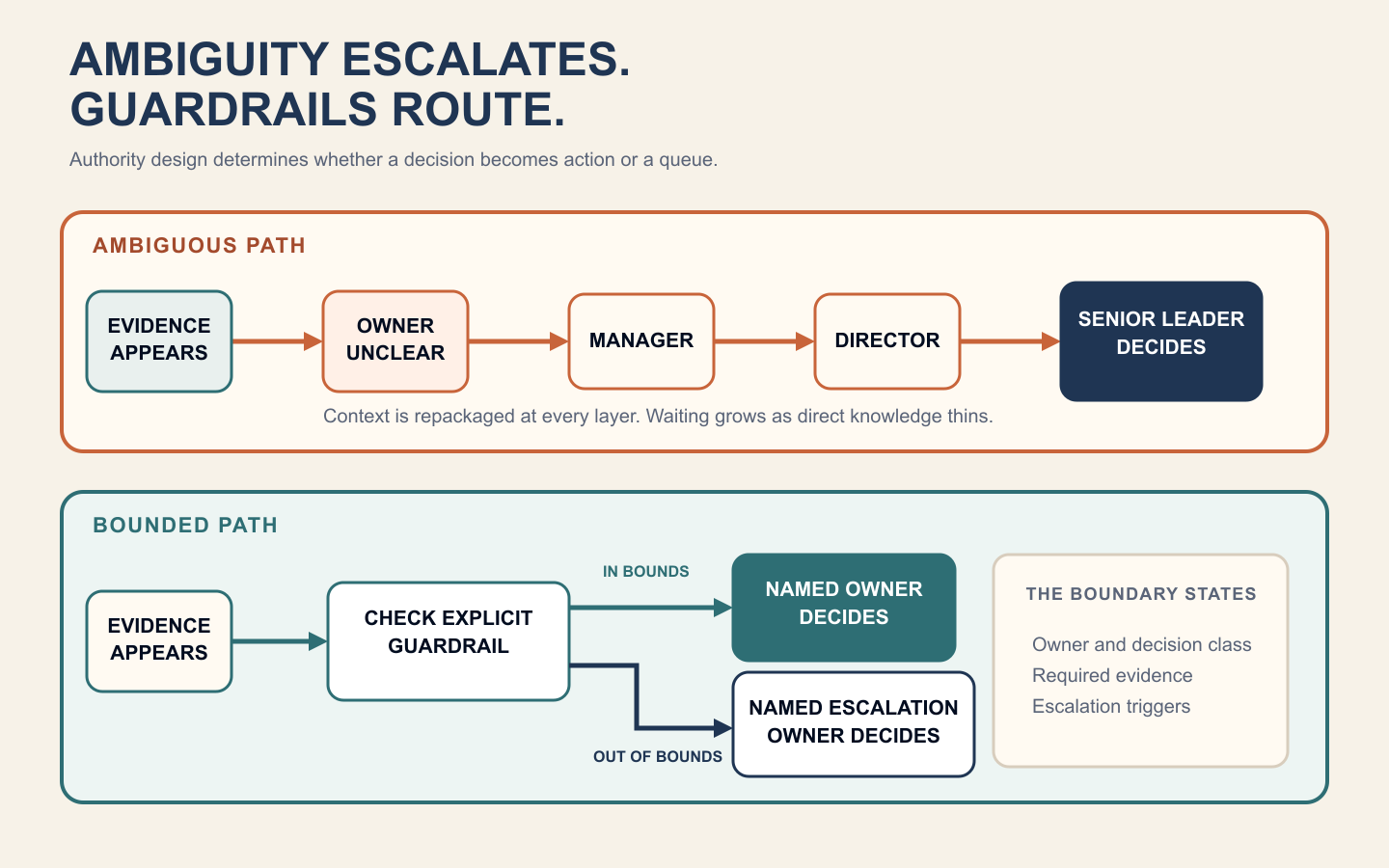
The team asks its manager. The manager agrees with the change but is unsure whether the choice belongs to product, operations, or a director. The question moves up. Each layer repackages the context for the next. Eventually the decision reaches a senior leader whose authority is clear and whose direct knowledge of the issue is thin.
The decision did not escalate because it was necessarily consequential. It escalated because nobody could show who was allowed to say yes.
Applied End-to-End Flow calls this Decision-Rights Fog: authority for a recurring decision is implicit, inconsistent, or remote enough that escalation becomes the default path.
The system trains escalation
Under ambiguous authority, escalation can be the defensible choice.
Making a decision outside your authority creates visible downside. If the choice goes badly, the organization can say you overstepped. Escalating a choice you might have owned often carries less personal risk. Someone may tell you to decide next time. The decision still moved through the accepted hierarchy.
That incentive does not require timid people, poor intent, or a bureaucratic personality. It is built into the allocation of risk. The organization asks people to act with ownership while leaving the ownership boundary implicit.
The rhetoric says, “We want empowered teams.” The operating system says, “Ask first unless you can prove you are allowed.”
Routine decisions can end up waiting for a senior leader because nobody can establish who may decide sooner.
Ambiguity manufactures a queue
The wait is not empty.
Context gets repackaged. Each escalation layer needs a summary, recommendation, risk statement, or meeting. People translate the same decision for audiences farther from the work.
The decision joins a broader calendar. A bounded choice now competes with unrelated executive priorities for attention. Its place in the queue depends on access to someone with unmistakable authority.
Information thins as authority rises. Senior leaders may see the enterprise consequences that a team cannot. They may also lack the direct customer, workflow, and technical context that made the choice visible in the first place.
Leadership attention shifts downward. Executives can become approval routers for recurring tactical decisions instead of redesigning the conditions that keep those decisions moving upward.
The escalation can also generate Latency Load: coordination, recontextualization, status work, decay, and recovery work that would not exist if the decision had a usable path.

Guardrails are not permission slips
An empowerment statement tells people how leaders hope they will behave. A decision boundary tells them what they may decide.
“Use your judgment” leaves the risk boundary inside someone’s head. “You own this decision when these conditions are true, using this evidence; escalate when these triggers appear” lets people check who may decide and when escalation is required.
A useful boundary answers four questions before the next decision arrives:
- Which recurring decision class does this cover?
- Which role owns the in-bounds choice?
- What evidence and constraints define the usable range?
- Which triggers move the decision to which named owner?
The guardrail does not remove accountability. It places accountability where the organization says it belongs.
Not every decision belongs at the edge
Clear decision rights are not a command to push every choice downward.
Some decisions carry enterprise-wide consequences. Some are difficult to reverse. Some cross legal, regulatory, financial, security, customer, or portfolio boundaries. Some require trade-offs that only a broader owner can make. Those choices should escalate by design.
The failure is not escalation. The failure is making escalation the default because the organization never defined the ordinary path.
Decision-Rights Fog concerns whether authority is clear. Governance Drag concerns a known gate’s cost relative to its decision value and risk reduction. Either can occur without the other: a clearly owned gate can be expensive, and finding the authorized owner can be costly even when the review itself is quick.
Build one Decision Boundary Card
Choose one recurring decision class that often travels upward. Review a recent, meaningful sample. Do not score the whole organization.
Record six fields:
- Decision. What recurring choice is being made?
- Default owner. Which role has the context and should own the in-bounds decision?
- Boundary. What consequence, reversibility, cost, customer impact, obligation, or cross-boundary condition defines the delegated range?
- Evidence. What information must the owner see before deciding?
- Escalation triggers. Which explicit conditions move the choice to which named role?
- Review signal. After one operating cycle, what evidence will show whether the boundary produced clearer ownership without hiding consequential risk?
Test the card for one operating cycle. Inspect whether ordinary decisions stayed with the named owner, whether exceptions reached the correct escalation owner, whether usable evidence was present, and whether the test exposed a different constraint.
The current escalation may be correct. The card may reveal that the owner is already clear and the real problem is unavailable evidence, an overloaded reviewer, a fixed decision calendar, or a costly gate. That is a valid result. A diagnostic earns its place by locating the constraint, not by confirming its own premise.
Make authority visible before the next decision
Do not start with an enterprise-wide responsibility matrix. Start with one recurring choice that keeps climbing.
Name the owner. Define the usable range. State the evidence. Mark the escalation triggers. Then watch what the decision actually does.
Empowerment without a boundary is a slogan. Authority becomes real when people can show where it begins, where it ends, and what happens next.
Sources and lineage
This Insight is derived from the Decision-Rights Fog and Choked Flow treatments in Applied End-to-End Flow: Enterprise, the canonical Three Barriers and Governance Drag pages, and the Enterprise Implementation Guidelines. The Decision-Rights Fog definition, incentive framing, Decision Boundary Card, and paired-path visual are Applied End-to-End Flow synthesis. No universal delegation threshold, delay benchmark, prevalence claim, or performance guarantee is asserted.
Curtis Hibbs and Joshua Barnes are co-creators of Effective Enterprise AI and Applied End-to-End Flow, and co-authors of Applied End-to-End Flow: Enterprise. Their work combines enterprise diagnosis, value-delivery mechanics, and practical intervention patterns across strategy, portfolios, value streams, and teams.