Insight
Process Passes for Competence
Consider this hypothetical scene. The audit passed in the spring. The situation the process was never written for arrived that summer, and the room that had followed every step to the letter had no idea what to do next.
The moment the script ran out
In this illustration, A delivery organization has spent two years getting good at its process. Every team runs the ceremonies. The maturity assessment scores in the top band. The certification count is on a slide in the quarterly deck, and the audit that checks whether the process is being followed comes back clean.
Then a customer escalation arrives that the process has no step for: a defect that crosses three teams, a regulator asking a question nobody has been asked before, a dependency that fails in a way the runbook did not anticipate. The people in the room have followed the process for two years. They wait for someone to tell them which step applies. Nobody can, because there is no step. The escalation sits while the organization looks for the process that would cover it, and the eventual answer comes from one person who ignores the process and uses judgment. Afterward, the fix is a new step.
Everyone in that room did what the organization had asked of them. The audit had confirmed as much three months earlier. What the audit was taken to mean, that these people could handle what came, had never been examined by anyone.
What the audit could see
An audit of process compliance can see one thing: whether the steps were followed. It can count ceremonies held and certifications earned, confirm that the artifacts exist and the roles are staffed, and score all of it on the day. A checklist of completed steps does not, by itself, establish how people handle an unfamiliar situation. Competence, in the operational sense that matters here, is the ability to act well when the situation leaves the script, and by definition the script runs out on nobody’s schedule.
The audit therefore measures the only thing available to it, and the organization draws the natural conclusion about what gets scored. A clean audit becomes the goal of the people being audited, which is a reasonable response to the instrument and a poor one for the capability.
Applied End-to-End Flow: Enterprise draws the line this way: you can train people in a set of practices and certify them, but the capability those practices are meant to produce cannot be trained or certified into existence. The training happened. The results did not follow.
What a process is for
Here is the argument this article rests on, and it is ours rather than the book’s. A process is someone’s judgment about a class of situations, written down so that other people can act well in those situations without re-deriving the judgment each time. A useful process lets people reuse that judgment.
The judgment is what the process stands in for. In the situations its author had in mind, following the steps produces the outcome the judgment would have produced. The moment a situation arrives outside that class, the steps have nothing to say, and what remains is whatever judgment the people following them have of their own.
Whether they have any is the question the audit never asked. Knowing that a step exists, and following it, is a different thing from understanding what failure the step exists to prevent. The second kind of knowing is what lets a person recognize the situation the step does not cover. The framework has a name for the shallower kind, bumper-sticker depth, the level at which a principle can be recited but is not enough to diagnose with, argue with, or apply under pressure.

How performers get made
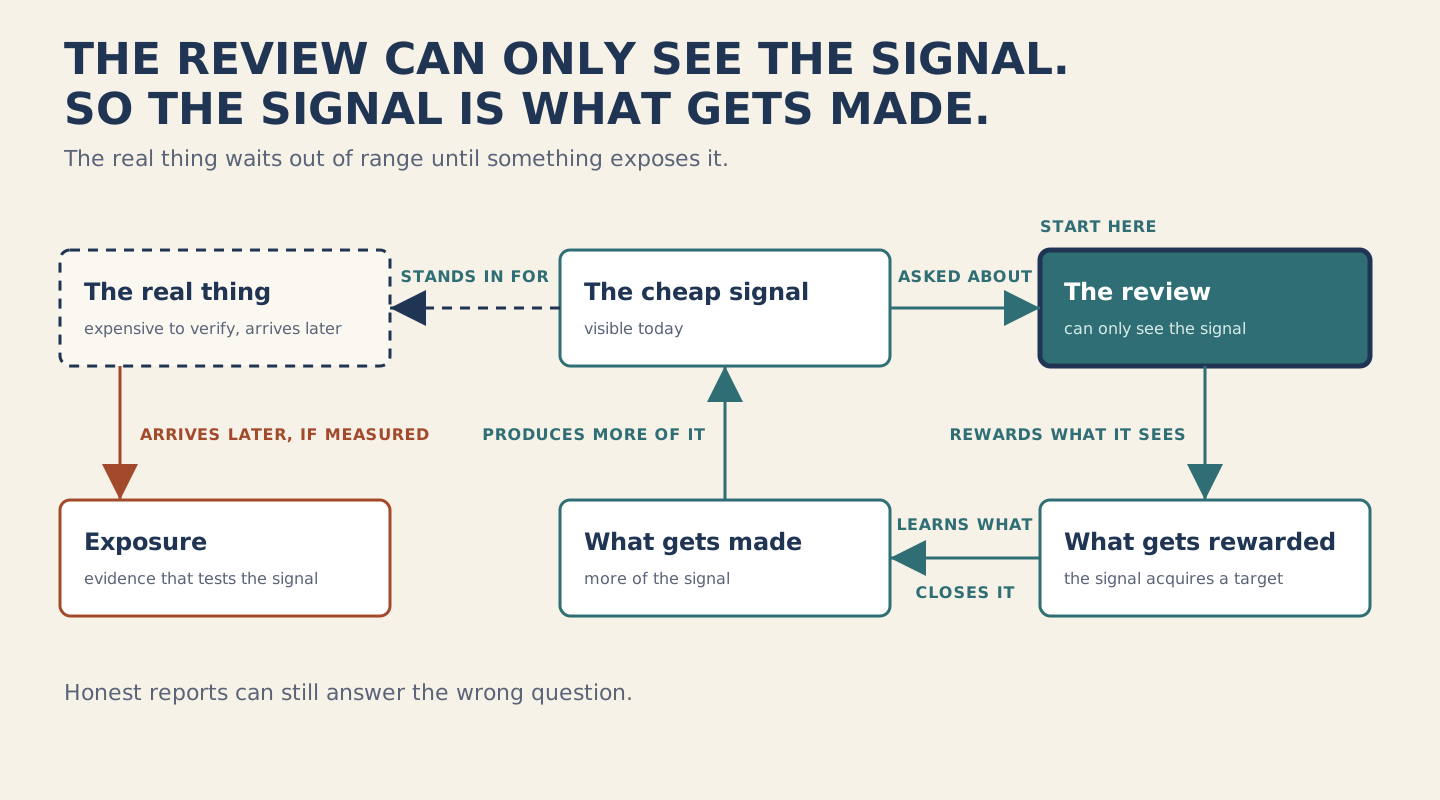
The loop is the one the concept page describes, running on a different instrument. The review in the first article could only see motion. The audit here can only see compliance. Once compliance is what gets scored, promoted, and funded, people learn to produce it, and they learn without anyone deciding to.
Two things follow, and both are invisible from the audit’s side. The mechanics go hollow: ceremonies run because the calendar says so, artifacts get produced because the template demands them, and the judgment the process was written to carry stops being transmitted, because nobody is asked to demonstrate it. Then the mechanics go fragile. Our position, from watching enough transformations to state it as one, is that practices adopted without the principles underneath tend to hold only as long as leadership attention holds them, and tend to be dropped when real pressure arrives, because the people executing them were never shown why they worked. An organization that sheds its process under pressure is showing you how much of the process was ever carrying judgment.
When the prescribed steps do not fit
An unfamiliar escalation can expose what a compliance record never tested: whether people understand the process well enough to respond when its steps no longer fit. In the opening illustration, the organization spent two years scoring compliance before the escalation revealed the gap. The register of counterfeits gives other possible exposure events; it does not prescribe their order.
What changes
If you fund training, certification, or a maturity program, the practical change is in what you accept as evidence. A clean audit tells you the process is being followed. It tells you nothing about what happens when the process runs out, and reading it as if it did is the substitution this article is about. The evidence you want is a record of departures: situations where someone left the script on purpose because the situation called for it, and what they did instead. Examine whether each response fit the situation, why the person chose it, and what happened. A departure alone does not establish good judgment, and missing written examples do not prove that judgment is absent.
An example from our own practice. Every article we publish passes a set of mechanical checks before release, and none of those checks is allowed to count as a decision. Verification is what the checks can see. Approval is a judgment, made by a person, on the same evidence. We keep the two apart on purpose, because letting a green check stand in for the call it was built to inform is exactly the counterfeit described here.
Applied Test: purpose and departure
Pick one process your organization is proud of following. Find five of the people who run it and ask each two questions. First: what failure does this process exist to prevent? Second: when did you last depart from it on purpose because the situation called for it, and what did you do instead?
Compare the purposes people describe before counting differences. A process can serve several legitimate purposes; investigate answers that conflict about what it is meant to prevent. For each departure, examine the situation, reasoning, and result. If nobody recalls one, ask about an unfamiliar case and how they recognized and handled it.
If answers conflict about the process’s purpose, have the process owner resolve that conflict. If an unfamiliar case required sound reasoning beyond the steps, share the reasoning and assess whether the process needs updating. If no usable example emerges, observe a relevant case before drawing a conclusion. Five people are a starting sample, not a verdict on the organization’s competence. The mechanism itself, and the register this counterfeit sits in, are on the Counterfeit Signals concept page.
The audit can only see compliance, so compliance is what the organization performs. Ask for the departures, and you start to see the rest.
Sources and validation
This is the second application of the Counterfeit Signals concept in the What Passes for Progress series. Its sources in Applied End-to-End Flow: Enterprise are the distinction between practices that can be trained and certified and the capability that cannot, in the book’s opening, and the observation in its first chapter that the training happened and the results did not follow. The bumper-sticker-depth line and the trained-and-still-stuck pattern come from the series’ framing of the Team volume. The process-as-encoded-judgment argument, the reversion-under-pressure position, and the purpose-and-departure test are the authors’ own, not book citations and not measured findings. The opening scene is an illustrative construction. The publishing-practice example is the authors’ own working practice.
Curtis Hibbs and Joshua Barnes are co-creators of Effective Enterprise AI and Applied End-to-End Flow, and co-authors of Applied End-to-End Flow: Enterprise. Their work combines enterprise diagnosis, value-delivery mechanics, and practical intervention patterns across strategy, portfolios, value streams, and teams.