Diagnostic Frame
The Vicious Cycle
A local improvement can be real and still fade. The Vicious Cycle shows how untreated barriers rebuild the conditions that the intervention removed, and how coordinated changes can help improvements last.
What the cycle explains
Applied End-to-End Flow names three structural barriers in enterprise value delivery.
Alignment Drift breaks the connection between strategy and executable outcomes. Choked Flow traps work in overloaded portfolios, dependencies, approvals, and queues. Broken Feedback prevents customer evidence from changing decisions.
Five transmission mechanisms explain how the barriers reinforce one another: wrong work, wrong sequence, overload, delayed learning, and opinion drift. Together they form a reinforcing loop.

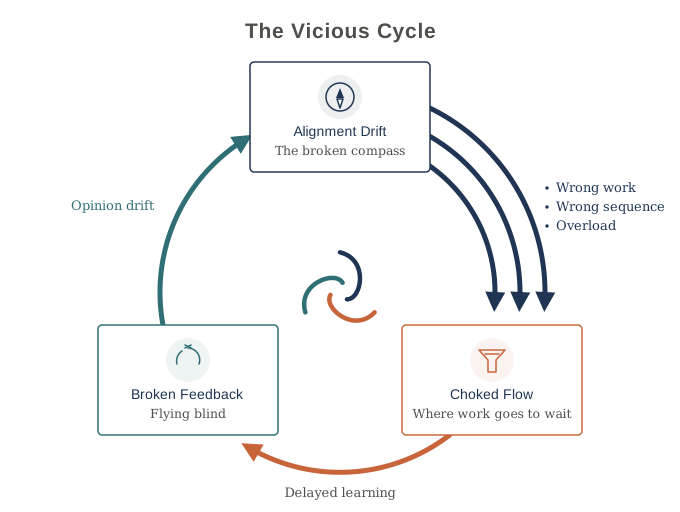
Five mechanisms rebuild the problem
1. Wrong work
Alignment Drift to Choked Flow. When outcomes are unclear, teams must interpret what leadership intended. Reasonable people make different assumptions, build different solutions, and create work that later requires reconciliation or rework.
When reconciliation or rework follows, the system pays once to build the work and again to correct it. Misalignment can become additional demand inside an already constrained delivery system.
2. Wrong sequence
Alignment Drift to Choked Flow. Valid work can still arrive in the wrong order. Political weight can outrank economic value. Dependencies can surface after commitments lock. High-value work waits while lower-value work consumes finite capacity.
The portfolio may contain the right work and still forfeit value because it cannot sequence that work around outcomes, urgency, and dependency reality.
3. Overload
Alignment Drift to Choked Flow. New priorities enter without old commitments leaving. Teams divide attention across more work than the system can finish. Coordination grows, queues lengthen, and apparent utilization replaces throughput.
Wrong work, wrong sequence, and overload carry Alignment Drift into Choked Flow. The delivery system receives too much work, some of it unnecessary and much of it badly ordered.
4. Delayed learning
Choked Flow to Broken Feedback. Choked Flow stretches the time between action and usable evidence. By the time a result becomes visible, the next plan may be committed, the team may have moved on, or the decision window may have closed.
Feedback may still arrive, but too late to change behavior. Evidence then becomes historical information instead of an input to the next decision.
5. Opinion drift
Broken Feedback to Alignment Drift. Planning does not stop because evidence is missing. Decisions still have deadlines. When usable feedback cannot reach the room, assumptions and executive judgment fill the gap.
Judgment is unavoidable under uncertainty. The problem begins when opinion repeatedly substitutes for evidence and the next planning cycle rebuilds alignment around untested assumptions.
Alignment Drift creates work that chokes flow. Choked Flow delays learning. Broken Feedback allows opinion to regenerate Alignment Drift.
Why isolated gains can fade
An intervention can improve its target and still operate at the wrong scope. The model exposes three routes around a single-barrier fix.
- Improve alignment alone. Outcomes become clearer, but work already trapped in long queues delays the evidence needed to test those outcomes. Weak feedback lets assumptions shape the next plan.
- Improve flow alone. Approval queues shrink and delivery accelerates, but misalignment keeps feeding wrong or badly sequenced work into the faster system. Weak outcome signals hide the result.
- Improve feedback alone. Better evidence arrives, but locked priorities and overloaded delivery paths prevent the organization from acting on it before the next commitment cycle.
Local interventions can produce gains that are often necessary. But improvement in one barrier metric does not prove that the surrounding system changed.
The cycle carries whatever you put into it
The five mechanisms are connections between barrier conditions, not one-way valves. Each describes what one barrier does to the next. When the upstream condition is degraded, the connection carries dysfunction. When the upstream condition improves, the same connection carries the improvement.
In this model, alignment feeds flow, flow feeds feedback, and feedback feeds alignment. Those connections can transmit improvement as well as dysfunction.

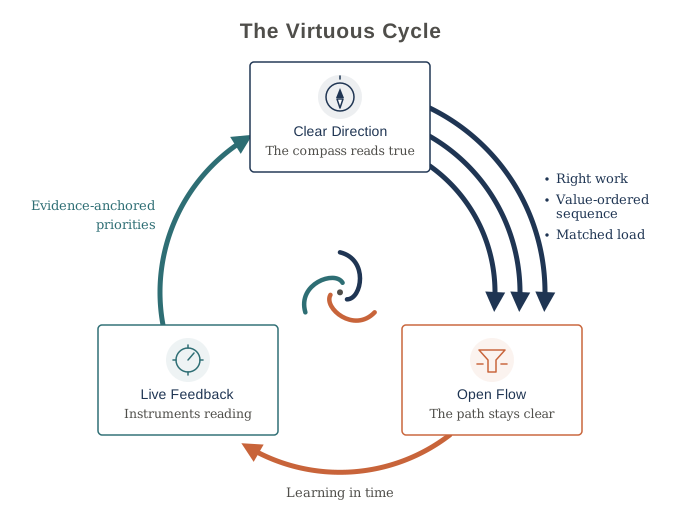
Follow how improvement passes through the loop. Clearer outcomes reduce the volume of work that should not exist, so less rework demand reaches the delivery system. Value-ordered sequencing moves the highest-value work through finite capacity first, so the evidence that arrives is evidence about decisions that mattered. Demand matched to capacity shortens queues, so the distance between action and usable evidence contracts. Evidence arriving while the decision is still open leaves less unclaimed space for opinion to fill. Priorities anchored in evidence produce clearer outcomes, which is where the loop began.
Improving connected conditions can help a local gain last. Clearer priorities reduce unnecessary demand; shorter queues return evidence sooner; that evidence supports the next priority decision.
The cycle can be vicious or virtuous. Which one it is depends on what is being conveyed.
Keeping those improvements requires continued attention to the affected connections.
The directions are not symmetric. Dysfunction compounds without anyone maintaining it. Queues fill, evidence decays, and assumptions harden on their own. Improvement compounds only while it is sustained. If attention stops, the original queues, weak evidence, and assumptions can re-form.
The change is not simultaneous. A connected intervention changes the conditions on the paths it touches; the untouched paths can continue to transmit the original problems. The loop changes where the connections change, not everywhere at once.
Trace an intervention that faded
Choose one improvement effort that changed its target metric but did not produce a durable business result. Then ask:
- Which barrier did the intervention target: Alignment Drift, Choked Flow, or Broken Feedback?
- What improved locally?
- Which condition returned or remained unchanged?
- Which mechanism carried that condition back into the problem: wrong work, wrong sequence, overload, delayed learning, or opinion drift?
Use the exercise to identify the mechanism that carried the problem back, rather than to declare the intervention a failure. That mechanism identifies where the next intervention must also act.
A flow improvement may need a clearer outcome and a faster feedback path. Better evidence may need decision rights that let the portfolio respond. Stronger alignment may need capacity discipline so the right work can move.
Act on the arrows, not only the symptom
Trace the active loop before choosing the intervention. If another path keeps rebuilding the problem, include that connection in the improvement work and check whether the gain lasts.
The cycle trace identifies what must change together. The Value Acceleration Process establishes the improvement backlog, owner, and review rhythm for acting on it.
The practical question is not, “Which practice should we install next?” It is, “What will regenerate this problem if we fix only what we can see?”
Sources and lineage
The Vicious Cycle and its five connections form part of the Applied End-to-End Flow framework developed by Curtis Hibbs and Joshua Barnes. The complete treatment appears in Applied End-to-End Flow: Enterprise. These are authored framework models, not externally validated diagnostic scores.