Insight
Your Strategic Portfolio Is Funding Boulders
The initiative is green. Its milestones moved. The target still cannot use anything, and the assumption most likely to change the investment remains untested.
The milestones moved. The value did not
Consider an initiative with a familiar status report. Environments are ready. Components passed review. Dependencies have owners. Several internal milestones are complete.
The target cannot use the result yet. The capabilities become useful only after the remaining parts are assembled. A critical assumption about value or feasibility will not be tested until the integrated package reaches its target.
The status report is accurate. It measures progress through the funded package. It cannot show realized value or decision-quality learning because the package was not designed to produce either one before the end.
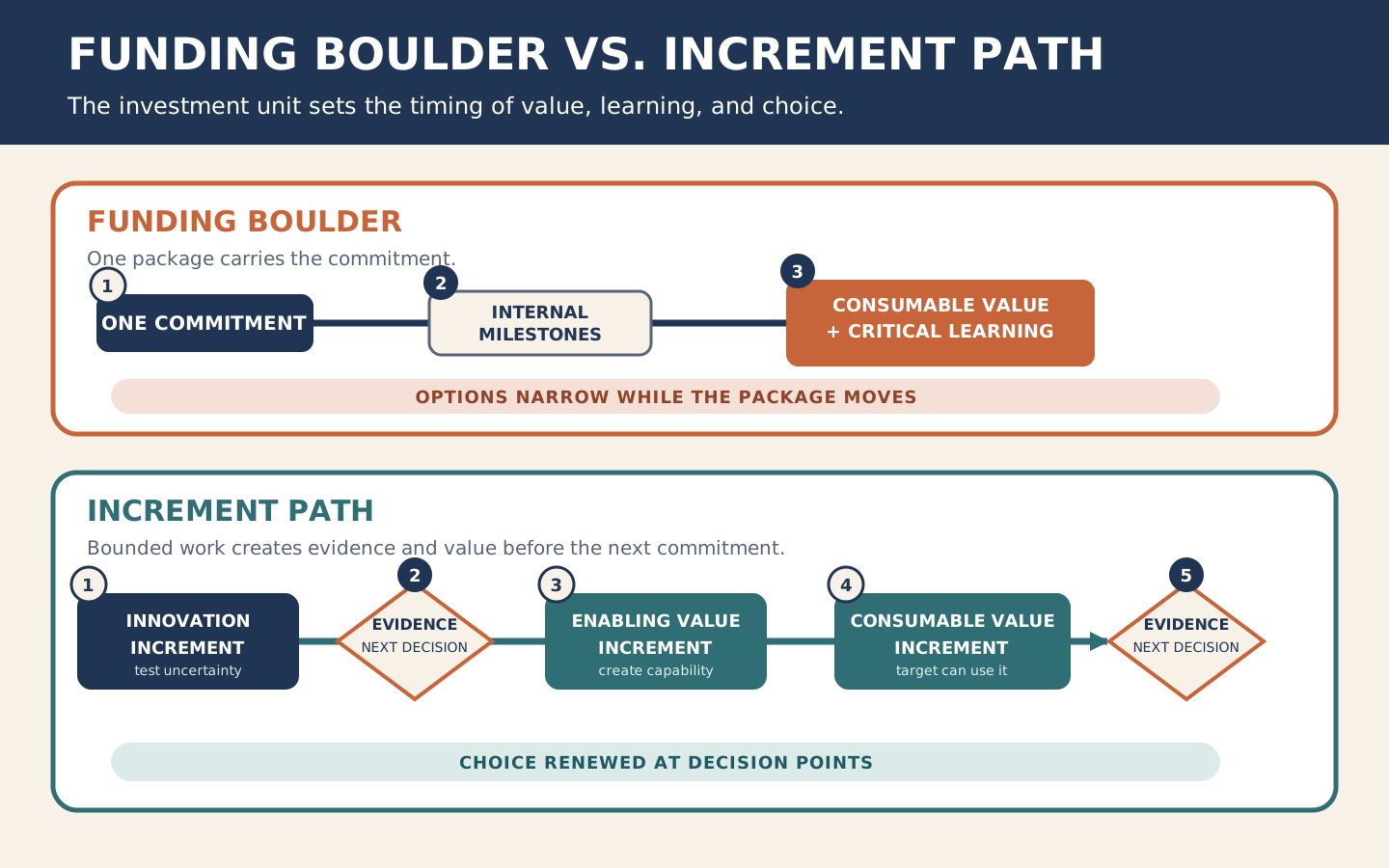
That package is a Funding Boulder: a large initiative treated as one investment decision whose consumable value, critical learning, or next meaningful portfolio choice arrives late.
The funded unit sets the decision clock
The portfolio approved one business case, one scope container, and one commitment. It can review milestones inside that container, but those reviews do not automatically create a new investment decision.
As work proceeds, dependencies become active, teams coordinate around the plan, and accumulated effort changes the practical cost of stopping or redirecting the initiative. Options can narrow even while delivery reports remain green.
This is the investment-unit mechanism. The portfolio does not merely choose what to fund. By choosing the investment boundary, it also designs the next point at which evidence can support a fresh decision.
While the package waits to become consumable, the accumulating coordination, dependency management, and delayed feedback can create Latency Load.
The investment unit determines when value, learning, and choice can become available.

Consumable value is the boundary
A Value Increment is a discrete package of work that delivers known value; the concept page gives the direct and enabling tests. For the funding decision, identify where that value becomes usable and whether the current package delays the next choice until everything is complete.
Learning needs its own increment
Known-value delivery and exploration produce different outputs.
An Innovation Increment produces evidence for a decision about uncertain value or feasibility. Funding that learning separately can expose a failed assumption before it becomes embedded in a larger delivery commitment.
Value and Innovation Increments consume the same constrained capacity. Keeping them visible in the same decision system makes the tradeoff explicit. The portfolio can choose known-value delivery, enabling capability, or uncertainty reduction with a clearer view of what each investment should produce.
Earlier evidence creates a decision opportunity. Leadership still has to use it.
Smaller is not the test
The classification and sizing tests distinguish usable value, deliberate enabling capability, exploratory learning, and unfinished components. For a funding boulder, the question is how long the portfolio must wait before it can realize value, retire uncertainty, or choose again. Several phases renamed as increments leave that wait intact if all must finish before any value becomes usable.
Redraw one active initiative
Use an initial 60-minute cross-functional session to create a Boulder-to-Increment Map for one funded initiative. Identify candidate value and learning boundaries and the decisions they could support. Assign each unresolved question an owner and review date. The map is a proposal for the responsible investment and delivery owners to consider.
Use five questions:
- Target and known value. Who should use the result, and what value should they realize?
- First consumable boundary. What is the first coherent package that target could use for meaningful value?
- Enabling work. What capability must exist for that value to become consumable, and which part deserves deliberate investment?
- Critical uncertainty. Which assumption about value or feasibility could change the larger investment? What bounded Innovation Increment could test it?
- Next decision. What evidence from the Value or Innovation Increment would support continuing, redirecting, expanding, or stopping the next investment?
The output is a Boulder-to-Increment Map, not a delivery commitment. It shows the current boulder, candidate increment boundaries, the evidence each one should produce, and the point where leadership could choose again. Readiness, dependencies, funding authority, and delivery feasibility still need to be checked before commitment.
The map changes the conversation
An organization can use increment language before it changes funding governance. Teams can decompose already approved work, sequence toward consumable value, and isolate uncertainty without reopening the annual budget.
That move improves visibility. It does not create increment-based funding by itself. The portfolio still has to decide whether evidence can redirect investment, whether increments can be funded independently, and whether governance can act at the same boundary where value or learning appears.
The map gives leaders something better than an abstract argument for smaller projects. It shows where the existing investment waits too long to produce a usable result or a decision signal. That evidence can support the next governance move without pretending the complete operating model changes in one workshop.
The decision belongs upstream
Delivery teams can identify components, dependencies, consumable boundaries, and unresolved assumptions. Product and portfolio leaders can compare candidate increments. Finance and governance partners can explain the constraints attached to the current funding container.
The authority to change the investment unit sits upstream with the leaders who approve work and control the decision system.
Their obligation is concrete. Funded work should show when its target can realize value, when a critical assumption will be tested, and when the portfolio may choose again.
The investment unit determines when value, learning, and choice can become available.
Sources and lineage
This Insight is derived from the Value and Innovation Increment treatments in Applied End-to-End Flow: Enterprise, the Enterprise Quick Starts, Applied End-to-End Flow: Team, and the jointly authored May 2026 Funding Boulders article. The historical article supplied the metaphor and strategic-side recognition pattern. The published framework supplies the consumability definition, direct and enabling forms, separate Innovation Increment class, sizing boundary, and investment guidance.
Curtis Hibbs and Joshua Barnes are co-creators of Effective Enterprise AI and Applied End-to-End Flow, and co-authors of Applied End-to-End Flow: Enterprise. Their work combines enterprise diagnosis, value-delivery mechanics, and practical intervention patterns across strategy, portfolios, value streams, and teams.