Operating Concept
Value Increments
A Value Increment is a discrete package of work that delivers known value. Its defining characteristic is consumability: a customer, internal user, or operational process can use what was delivered to realize the promised value.
Consumability is the test
A completed component is not automatically a Value Increment. Neither is a feature, milestone, phase, or release. The target must be able to use the delivered work to realize value.
A feature that is built but cannot be used is inventory. A capability that depends on several unfinished capabilities is a component waiting for assembly. Both may be necessary. Neither is a Value Increment on its own.
The target is often a customer. It can also be an internal user or an operational process. The form changes with the target. The test does not: can the target use this package of work to realize known value?
Direct and enabling Value Increments
Value Increments deliver value in two forms.
Direct Value Increments deliver capability the target can use immediately. An account-opening capability that lets a customer complete the process online is direct value. The customer can do something useful that was not available before.
Enabling Value Increments deliberately create the conditions for future value delivery. Architecture runway, technical-debt reduction, and reusable platform capabilities can qualify when they are intentionally scoped and prioritized as enabling work. A reusable identity-verification service may not be consumed directly by a customer, but it can enable several later customer-facing increments.
Calling work enabling does not exempt it from prioritization. The future value it supports should be clear enough to compare with other uses of capacity.
Use the appropriate practical test:
- Direct value: Can the target use this increment to do something valuable they could not do before?
- Enabling value: Does this increment deliberately create capability that supports future value delivery?
Value Increments are not Innovation Increments
An Innovation Increment is a separate class of work. It is exploratory work designed to validate a hypothesis about potential future value. Its output is learning, not delivered capability.
Takeaway: Value Increments deliver known value. Innovation Increments reduce uncertainty. Both consume the same constrained capacity. On smaller screens, scroll horizontally.
| Decision | Value Increment | Innovation Increment |
|---|---|---|
| Starting point | The value proposition and target are understood. | A hypothesis about value or feasibility needs testing. |
| Primary output | Consumable capability or deliberate enabling capability. | Evidence that reduces uncertainty. |
| Success test | The target can realize the promised value. | The work produces enough learning to support a decision. A disproven hypothesis can be a successful result. |
| Evaluation | Execution confidence, delivery cost, and value realization. | Cost of the uncertainty, quality of learning, and size of the opportunity. |
The distinction makes the capacity tradeoff visible. Exploratory work does not become free because it sits in an innovation program, and known-value delivery does not become certain because it has a roadmap date. Value and Innovation Increments should be compared in the same decision system because choosing one displaces capacity from the other.
Size for meaningful use
A Value Increment should be large enough to deliver meaningful value and small enough to realize that value without unnecessary delay. Smaller increments generally provide faster feedback, lower risk, and more frequent prioritization decisions.
The goal is not the smallest possible increment. Technical dependencies may resist clean separation. A customer workflow may require a coherent end-to-end capability. Regulation may require complete functionality before any part can be used. Those are valid reasons for a larger increment when the consumability boundary is real.
The wrong sizing test is whether the work fits a fixed time box. The useful test is whether a smaller package would still let the target realize meaningful value.
The scope changes with altitude
The concept applies to product delivery, operational work, and improvement work. Its scope expands with the decision authority involved.
At team altitude, a Value Increment may be a coherent bundle of features, stories, or tasks that together produces one usable result. It is not a synonym for any one of those work-item types.
At value-stream altitude, it may span several teams or systems because the consumer’s workflow crosses those boundaries.
At enterprise altitude, it may carry a larger investment and broader dependency set. The test remains consumability, not organizational size or a prescribed planning cadence.
Altitude changes the boundary of the work. It does not change the definition.
Common classification errors
A component presented as value. Necessary work has finished, but the target still cannot use it. Classify it as inventory or as part of a larger Value Increment.
A hypothesis presented as delivery. The organization does not yet know whether the value exists or whether the approach is viable. Frame the work as an Innovation Increment and name the learning decision it must support.
Technical work dismissed as valueless. Architecture, debt reduction, and platform work can be enabling Value Increments when their connection to future delivery is deliberate and explicit.
A time box mistaken for an increment. Duration does not create consumability. A short package that delivers nothing usable is still not a Value Increment.
A large initiative relabeled without being sliced. A new name does not change the point at which value becomes usable. Find the coherent consumable boundary.

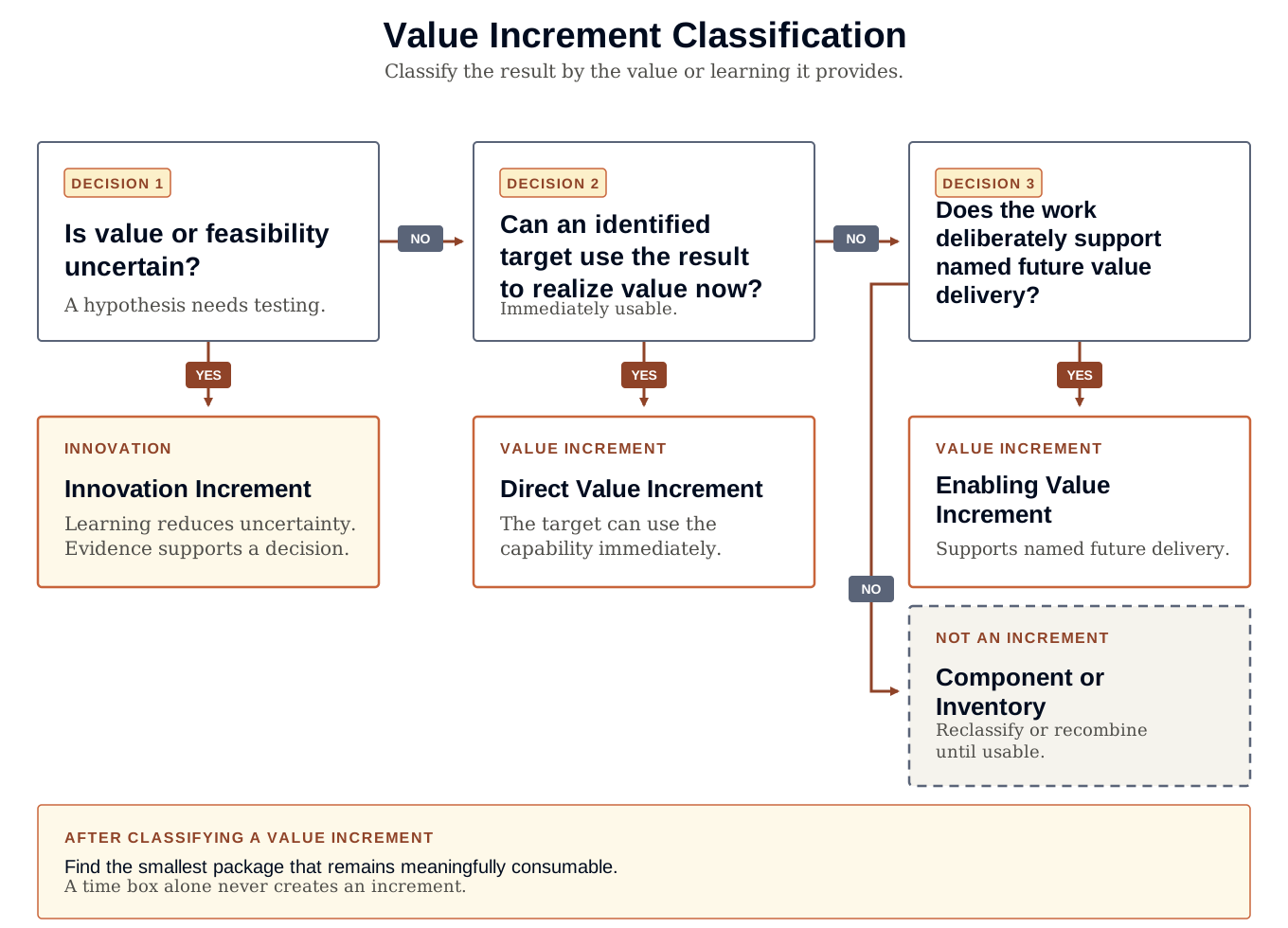
Applied test: classify one candidate item
Take one high-priority item from a product, portfolio, operational, or improvement backlog. Ask:
- Is the value already understood, and is the target identifiable?
- Can that target use the result to realize the promised value?
- Is the value direct, or does the work deliberately enable future delivery?
- If value or feasibility is uncertain, what hypothesis should an Innovation Increment test instead?
- Could a smaller package still deliver meaningful consumable value without breaking a required workflow, dependency, or regulatory boundary?
Use the answers to classify the item. If neither the direct nor enabling test fits, combine it with the work needed to make it usable or retain it as a component. If value or feasibility is unresolved, identify the hypothesis and decision for an Innovation Increment.
Sources and lineage
The canonical framework treatment appears in Applied End-to-End Flow: Enterprise. This Knowledge Base page condenses that treatment into a reusable definition and classification test. The historical Funding Boulders article remains source lineage for an earlier strategic-side formulation, not authority for the published taxonomy.