Altitude: Personal Diagnostic Frame
The 10 Dysfunctions at Your Desk
You end the week busy and behind, and the advice never changes: plan better, push harder, protect your time. But some of what slowed you down was in place before the work reached you. This page names ten causes.
What a dysfunction is
A dysfunction is a pattern in how work reaches you, and it acts on particular work: you can point to the piece of work it hit and say what it blocked.
How you respond can feed a dysfunction, but having a part in one never makes you the dysfunction.
Productivity tools, such as a focus block, a better list or an earlier start, make the cost easier to carry but leave the dysfunction in place.
Read with your last two weeks in mind, not the typical week you’d describe. Mark every dysfunction you recognize.
Two questions for every dysfunction
First, which barrier does the dysfunction sit in? Check each barrier’s cue against your week:
- Alignment Drift obstructs direction. The cue: you end the day busy and can’t say whether you worked on the right thing.
- Choked Flow obstructs the movement of work. The cue: most of your open work is waiting on someone else, and the waiting decides your dates.
- Broken Feedback obstructs the feedback that would correct your work. The cue: you learn how your work landed by surprise, by rumor or not at all.
Second, where does its cause sit? The answer is one of three verdicts. Mine: your own miss explains the problem. System: you did everything open to you, and the problem happened anyway. Mixed: your miss and the system both contributed. Expect Mixed. The entries say where to look; the log below says which verdict fits your case.
Something you could have done counts against you only if it was open to you and connected to the problem. A step you couldn’t safely take is not a step you neglected. Any verdict is a guess, whichever way it points, until the log tests it.
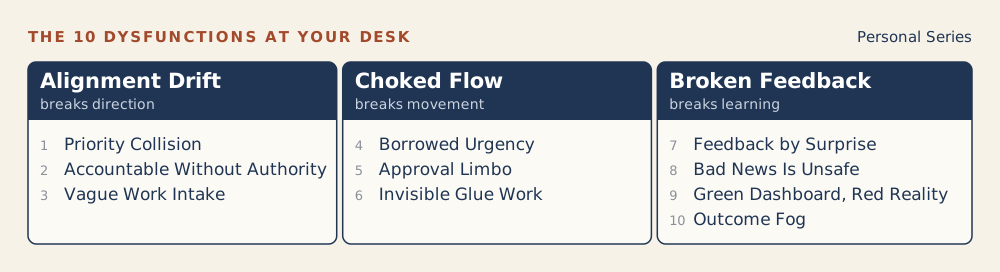
The 10 dysfunctions
Alignment Drift
You start on whichever urgent request comes from the person most likely to walk past your desk. By afternoon, one of the others has changed.
1. Priority Collision
Two people with the standing to say so each tell you their own ask comes first. You can’t do both, so you quietly put one of them second. Competing Signals, described below, is the standing condition; the collision is the day when two of those signals claim the same hours. The enterprise gap Priority Collision is different: an executive’s opinion overrides the business case when work gets prioritized.
Common misdiagnosis: “I’m bad at prioritizing.” But the order was never yours to decide.
What is yours: Telling both senders early that their asks needed the same hours, instead of choosing between them in silence.
What is inherited: The authority to rank the asks sits above you.
Go deeper: Priority Collision at Your Desk
2. Accountable Without Authority
Your name is on the launch date, but the inputs are on other people’s calendars. You chase them, apologize for work you couldn’t command and make up the late days yourself.
Common misdiagnosis: “I need more influence.” Influence gets you favors, but a favor isn’t authority.
What is yours: When you took the commitment, did you name what the result depended on? Did you request the right to decide, or dated commitments from the people who decide? And when that request was refused, did you ask to renegotiate the scope?
What is inherited: The decisions were divided up before you took the work.
3. Vague Work Intake
The ask arrives as one sentence: “Can you take a look at the onboarding emails?” At review, “take a look” turns out to have meant a redesign, and you redo the work days later.
Common misdiagnosis: “I should be able to figure this out.” But a guess was all the ask allowed.
What is yours: Clarifying the ask before you accept it, breaking the work down to find the open questions, and showing a rough version early. Of this barrier’s three dysfunctions, Vague Work Intake is the one you control most.
What is inherited: Senders who don’t specify what they want even when you ask, and workplaces where a clarifying question reads as not knowing your job. There, asking isn’t open to you.
Choked Flow
You have seven pieces of work open, and you chose only two of them. Of the rest, one waits on another team and one waits on a signature. Another can’t close, because you’re the only person who knows how the systems involved fit together.
4. Borrowed Urgency
The figures promised for the 4th arrive on the 13th, and the review date hasn’t moved. Your ten working days become three, and the sprint is the only part anyone sees.
Common misdiagnosis: “I should have started sooner,” said about work whose main input hadn’t arrived.
What is yours: Flagging the dependency early, starting the parts that didn’t need the figures, giving an estimate that showed the wait, and saying that the time left had shrunk to three days.
What is inherited: The late figures, an end date set before anyone knew how the chain would run, and a plan with no buffer where your step needed one.
5. Approval Limbo
The training schedule is finished and needs one go-ahead. You nudge after four days, then again after eight. Meanwhile the training dates get closer, one trainer’s availability changes, and the finished schedule needs work again. In Borrowed Urgency, the wait comes before you can start; here, it comes after you finish.
Common misdiagnosis: “I need to follow up better.” But the line your request stands in was there before the request arrived.
What is yours: The request itself. Was it complete enough to decide on? Did it say when you needed the answer, and what would slip after that date? Did it go, on the day it was ready, to someone who can say yes?
What is inherited: The approver’s load, the number of gates between done and released, and how senior the approver had to be.
6. Invisible Glue Work
At five o’clock, the work you meant to finish is where you left it. You unblocked four people and reconciled a list two systems disagreed about. None of it was on your plan, and none of it gets counted.
Common misdiagnosis: “I need to protect my time better.” But most of the interruptions were work somebody needed.
What is yours: Do you volunteer for coordination outside your role? Do you keep the know-how only in your head? Do you absorb the load without saying what it adds up to?
What is inherited: Systems that don’t connect, teams with no shared process, your position where those systems and teams meet, and measures that count only what you finish yourself.
Broken Feedback
Two weeks after you deliver, you hear secondhand that the work missed the mark. That’s the first word anyone has sent back.
7. Feedback by Surprise
You spend five weeks redesigning how customer complaints get routed. In the week the new routing goes live, the complaints team’s lead sees it for the first time. In week two, she could have steered the design with one sentence. Now the same point means a rebuild. Unlike Vague Work Intake, the target was clear enough to start on.
Common misdiagnosis: “I should have checked in more.” But did you offer an early look, and did anyone take it?
What is yours: Asking for feedback early, showing a rough version of the work before a finished one, and restating the target before you started building. An early look you offered and nobody took is not a miss.
What is inherited: A review process that collects every judgment at the end, reviewers who look only at finished work, and workplaces where a rough draft costs standing.
8. Bad News Is Unsafe
You have the supplier’s email saying they can’t deliver what the plan assumes. You draft the message, soften it, delete it and let the meeting pass. The dysfunction is that specific news being held back; low Safety, described below, is the condition that makes holding back likely.
Common misdiagnosis: “I lack courage.” But the silence was also a calculation, based on what you’ve watched happen in this room.
What is yours: What is your sense of this room based on: how it handles small concerns, or one time it reacted badly to bad news? When you did speak, did you frame the news as evidence or as alarm? And has silence become your default everywhere? Holding back in an unsafe room is not a miss.
What is inherited: How leaders here react to unwelcome news, and the lack of any sanctioned place to bring it.
9. Green Dashboard, Red Reality
The status page shows green. Your week was two late nights, a test you skipped to make the date and a fix you pushed to next month.
Common misdiagnosis: “Maybe I’m the negative one.” But everyone else sees the same green page, and some of them keep it green the same way you do.
What is yours: Your own line in the report. If you mark your work green under the same pressure, that counts toward Mine, but only where an honest status was safely open.
What is inherited: What the dashboard measures, and the layers above you that round each summary toward green.
10. Outcome Fog
You ship, and the work vanishes. The next request arrives, and you make the same kind of choices without knowing how the last ones turned out. Feedback by Surprise brings the first response at the end; here, no word on the result comes at all.
Common misdiagnosis: “I shouldn’t need validation.” But praise is about you, and a result is about the work. You can’t aim the next piece without one.
What is yours: At the start, finding out what result the work was for and how anyone would know whether that result came about. After the work shipped, asking how it turned out. A question you asked that nobody could answer is not a miss.
What is inherited: Tracking that stops at delivery, outcome data held in another function, and no step in the flow whose job is to close the loop.
What your marks tell you
Where they cluster. If your marks bunch under one barrier, start there. If they land under all three, the barriers may be feeding each other: The Vicious Cycle shows how.
What the conditions change. The same dysfunction can cost two people very different amounts. A vague request costs one person a quick question and another an evening’s rebuild, depending on whether asking is safe and the week has room. Three conditions, set before the work arrived, make that difference. Unlike a dysfunction, a condition acts on everything that crosses your desk:
- Safety governs what you can do with a diagnosis once you have one.
- Competing Signals governs whether the right action can be known at all: direction reaches you from several sources, and nobody with authority reconciles them.
- Capacity Margin is the room in your week to clarify, absorb a delay and ask for feedback early. It decides how much every barrier hurts.
Check all three conditions in your own situation before you decide what to attempt.
One move tonight: start a log. Pick one problem that keeps coming back. Each time it shows up, write down:
- the date;
- what you were waiting for or were asked to do, and who it came from;
- how long it took and what it cost you;
- what you did or didn’t do, when, and what came back; and for anything you didn’t do, whether it was open to you and connected to this problem.
Don’t decide whose problem it is yet. If the problem shows up only where you missed a step, the verdict moves toward Mine. If it shows up even where you did everything open to you, the system’s part is real.
What the list is. These ten dysfunctions are the authors’ framework for sorting what you observe, not a scored assessment.
Where to go next
Applied End-to-End Flow: Personal covers all ten dysfunctions. It adds the four-move diagnostic, which tests whose part is whose. It also shows how to read the room before you raise a problem. Once you have evidence from the log and a read of the room, Surfacing Moves by Posture shows the move that fits. Each dysfunction gets its own page as the series runs.
Sources and lineage
The 10 dysfunctions and the Three Barriers form part of the Applied End-to-End Flow framework developed by Curtis Hibbs and Joshua Barnes. The complete treatment appears in Applied End-to-End Flow: Personal. These are authored framework models, not externally validated diagnostic scores.