Altitude: Personal Alignment Drift Dysfunction
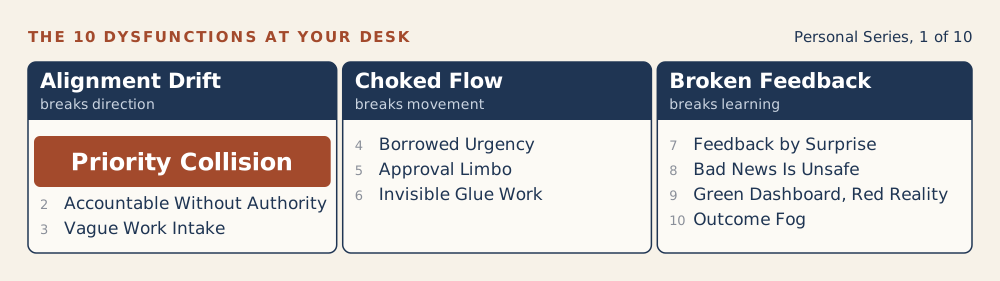
Priority Collision at Your Desk
Two people, both entitled to direct your work, have each told you their ask comes first. This morning you started on one ask and told nobody which one you chose. Sometime this week, the person whose ask you put second is likely to come looking for their work.
Definition
Priority Collision happens when two or more asks each arrive as the top priority and nobody with the authority to rank them has ranked them.
So the job of ranking them falls to you.
The recognition pattern
Look at last week’s asks, not at how organized you felt.
- Two or more senders have each marked their own ask top priority.
- Neither sender knows the other’s ask is on your desk.
- Starting one ask means quietly putting another second, and nobody but you knows the order.
- A sender wants to know where their work is, and you defend an order you were never told to set.
- When you put the question “Which comes first?” to your manager, the answer is “They’re both important.”
A collision doesn’t need every sign: the ones that matter concern the same two asks, and you can’t finish both in time.
Why the job of ranking lands on you
From where each sender sits, their ask does come first, because each ranked it against their own list. No one has to be careless for the two rankings to clash. Each is looking at half of what reached you.
Ranking the two asks against each other takes someone whose answer both senders have to accept. If that person had seen both and ranked them, there would be no collision.
You can still choose an order, but it doesn’t bind either sender, because neither answers to you. So the usual explanation, “I’m bad at prioritizing,” points at the wrong problem. A better method can put the list in a good order, but it can’t make the sender you put second accept that order. You can rank well and still be overruled, because the order was never your decision.
Competing Signals is the condition that runs week after week: several people send you direction, and nobody with authority reconciles it. A collision is one event within it, on a date you can name, when two of those signals can’t both be met in time.
People facing unreconciled expectations from several senders feel conflict and strain, in research by Robert Kahn and colleagues. But unclear expectations are more closely linked to lower performance than conflicting ones are, in a review by Travis Tubre and Judith Collins. Our inference: in a collision, what’s unclear is which ask takes priority. If unclear expectations do more harm than conflicting ones, the damage comes mainly from that question, and from having to answer it yourself.
What is yours, what is inherited
The authority to rank the two asks sits above you: that’s structure, not skill. But did you warn both senders, before choosing, that their asks had collided? And when the two asks together passed what you could finish, did you say so, or take both on and hope?
Your answers point to a verdict, which later collisions will test:
- You chose in silence. That part is yours, so the verdict is Mixed, not System.
- You warned both senders early, said what you could finish, requested a ranking and got none. The evidence points toward System.
- Raising the collision wasn’t safe where you work. Skipping that step doesn’t count against you, but skipping any other step that was open to you still does. Write down that it wasn’t safe.
What it costs
- Your order of work won’t stay settled. It reopens every time two asks collide.
- Work that goes stale. You drop one ask half done to switch, and by the time you return, some of it has to be redone.
- The blame. When the ask you put second misses its deadline, your name is on the miss, and “I’m bad at prioritizing” looks confirmed.
- No room left. Carrying both asks can use up the slack in your week, and then the next late request lands as a rush.
Applied End-to-End Flow: Personal, Chapter 6, traces how these costs feed one another.
Boundaries and distinctions
Priority Collision at the enterprise altitude means something else. There, an executive’s opinion outweighs the business case when the organization chooses its work. Here, two asks land on one desk, and nobody ranks them.
Vague Work Intake leaves one ask undefined. A collision leaves two competing asks unranked, and a vague ask can hide a collision until both asks are half done.
Accountable Without Authority is often where a collision ends. The ask you put second misses its deadline, and you answer for a ranking you had no authority to make.
A full week is not a collision. Heavy load becomes a collision only when two top-priority asks can’t both be finished in time and nobody will rank them. Load without a collision belongs to Capacity Margin, the room in your week to clarify, absorb a delay and seek feedback early.
Example
An illustration, by construction. A finance analyst’s manager has assigned the analyst to support two people, and has ranked the analyst’s work before. On Monday, the head of sales requests a revised forecast for the board pack: “Top priority, Friday.” That afternoon, the operations director wants the supplier cost model rebuilt for Friday’s negotiation: “This comes first.” By Tuesday morning, the analyst can see there isn’t time for both. The analyst starts the forecast and tells nobody. On Wednesday, the operations director comes looking for the model, and the analyst switches. The forecast reaches the board pack a day late.
The log entry:
- The asks: forecast, “top priority, Friday” (head of sales); cost model, “this comes first,” Friday (operations director).
- Collision visible: Tuesday morning.
- Ranking requested: no.
- What stalled: the cost model, until Wednesday; the forecast, one day late.
The third line, the analyst’s part, makes the entry Mixed.
Applied Test: log your last collision
Find the last time two asks were each marked top priority and you couldn’t finish both in time. Write down four things:
- each ask’s stated priority and deadline, in the sender’s words;
- the date you could first see that the asks collided;
- whether you requested a ranking, from whom, and what came back;
- the work that stalled, and for how long.
Then answer the two questions about your own part, and write the answers with the entry. Count your collisions each week. The entries show how often you requested a ranking and how often you chose in silence.
Safety decides whether you raise the next collision, who hears it first, and how directly you put it: see Surfacing Moves by Posture and Applied End-to-End Flow: Personal, Chapters 7 and 8. If you raise the collision, bring it as a decision request to someone whose answer both senders have to accept. Often that’s your manager. A complaint about your workload usually gets you advice on time management. Instead, say something like: “A and B are both due on the 14th, and I can finish one by then. Which one, and what date do I give for the other?”
If no ranking comes, you still choose, and you write down the choice and why. That record is what you show the sender you put second, as far as Safety allows.
Sources and lineage
Priority Collision is one of the 10 dysfunctions in the Applied End-to-End Flow framework developed by Curtis Hibbs and Joshua Barnes. The complete treatment appears in Applied End-to-End Flow: Personal. The finding on unreconciled expectations is from Robert L. Kahn and colleagues, Organizational Stress: Studies in Role Conflict and Ambiguity (Wiley, 1964), and the comparison of ambiguity and conflict is from Travis C. Tubre and Judith M. Collins, “Jackson and Schuler (1985) Revisited” (Journal of Management, 2000).
Curtis Hibbs and Joshua Barnes are co-creators of Effective Enterprise AI and Applied End-to-End Flow, and co-authors of the Applied End-to-End Flow book series. Their work combines enterprise diagnosis, value-delivery mechanics, and practical intervention patterns across strategy, portfolios, value streams, and teams.