Altitude: Enterprise Foundational Gap
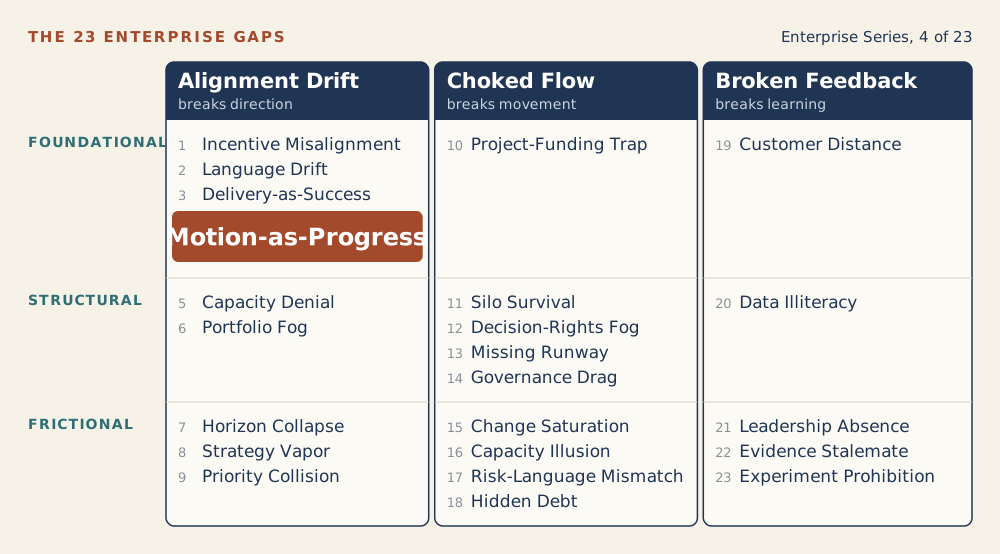
Motion-as-Progress
The review pack is exact: velocity to the decimal, spending to the dollar, a check mark beside every milestone. Ask whether the organization is heading the right way, and the pack has nothing to say. The precision makes the silence easy to miss.
Definition
Motion-as-Progress means that completed activity is counted as progress, whether or not the activity has moved an outcome such as renewals, complaints or what customers do.
So the evidence behind decisions is corrupted: it shows how fast the organization is moving, not whether the work is changing anything for customers.
The recognition pattern
Look in the documents leaders steer by:
- The status report is a list of activities completed, not results achieved.
- The headline is what shipped, not what changed for customers.
- Utilization is high while customer satisfaction is flat or falling.
- The portfolio review tracks spending and milestones, not changes in what customers do.
- After a major release, nobody can answer “What changed for the customer?”
Any one sign can have another cause. Together they point to a review pack built to show speed.
Speed gets measured, direction doesn’t
Features shipped, story points burned, projects completed: that is output. Output is visible, mostly within the team’s control, and exactly countable. Exact numbers look rigorous.
Outcome evidence often arrives after the decision. Measuring outcomes takes patience, a way to track what customers do, and a tolerance for ambiguity. Attribution is messy, too: did churn drop because of the product fix, or because a competitor stumbled?
So the organization measures the clean thing (output) and assumes it tracks the hard thing (outcome). Nothing in the review examines that assumption. Wharton’s Christopher Ittner and David Larcker saw the same habit with non-financial measures: many companies adopt them without checking that they affect financial results.
The assumed link between output and outcome can hold for a while, but the pack can’t show when the link breaks. Teams aim at what is counted, so they ship faster and ship more. The scoreboard improves whether or not customer value does. And when reports must be green on output, teams learn to keep bad news about outcomes out of them. No one has to lie. The report gets what it asks for.
These numbers don’t stay in the pack. Decisions to fund, continue or stop a program are made from them. But at full speed, a program heading the wrong way can report the same healthy numbers as one heading the right way. And any evidence of direction stays outside the room until the lagging numbers force the question.
Attribution often can’t be proved. But reading the direction doesn’t need that proof. A renewal rate falling while output climbs is worth a question at the review, even before anyone knows why. Messy attribution is a reason to read an outcome with care, not to leave it out of the room.
What it costs
The organization believes it is winning, because the numbers say so. Velocity is up and the portfolio looks healthy. Meanwhile market share erodes, complaints rise and renewals soften.
Some programs never get corrected. By the time the lagging indicators force attention, quarters of effort have gone the wrong way. Recovery can mean taking the old work apart as well as starting new work.
The Vicious Cycle is the loop where the barriers feed one another. This gap supplies it with wrong work, which looks like progress until someone asks whether customers are better off.
Boundaries and distinctions
Delivery-as-Success corrupts the definition of done. It scores the work at the finish. Motion-as-Progress scores the work along the way and corrupts the evidence used for decisions. Each gap reinforces the other.
Portfolio Fog blurs what teams report. In the roll-up, teams that are blocked, overloaded or thrashing look healthy. Here the report can be accurate and still measure the wrong thing. The gaps connect: without outcomes to look at, portfolio decisions fall back on output figures and keep funding low-value work.
Counterfeit Signals is the general mechanism. Any signal that is easy to produce can take the place of the result it is supposed to indicate. Motion-as-Progress is the case where output stands in for outcome, and this page follows what that does to decisions.
Output measures are not the problem. They show how the work is running, and a leader needs that. The gap opens when they are read as evidence of progress, because a program can be fast and wrong at once.
Example
An illustration, by construction. A company launches a program to change how new customers are set up. The change is due within three quarters. At the quarterly review, the program shows rising velocity, every milestone met and spending on plan. The steering group releases the next round of funding. In another meeting, the customer team watches renewals soften among the accounts the program serves. Nobody links the renewals to the program, because nothing on its report mentions them. Three quarters in, the renewal numbers reach the executive review, and someone asks what the program changed for customers. New customers still go through the old setup. That funding went into work that now has to be taken apart, along with what other teams built on it.
Applied Test: what steered the last decision
Pull the pack from your last quarterly business review. Count how many metrics in the pack describe outputs and how many describe outcomes, as Applied End-to-End Flow: Enterprise asks. Spending, utilization and similar measures fit neither.
Then pick the review’s biggest decision about work meant to change an outcome: to fund, continue, stop or redirect it. Could any evidence behind that decision, metric or not, have shown the direction was wrong? If none could, that decision went ahead with no evidence of direction behind it.
This test’s result describes one review. It is not a score, nor proof that the work lacked value or should have stopped. A decision made before outcome evidence could exist is not a wrong decision. The question is whether anyone named an outcome and a date to check it.
Sources and lineage
Motion-as-Progress is an Applied End-to-End Flow concept developed by Curtis Hibbs and Joshua Barnes. Its framework treatment comes from Applied End-to-End Flow: Enterprise, in the Alignment Drift barrier, where it reinforces Delivery-as-Success, connects to Evidence Stalemate and Portfolio Fog, and feeds the Vicious Cycle by producing wrong work. The observation on non-financial measures is from Christopher Ittner and David Larcker, “Non-financial Performance Measures: What Works and What Doesn’t” (Financial Times, 2000).
Curtis Hibbs and Joshua Barnes are co-creators of Effective Enterprise AI and Applied End-to-End Flow, and co-authors of the Applied End-to-End Flow book series. Their work combines enterprise diagnosis, value-delivery mechanics, and practical intervention patterns across strategy, portfolios, value streams, and teams.