Altitude: Enterprise Structural Gap
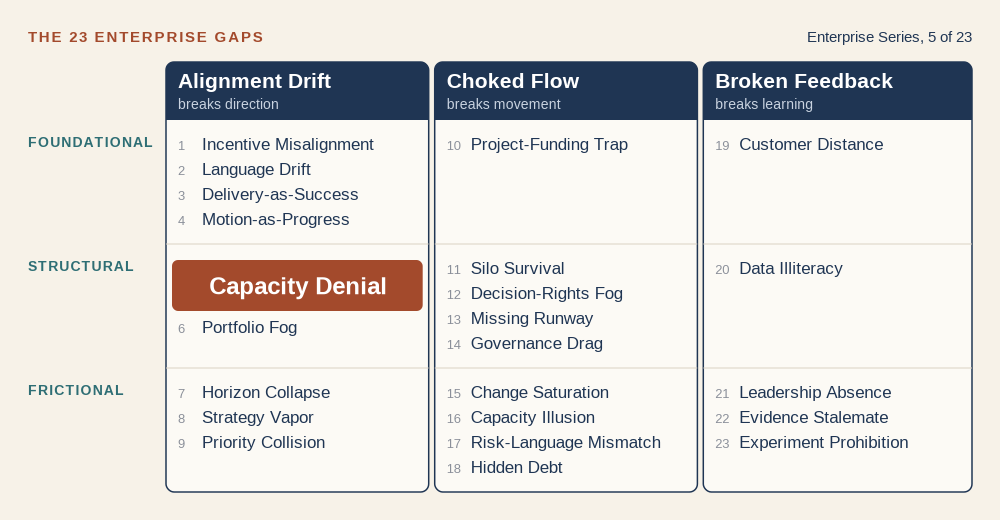
Capacity Denial
The quarterly portfolio review approves a new priority, and its sponsor asks the teams to find the capacity. Nothing comes off the list to make room. Next quarter the review approves another. The teams get busier, and less of their work finishes.
Definition
Capacity Denial means the portfolio adds work for teams whose time is already committed, without removing any existing work, as if capacity stretched to fit whatever was approved.
An organization with real slack can add work for a while without displacing anything. The gap is the habit of adding as if the slack never ran out.
Without slack, the choice of what gives way is only deferred, to the teams and team leads who inherit it.
The recognition pattern
Look at the portfolio forum’s decisions:
- New initiatives launch with a call to “find the capacity,” while the work already under way continues unchanged.
- Each portfolio review adds priorities and never removes one.
- A team’s allocations across initiatives add up to well over 100 percent.
- Cycle time, the time from start to finish, stretches as more work gets started. Throughput, the rate at which work finishes, stays flat.
- “Do both” is the standard answer when sponsors compete for the same people.
One sign proves little. Several at once are a reason to check what the forum has actually removed.
The choice gets made anyway
A competitor launches a feature. A large customer asks for a new capability. A market shift demands a response. Each comes with a sponsor and a good case and is weighed on its own. So the question in the room is whether to approve the new work, not what it replaces.
The reassurance is that teams will find a way. Teams can push hard for a while, and some efficiency can be found. That limited truth is why the reassurance survives.
Taking something off the list is harder. Saying “this instead of that” means someone’s commitment gives way: an initiative waits, a budget shrinks, a sponsor hears “not now.” Adding postpones that conversation.
So the new work is approved and starts alongside everything already running. Teams split their time across more work in progress: work started and not yet finished. Everything moves a little. The forum may rank its initiatives, but it never says what gives way, so the ranking cannot settle the competing claims on the same people. Team leads settle them case by case. A team lead pulled between sponsors weighs the ranking against blockages, escalations and whoever pushes hardest. Higher-ranked work often loses time to whatever is least blocked or most loudly escalated.
Spreading the same people across more work has a price in time. Little’s Law makes the cost exact: with throughput the same, if the average amount of work in progress doubles, the average time to finish a piece of work doubles too. Moving people between initiatives can lower throughput as well, which would make the stretch worse.
What it costs
Value arrives later than planned, though everyone stays busy and the organization looks productive.
The ability to respond shrinks too. When the teams are fully booked, the next urgent opportunity competes with everything already committed for the same people. Its window can close before anyone is free to take it on.
And people stop investing in the next change. Initiatives that start and never finish teach them that waiting outlasts any priority. That lesson feeds Transformation Fatigue, one of the enterprise amplifiers. The fatigue leaves little energy for the day the organization does prioritize well.
In the Vicious Cycle, Capacity Denial feeds Overload, the arc where demand exceeds capacity and flow chokes.
Boundaries and distinctions
Portfolio Fog hides the overload. Capacity Denial creates it. Fog is also part of why the adding continues.
Latency Load is the rechecking, coordination and catch-up that pile up while work waits. Latency Load starts from the condition Capacity Denial produces: more work in motion at once than unchanged capacity can carry.
Capacity Denial sets up Capacity Illusion. Capacity Denial treats capacity as unlimited. Capacity Illusion treats the shortfall that follows as a headcount problem. Hiring cannot close a shortfall made by commitments that keep growing.
Ambition is not the problem. A portfolio can aim at ambitious outcomes and still keep the work under way at once within the capacity behind it. The gap is a portfolio that can only grow, because nothing ever comes off it.
Example
An illustration, by construction. A quarterly portfolio review approves a partner integration to support a large deal. Its sponsor asks the platform teams to fit it in. Nothing is removed: a billing migration and a reporting rebuild stay on the list. By the next quarter, the integration has part of each team’s time, and the migration has slipped. Nobody at the review chose that. A team lead did, caught between the integration’s sponsor and the migration’s sponsor, both escalating in the same week. The lead moved the migration’s testing back to keep the integration moving. The reporting rebuild slowed without anyone deciding it should. At the following review, the integration, the migration and the rebuild are all late, and the discussion turns to execution and whether the teams need more people.
Applied Test: what did the last addition displace?
Pull the decisions from your last three portfolio planning sessions. Count the times leadership explicitly stopped, defunded or delayed existing work to make room for something new, as Applied End-to-End Flow: Enterprise asks. Count only decisions that freed the people or time the new work needed, not a reshuffle elsewhere. A count of zero is the book’s sign of this gap, provided the teams had no slack left when the work was added. A higher count does not clear the portfolio, because one explicit trade-off can sit beside several additions that had none.
Then take the most recent addition. Name what it displaced, who decided that, and when. If nobody can answer, no identifiable decision was made in the room. An empty answer is not proof that anything was displaced. Look at which work has since lost people, time or its place in the sequence, and whether the change traces back to the addition. Slippage alone does not show that the addition caused it.
Three sessions and one traced addition are a sample of how the forum decides, not a verdict on the whole portfolio.
Sources and lineage
Capacity Denial is an Applied End-to-End Flow concept developed by Curtis Hibbs and Joshua Barnes. Its framework treatment comes from Applied End-to-End Flow: Enterprise, in the Alignment Drift barrier, where it compounds Capacity Illusion, reinforces Portfolio Fog, and feeds the Overload arc of the Vicious Cycle. The queueing relation is from John D. C. Little, “A Proof for the Queuing Formula: L = λW” (Operations Research, 1961).
Curtis Hibbs and Joshua Barnes are co-creators of Effective Enterprise AI and Applied End-to-End Flow, and co-authors of the Applied End-to-End Flow book series. Their work combines enterprise diagnosis, value-delivery mechanics, and practical intervention patterns across strategy, portfolios, value streams, and teams.