Altitude: Enterprise Frictional Gap
Horizon Collapse
Three weeks into the quarter, a team finds that its plan won't achieve the result it was meant for. The team reports the finding and is told the plan is locked for the quarter. So it writes the finding down for next quarter's planning and carries on with the plan.
Definition
Horizon Collapse means commitments are fixed for the whole planning horizon, so what the teams learn inside it cannot change the plan until the next planning cycle.
The planning horizon is the period a commitment covers, often a quarter. The planning cycle is the recurring round of planning, and its next session is the first chance to change the plan.
A long horizon is not the gap. Boards, customers and partners need commitments they can rely on. The gap is that the next planning cycle comes only when the horizon ends.
The recognition pattern
Watch what happens to new evidence between one planning cycle and the next:
- Proposals for a mid-quarter change of plan meet “we already committed to the board.”
- Teams keep executing plans they say are out of date, because the quarter is locked.
- Roadmaps reach twelve months ahead with no decision points along the way.
- Each round of team planning lines up with the quarterly plan, even when recent evidence suggests a different direction.
- Retrospectives reveal that teams knew in the first few weeks that the plan wouldn’t work, and that they couldn’t change it.
Any one of these can have other causes.
The plan becomes the promise
Boards think in quarters and fiscal years. Strategy is set in annual roadmaps. Teams work week to week. Markets move on their own schedule.
A board needs return expectations. Sales needs commitments to close deals. Partners need delivery windows to schedule their own work. So leadership commits for the quarter.
The commitment reaches the teams as a plan: what to build, in what order, by when. From then on, status reports and quarterly reviews measure each initiative against the plan. Being on plan now counts as keeping the commitment.
Teams learn week by week, so evidence that the plan is wrong can arrive by the third week. At that point, changing the plan means going back to the people who received the commitment to explain why. That can sound like admitting the original plan was wrong. A forecast or business case built on the plan must be reopened too. In the status report, staying on plan looks fine until the quarter ends, while a change of plan shows at once as a departure from what was promised.
The evidence goes into the retrospective, the risk log and the notes for the next planning cycle, and waits there.
None of this requires anyone to be careless: each step answers a real pressure.
What it costs
Until the next planning cycle, the work follows the evidence the plan was built on, not the newer findings. Meanwhile, an opportunity those findings pointed to can pass: a buyer signs with someone else.
Teams can ship work that customers no longer need, because the work was on the roadmap.
By the next planning cycle, the findings are months old, so the next plan may start from evidence that needs rechecking.
In the Vicious Cycle, Horizon Collapse feeds Wrong Sequence, when evidence says the work is in the wrong order and the order holds. It also feeds Delayed Learning: the evidence arrives in time, but the organization’s behavior changes only when the horizon ends.
Boundaries and distinctions
The Strategic Cadence Trap asks who may reopen a strategic commitment, and when. That Insight works through one commitment and gives a check for it. This page stays with why the plan hardens and where the findings go.
Under Delivery-as-Success, a change of plan on evidence counts as a miss. Under Horizon Collapse, the same evidence may be welcome and still have to wait for the next planning cycle. Together the two gaps make staying on plan the safe choice twice over.
We read Priority Collision as the opposite failure. There, an executive’s opinion can outweigh the analysis when the plan is set or reordered. Here, the evidence cannot reorder the plan until the horizon ends. One portfolio can have both.
Horizon Collapse enables Strategy Vapor, a strategy too broad to guide what teams build. A broad strategy gets concrete when what teams learn changes the work. Inside the horizon, nothing they find can change the work, so the strategy stays as broad as it was when the plan was set.
Stability is not the problem. The gap is a plan that no evidence can change until the horizon ends.
Example
An illustration, by construction. A software company tells its board it will redesign customer onboarding this quarter to win a new segment. That commitment comes with a revenue projection. A team gets the redesign as its plan for the quarter. In week four, the team’s first customer interviews show that onboarding is not what keeps these customers from buying. What stops them is that the product doesn’t connect to their warehouse systems. The team raises the finding, and the program lead takes it to the initiative’s sponsor. The sponsor answers that the board approved the redesign and its projection, and that a warehouse integration can be proposed for next quarter. The team records the finding in its retrospective. The redesign ships on time, and sales in the segment barely move. At the next planning cycle, the warehouse integration is on the list. By then, two of the prospects in the projection have signed with a competitor that already offers that integration.
Applied Test: what did last quarter’s learning reach?
Applied End-to-End Flow: Enterprise asks how many changes of plan you made last quarter on new evidence. Count a change of plan only if, inside the quarter, a finding from the teams changed the scope, order or staffing of committed work. The book reads zero as one of two things: the teams learned nothing material, or the horizon kept anyone from acting on what they learned. There is a third explanation the book does not name: the findings were weighed and judged not to call for a change.
Pull that quarter’s retrospectives, risk logs and team planning notes. These records help tell which explanation fits. List each finding that suggested a change of plan, whatever was decided about it. For each, write down whether it reached someone who could change the plan, when, what they decided, and the reason given.
If these records hold no such finding, that shows only that none was written there, not that nothing material was learned. Before concluding that nothing material was learned, check where else findings get written down, such as decision papers and email. Look for two kinds of finding: those that never reached anyone who could change the plan, and those deferred because the plan was locked for the quarter. Keeping the plan can be the right decision when a finding was weighed on its merits. The reason given is where to see whether the finding was weighed or deferred.
Sources and lineage
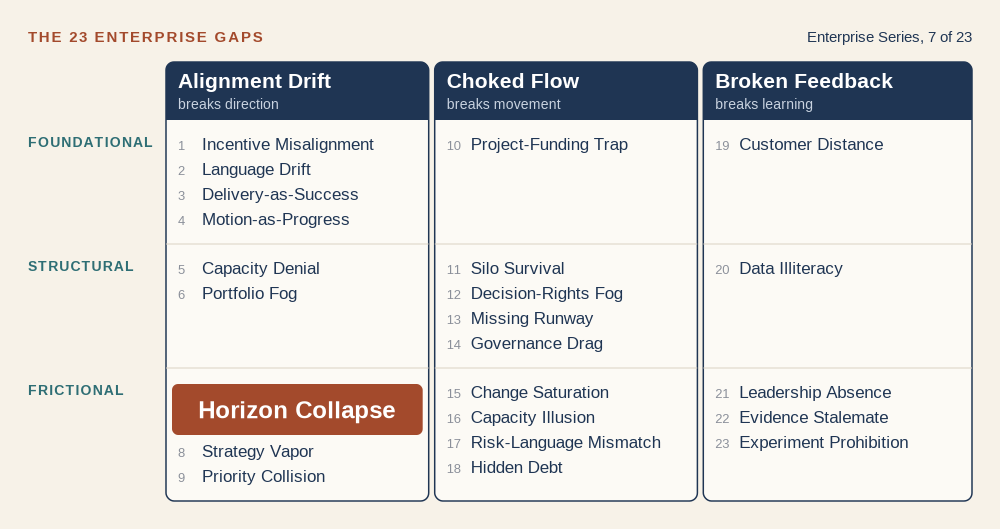
Horizon Collapse is an Applied End-to-End Flow concept developed by Curtis Hibbs and Joshua Barnes. Its framework treatment comes from Applied End-to-End Flow: Enterprise, in the Alignment Drift barrier, where it enables Strategy Vapor, compounds Delivery-as-Success, and feeds the Wrong Sequence and Delayed Learning arcs of the Vicious Cycle.
Curtis Hibbs and Joshua Barnes are co-creators of Effective Enterprise AI and Applied End-to-End Flow, and co-authors of the Applied End-to-End Flow book series. Their work combines enterprise diagnosis, value-delivery mechanics, and practical intervention patterns across strategy, portfolios, value streams, and teams.