Altitude: Team Alignment Drift Gap
Proxy Trap
A developer asks who a new item is for, and what that customer does today without it. The answer names who asked for it, not a customer. The product manager had the request from an account manager, who heard it on a call. Nobody along that chain has watched a customer at work.
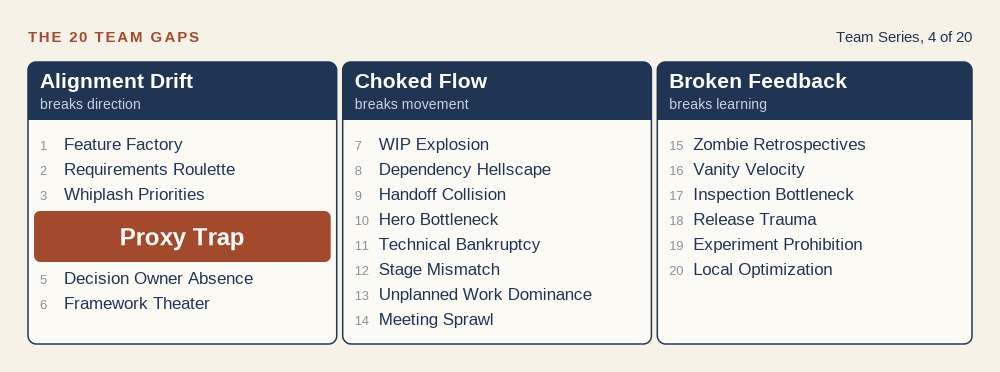
Definition
Proxy Trap means the team builds from requirements passed to it by people far from the customer, and the requirements don’t show what they rest on. So the team cannot tell which ones rest on what customers actually do and which rest on an assumption.
The team effectively builds for a persona, someone else’s picture of a customer type, written or not. A team that never sees the customers behind the persona can’t check it against what they do.
The recognition pattern
- Requirements name a solution, never the customer problem it solves.
- Nobody on the team could describe a real customer’s workflow if asked.
- “Customer feedback” means a stakeholder’s summary, not anything the team saw or heard.
- User research happens upstream, if at all, and its findings never reach the team.
- Assumptions about what customers need go untested, because the team has no customer to check them with.
Several at once suggest the team builds from someone else’s picture of the customer.
A guess and a need look the same
Sales protects its relationships. Customer success owns the account. Customers tire of surveys. Each makes sense on its own. None is meant to keep the team out, yet the team itself seldom sees a customer. What the team learns about customers comes through a proxy: anyone who speaks for the customer to the team, such as a product manager, an account manager, an analyst or a business stakeholder.
A product manager sifts feedback so the team isn’t buried in noise, and sifting has to drop detail the team may need.
A requirement also doesn’t show what it rests on. “Customers need a faster way to reschedule” reads the same whether someone watched customers struggle, an account manager heard it once, or someone assumed it. A requirement built on a guess and one built on a need someone saw look the same when they reach the team.
Nothing in the team’s intake screens out a requirement for lacking first-hand evidence, and the team never sees how customers actually do the work, so it has nothing to check either kind against. With nothing else to go on, building what arrives is reasonable.
The team also can’t see what nobody wrote down: the workaround a customer uses every day, the step customers skip, the need nobody thought to turn into a requirement. A team that watches customers has a chance to notice these.
What it costs
Unless someone compares a requirement with the customer’s work first, a miss shows only when customers use the result. The team finds it then, if at all: as rework, or as a feature that leaves the problem where it was. Even then, the miss doesn’t show that the requirement rested on an assumption.
The needs nobody wrote down never reach the backlog.
In the Vicious Cycle, where gaps in one barrier feed gaps in the next, Proxy Trap feeds Wrong Work: a requirement written far from customers sends finished work back when it gets the customer’s problem wrong.
It costs motivation too: building for someone else’s picture of a customer is less motivating than building for customers the team has seen.
Boundaries and distinctions
Feature Factory loses sight of the result. There, nobody learns what a release changed for customers. Here the problem starts earlier, in the requirement. The two can run together.
Requirements Roulette never sets the finish line. There, nobody can say when an item is done. Here the finish line can be precise, and the item still misses what customers needed.
Experiment Prohibition blocks a small test. There, the test can’t get approved, because it must clear approvals meant for permanent changes. Here the team has no customer to check an assumption with. Both can apply at once.
A proxy is not the problem. One can arrange an observation, bring back a recording or quote a customer word for word, and so give the team a way to check. The trap is when the team can’t see what a requirement rests on and can’t see a customer itself.
Example
An illustration, by construction. The customer is a home-care agency, but the people whose work the team needs to see are its scheduler and caregivers. When a caregiver calls in sick, the scheduler has to find someone to take each visit: a caregiver who is free, nearby and approved for the client, the person receiving care. She does it by phone, from a spreadsheet.
Support tickets say “Rescheduling takes forever.” Customer success tells the account manager that customers want faster rescheduling, and a large agency mentions drag-and-drop. The product manager who works with the team writes the requirement: drag a visit from one caregiver’s calendar to another’s, with clear acceptance criteria. The team builds it well, in four weeks.
After the release, schedulers drag visits, but rescheduling takes as long as before. The calendar shows who is free, not who is approved for the client, so finding a replacement still means the phone and the spreadsheet. Support tickets keep coming.
In the same weeks, the team built a printable visit sheet after the same product manager watched caregivers start a shift. It is used every day. The two backlog items used the same template: a title, a description, acceptance criteria. Nothing on either said what it rested on. Nobody had watched, interviewed or otherwise studied the scheduler at work, so nobody compared the drag-and-drop solution with what she does. Asking her what she does today when a caregiver calls in sick would have pointed there.
Applied Test: who last watched a customer
Applied End-to-End Flow: Team asks when someone on your team last directly observed a real customer use your product, or struggle with the problem it addresses.
- Answer the book’s question with a date, who watched, and how. Contact that showed neither use nor struggle doesn’t count. “Never” and “unsure” are answers.
- Then trace last iteration’s finished items: list each with the customer problem it solves, or “unknown”. Set aside items known to solve no customer problem on their own, such as an upgrade or an enabling change.
- For each remaining item, ask whoever shaped it what it rested on. Ask first what any “unknown” item was for. Did anyone have first-hand evidence of customers having the problem in their own work, not just asking for a feature? Evidence can be an observation, interview, recording, usage data or a customer’s own words, quoted or in a support ticket, not a stakeholder’s summary. Did anyone compare the solution with how customers do the work? Record each answer, or “unknown”. Don’t answer for them.
- Mark any item that has already come back as rework or as “not what they meant”.
- For the escalation in “Whose move it is”, keep step 1’s answer (does the team see customers itself?), step 3’s answers (was each item shaped on first-hand evidence and checked against how customers work?) and any rework item that came back because the requirement missed what customers do.
As far as the people you asked know, the result shows which items rested on first-hand evidence and were checked against the work. Missing evidence doesn’t show an item was wrong: assumptions can be right.
Whose move it is
Within the team’s control. Ask of each requirement, with curiosity rather than challenge: “Help me understand the customer problem this solves. What are they doing today? What changes for them when this ships?” Sometimes the proxy has the answer. Sometimes the question shows that nobody knows. Ask the people who manage customer contact to let the team sit in on customer success calls and support conversations. A request to watch, not to start conversations or manage the relationship, is often easier to grant. Ask to read whatever unfiltered feedback channel exists. Use the product the way a customer would.
Requires escalation. Go to whoever now controls customer contact, such as the head of customer success or of product. Ask for standing ways to see customers: a regular session to watch them at work, a feed of support tickets, a seat in customer interviews. Frame the ask around delivery quality: “We’re building from third-hand information. Here’s one case where that led to rework.” Before using a rework item from step 4, ask why it came back. Use it only if the requirement missed what customers do. If none qualifies, make the case from what the Applied Test found: the items with no first-hand evidence, and one question about customers that nobody could answer.
If the leaders who set product direction also see customers only through layers of filtering and summary, the enterprise gap Customer Distance sits above this one. If they see customers directly, it doesn’t.
Check where the constraint sits before you choose either move. If the team has never asked to observe, that is the team’s to change. A policy on who may contact customers sits above the team. Altitude Error explains the check.
Sources and lineage
Proxy Trap is an Applied End-to-End Flow concept developed by Curtis Hibbs and Joshua Barnes. Its framework treatment comes from Applied End-to-End Flow: Team, in the Alignment Drift barrier, where it is one of the three gaps that corrupt the signal before it reaches the team, escalates as Customer Distance, and feeds the Vicious Cycle through Wrong Work.
Curtis Hibbs and Joshua Barnes are co-creators of Effective Enterprise AI and Applied End-to-End Flow, and co-authors of the Applied End-to-End Flow book series. Their work combines enterprise diagnosis, value-delivery mechanics, and practical intervention patterns across strategy, portfolios, value streams, and teams.