Altitude: Team Alignment Drift Gap
Whiplash Priorities
A stakeholder asks why the urgent request they made weeks ago still isn't done. The team started work on it the day it arrived. Then the next urgent request went ahead of it, and another went ahead of that one. Everything on the board has been started. Almost none of it is done.
Definition
Whiplash Priorities means the team’s top priority keeps changing before the team can finish what it started.
Each request that is set down keeps its top-priority label. Soon everything carries it, and the label no longer says what to work on first.
The recognition pattern
- The iteration goal is replaced partway through, sometimes more than once.
- Everything is labeled “Priority #1”, “urgent” or “critical”.
- Requests arrive through side channels: a direct message, an email, a word in the hallway, anything that doesn’t come through the backlog.
- People switch context all day, because their work stops being the top priority before it is done.
- The team starts many things and finishes few.
Any one of these has other explanations. Together, iteration after iteration, they suggest the order of work is changing faster than the team can deliver.
Nothing stays important long enough to finish
Suppose an item needs eight working days and the top priority changes every three. The item is set down before it is done, and so is the item that replaced it. The first item gets more time only when nothing newer is on top, and newer requests keep arriving.
A set-down item waits, and picking it back up can also cost time: someone has to remember where it stood and redo the plan. The more often the top priority changes, the more items wait, and the more of them pay that cost.
Each new top priority starts as a request from someone with a real need. Usually, nobody above the team holds the job of saying which request waits. That leaves protecting the iteration to the team lead, who lacks either the authority or the backing to refuse. Telling one colleague their work waits while another’s goes ahead creates friction, and saying yes avoids it. So the request goes in, at the top. No single yes is the problem; the sum of them is. Where someone above the team does decide but keeps changing the order, the effect on the work is the same.
A requester who sees only their own item sees it running late. They don’t see what pushed it back, or what it pushed back.
What it costs
Less work finishes. A dashboard that counts finished work doesn’t show the time lost to each change, so stakeholders see a team that seems slow.
Work in progress (work started and not yet finished) piles up and has usually delivered nothing. Cycle time (the time from start to finish) stretches, requests age, and some items never get enough time to finish. Waiting items also collect Latency Load: status requests, re-planning and other work of their own.
In the Vicious Cycle, Whiplash Priorities feeds Wrong Sequence: valid work in the wrong order, set by who asked most recently rather than by value or dependency. It also feeds Overload, because urgent work is added and none is removed.
Boundaries and distinctions
Under Unplanned Work Dominance, the priorities hold, but incidents and support requests use up the time to work on them. Here the priorities themselves keep changing. A single incident can do both.
WIP Explosion is too much in progress, whatever put it there. Whiplash Priorities is one way in, but a team with a stable goal can still start too much.
Requirements Roulette starts an item with no clear finish line. Here the finish line can be clear, and the team is pulled off before reaching it.
Capacity Denial adds work at the portfolio level and removes none. Here the order of the team’s work keeps changing. Capacity Denial can produce Whiplash Priorities when the added work goes ahead of unfinished work.
A real change of priority is not the problem. An outage or a customer about to leave can rightly displace the plan. A single change is a decision when someone with the authority says what waits. Whoever asked for the waiting work should then be told. Whiplash Priorities is a pattern: changes that keep coming sooner than the work can be finished, mostly with nobody saying what waits.
Example
An illustration, by construction. Two developers work as a pair through a two-week iteration. Its goal is to build a bulk upload feature, which needs eight working days with both developers on it. Two days in, the head of sales needs a five-day custom report for a renewal meeting, and it goes ahead of the upload. Partway through the report, after a customer complaint, the operations director says a four-day fix to an export format is critical. The fix goes ahead of the report. Before the fix is done, the head of sales asks about the report, and it goes back on top. Each switch takes about half a day to recover from.
After ten working days, none of the three items is finished. The upload has had two of its eight days, the report is a day short and the fix a day and a half short. Uninterrupted, the upload would have been done on the eighth day.
Applied Test: what changed, and what it displaced
Applied End-to-End Flow: Team asks how many times your iteration goal changed during your last iteration, and who authorized those changes.
- Write down the iteration goal as it stood on the first day. Then list every change to the order of work: the goal is replaced or set aside, an item is added, or an item is moved ahead of another. That includes an item put back on top. Flag the changes to the goal itself: they answer the book’s question.
- For each change, note who authorized it (“nobody” is an answer) and whether it came through the backlog. Then note what waited to make room: a named item, “nothing had to wait” or “not stated.”
- Mark each change “decided” if someone with the authority said what would wait, “undecided” if nobody did, and “unsure” if you can’t tell. If nothing had to wait, no trade-off was needed: leave that change unmarked. Decided changes that still come sooner than the work can finish are worth showing to whoever decided them, with what each one displaced.
- Count the items started during the iteration and how many of them were finished by its end. State both (“three of eight”): that is the team’s completion rate. Keep work carried in from earlier iterations out of both counts, and list it separately.
- Note how many changes you marked “unsure.” The marked list and the counts show a pattern worth raising, not how much of the work was left unfinished because of the changes.
One iteration is a single reading. The evidence is for raising the pattern, not judging the people it names.
Whose move it is
Within the team’s control. When a request arrives mid-iteration, answer: “We can take this on. What should we drop?” Ask it every time. The answer you need is a named item that will wait. If the team sets its own order of work, it carries on with what is in progress until someone answers. If the requester can’t answer because the work that would wait is someone else’s, take the question to whoever set the iteration goal. Record each mid-iteration change and what it displaced, where stakeholders can see it. Where the team controls what starts, limit what it has in progress and finish an item before starting another.
Requires escalation. Lasting improvement needs someone to decide which request waits. That person needs authority to rank the requests that stakeholders send to the team, in an order those stakeholders have to accept. The owner may be whoever set the iteration goal, or the manager those stakeholders share. If nobody holds that authority, ask for someone to be given it. Ask that person for two standing rules: a single channel for requests, and a trade-off conversation before any mid-iteration addition. Frame the case around completion rate: “We started eight items last iteration. We finished three.” Then bring several iterations of the Applied Test, each count beside its list of changes. The count shows how little got finished; the list shows what interrupted the work.
Above the team, either name may apply, or both:
- Priority Collision, when the order among competing requests is set by whoever pushes hardest rather than by a decision about value.
- Capacity Denial, when the requests trace back to a portfolio that adds work for already committed teams and removes none.
Before acting within the team or escalating, check where the changes come from. The team’s own reordering is the team’s to stop. Changes from outside need someone above the team to stop them. Altitude Error covers this check in full.
Sources and lineage
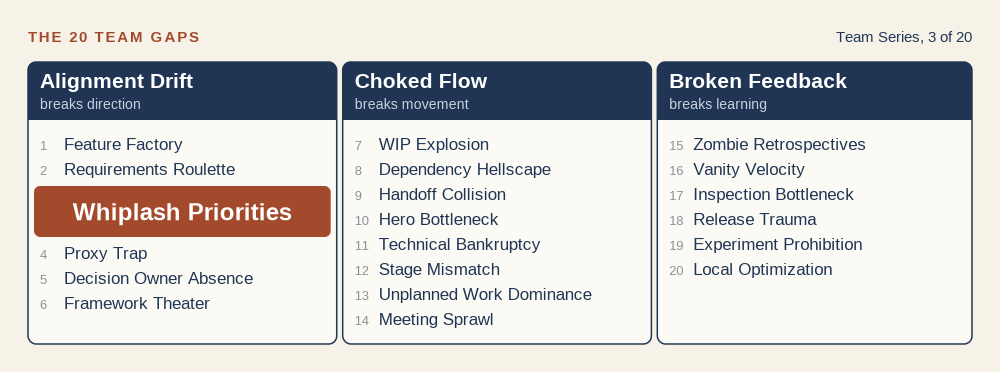
Whiplash Priorities is an Applied End-to-End Flow concept developed by Curtis Hibbs and Joshua Barnes. Its framework treatment comes from Applied End-to-End Flow: Team, in the Alignment Drift barrier, where it is one of the three gaps that corrupt the signal before it reaches the team, escalates as Priority Collision, and feeds the Vicious Cycle through Wrong Sequence and Overload.
Curtis Hibbs and Joshua Barnes are co-creators of Effective Enterprise AI and Applied End-to-End Flow, and co-authors of the Applied End-to-End Flow book series. Their work combines enterprise diagnosis, value-delivery mechanics, and practical intervention patterns across strategy, portfolios, value streams, and teams.