Altitude: Team Alignment Drift Gap
Requirements Roulette
At the review, the team shows an item it believes is finished. The person who asked for it says it's almost right, then names something nobody mentioned in planning. The item goes back to In Progress. On the board, the team hasn't finished it.
Definition
Requirements Roulette means an item goes into the iteration without acceptance criteria clear enough to tell when the item is done. Acceptance criteria are what has to be true for the item to count as done.
The criteria still get settled, but at review. They surface in the reasons the item is sent back. Each time, the team pays by rebuilding work it had finished.
The recognition pattern
- Acceptance criteria are missing or vague, or they change after work begins.
- “I’ll know it when I see it” passes for a specification.
- The same item moves from Done back to In Progress more than once.
- Reviews turn up requirements nobody mentioned in planning.
- The team pads its estimates to absorb the rework it expects.
Several at once suggest a finish line drawn after the race began. Criteria that change because of something learned while building don’t count here.
Who pays for a vague requirement
The person asking for the work often has a picture of it, not a specification. Turning that picture into acceptance criteria takes time and skill. A loose description takes minutes and, to someone who can see the picture, feels complete. Requirements also stay vague when stakeholders join late, when nobody settles criteria up front, or when the decision-maker is unavailable.
The team goes along, because pushing back feels adversarial and some teams have no say over what they start. So work starts with open questions that everyone hopes won’t matter. The ones that bear on acceptance turn up at review, unless someone answers them during the build.
Take a criterion the requester could have stated before work began. Settling it at planning usually costs a conversation. Settling it at review can cost a rebuild of finished work. Leaving it loose saves time up front. The team pays for that later, out of effort planned for other work. The person who wrote the requirement sees a team that needed three tries. The team sees a requirement that was never complete.
None of this takes carelessness. The requester sees the item come back, but rarely sees how much effort the rebuild took or what it pushed aside. The team can make that cost visible. That won’t make criteria easier to write, but it gives the requester and team a reason to write them together.
What it costs
A rebuild uses effort that could have gone to new work. When that effort was reserved for other items in the iteration, commitments slip. And estimates mean less once they have to allow for rework nobody can predict. Stakeholders stop trusting the dates and label the team unreliable, though the problem began in the requirement.
In the Vicious Cycle, Requirements Roulette contributes to Wrong Work by sending work never specified clearly enough to build correctly, which comes back as rework.
Boundaries and distinctions
Proxy Trap starts with requirements written far from the customer. They can be precise and still miss the need. Here the requirement may target the right need, yet nobody can tell when the item is done.
Whiplash Priorities moves the goal. Mid-iteration, the team is pulled onto other work. Requirements Roulette occurs without any change of goal, when an item’s finish line was never set. Both can hit a team at once.
Decision Owner Absence leaves decisions waiting. Without someone who can decide, the team waits or guesses. That absence can cause this gap, but Requirements Roulette also happens with the requester in the room.
Language Drift gives a strategic term a different meaning at each layer. Requirements Roulette concerns an item whose criteria are missing or too loose to check.
Changing a requirement is not the problem. A need nobody could have stated until something was built is learning, not this gap, and neither is a deliberate change of scope. This gap is a condition the requester could have stated before work began, if anyone had asked. On the item, it was missing or too loose to check.
Example
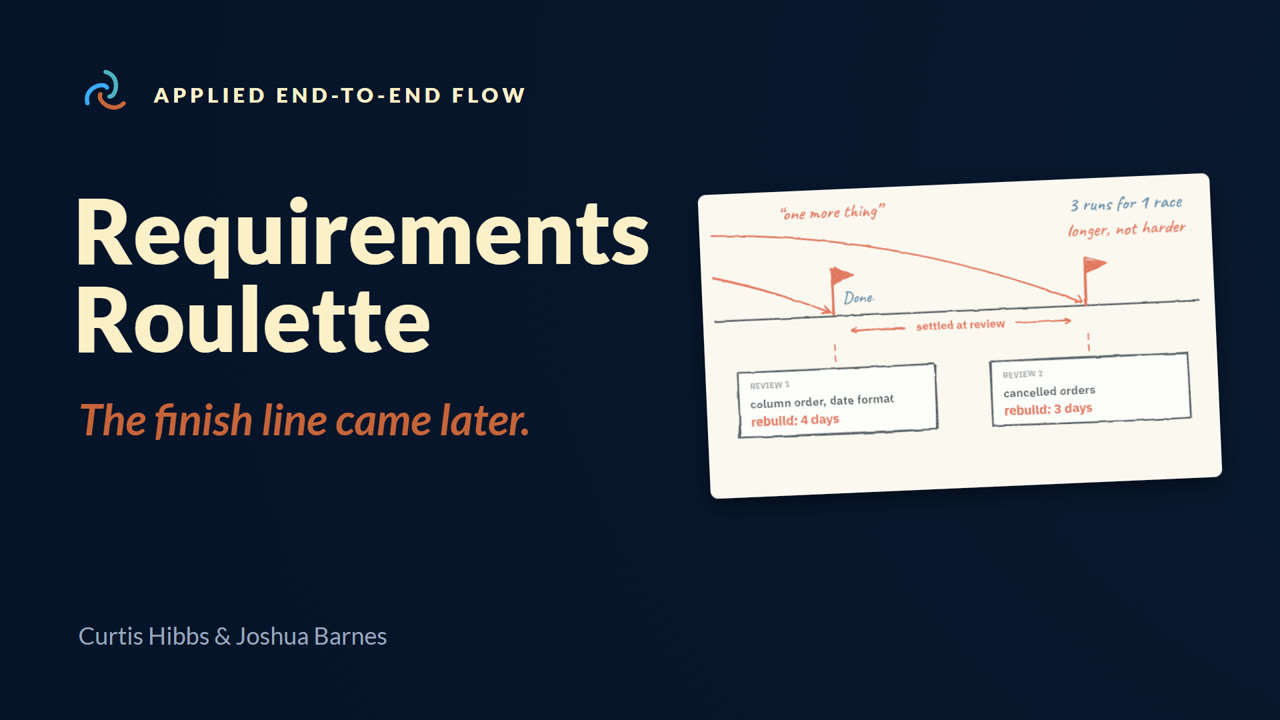
An illustration, by construction. An operations manager asks for a customer export “like the old one, but better.” The team recreates the old columns and adds filters. At the review, the manager explains that the file loads into the finance system, so column order and date format matter. The rebuild takes four days. At the next review, the export also has to include cancelled orders, which the old one left out. That takes three more days. Both criteria were in the manager’s head from the start, and neither was on the item. The iteration report shows the export late twice, with nothing about why. The team doubles its estimate for the next export.
Applied Test: what came back, and what it cost
What share of the items in your last iteration had clear, testable acceptance criteria before work began? Applied End-to-End Flow: Team asks that question.
- List the items your team started in the last iteration, with each one’s criteria as they stood at the start. Use the board’s history where it keeps one; mark an item “unsure” if its starting criteria are lost.
- Leaving out items marked “unsure,” note which ones had testable criteria: someone other than the requester could have checked them without asking. Their share answers the book’s question.
- For each item that came back from review, write what the review added or made precise.
- Put an addition on the cost list only if the requester could have stated it before work began, if anyone had asked. List the rest separately: a clear criterion the team missed, new scope, and anything nobody could have stated until something was built. Mark anything you can’t place “unsure” or “mixed”; it stays off the cost list.
- For each addition on the cost list, write roughly how much effort the rebuild took, in person-days.
- The cost list shows the rebuilds this gap caused, as far as the team can tell.
The test covers a single iteration and grades nobody.
Whose move it is
Within the team’s control. Before accepting an item, ask “How will we know this is done?” If the answer is vague, write the criteria yourselves and ask the requester to confirm them. Write down your assumptions too: “We’re assuming X. If that’s wrong, this comes back.” Once the requester confirms the written criteria, the item is judged against them, and anything added at review shows as an addition. The conversation turns to what was missing, not whether the team failed. If the team decides what it starts, decline an item whose finish line nobody can state. If someone else decides, take the item to them before work starts, with your draft criteria and open questions.
Requires escalation. Only whoever decides what enters the iteration can make testable criteria a standing rule for everyone who sends the team work. That may be a product owner, or the manager the requesters answer to. Take them the cost list. Frame the ask around throughput: these items came back, the rebuilds took this much effort, and the iteration plan shows what that effort was meant for. The list is the bill that rarely travels upstream.
If nobody can make the criteria testable, check whether the strategy behind the work ever became a plan. Above the team, a strategy that stayed a slogan is Strategy Vapor. Vague criteria have other sources, so use the name only then.
Before choosing a move, check whether the constraint sits with the team or above it (see Altitude Error).
Sources and lineage
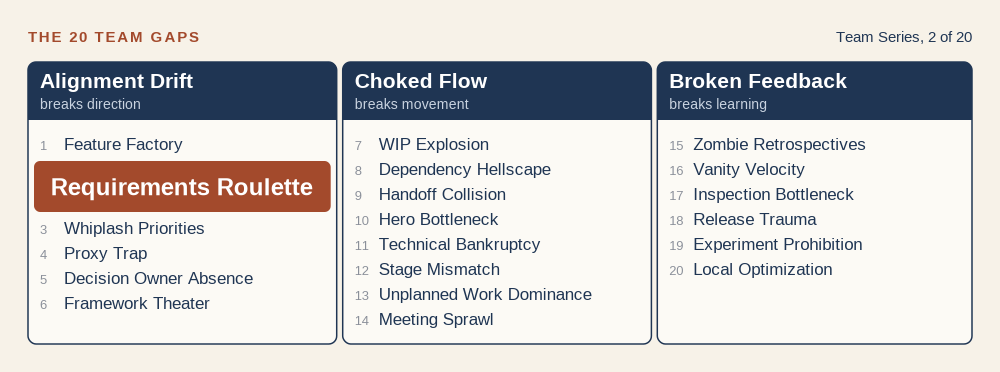
Requirements Roulette is an Applied End-to-End Flow concept developed by Curtis Hibbs and Joshua Barnes. Its framework treatment comes from Applied End-to-End Flow: Team, in the Alignment Drift barrier, where it is one of the three gaps that corrupt the signal before it reaches the team, escalates as Strategy Vapor when criteria cannot be made testable, and feeds the Vicious Cycle through Wrong Work.
Curtis Hibbs and Joshua Barnes are co-creators of Effective Enterprise AI and Applied End-to-End Flow, and co-authors of the Applied End-to-End Flow book series. Their work combines enterprise diagnosis, value-delivery mechanics, and practical intervention patterns across strategy, portfolios, value streams, and teams.