Altitude: Personal Alignment Drift Dysfunction
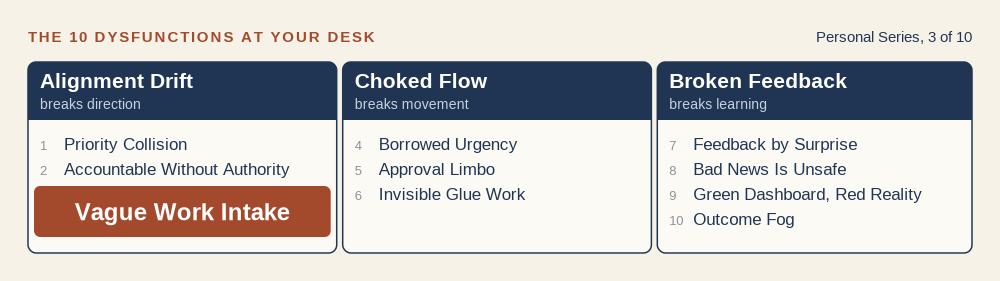
Vague Work Intake
The ask comes as a single sentence, and you do exactly what it says. At the review, you find out what the sender wanted. Days later you redo the work, after first reminding yourself where it stood.
Definition
Vague Work Intake means work arrives without enough definition to start.
Either of two things can be missing, or both: what done looks like, and who answers the questions that come up. A short ask is fine when neither is missing. “Done” means the form the finished work takes and what it is for.
The recognition pattern
Think back to the last piece of work you redid after a review.
- The ask came as a sentence or two, and nothing in it said what done looks like.
- At the review, after the work was finished, you found out what was wanted.
- You went back with questions more than once before you could get going, or guessed instead, or found nobody who could answer them.
- You redid the work days later.
- Going back got you “use your judgment,” and the review corrected your judgment.
One sign alone proves little. Several together suggest work judged against a definition of done you were never given, though a requirement that changed afterward shows some of the same signs and is told apart below.
How the mechanism works: a guess was all the ask allowed
When the sender has a picture of done and hasn’t put it into words, their sentence looks complete to them. Their picture fills in the rest. Nobody has to be careless for that to happen.
You build your own picture from the sentence alone, and at the review you find out whether yours matches theirs. The work came in as a sentence and was judged against requirements the sentence never stated.
You may be telling yourself “I should be able to figure this out.” A clarifying question can look junior, so you guess instead. A good guess feels like competence. A bad one feels like a personal failing.
But a guess was all the ask allowed, however senior you are. Working from the sentence alone, you could only guess, but a question back to the sender could have given you more.
Across the studies that Travis Tubre and Judith Collins analyzed, ambiguity about what is expected of someone in their role was more closely tied to lower performance than conflicting expectations were. The finding is about roles. We read an ask that doesn’t say what done looks like as the same ambiguity on one piece of work.
What is yours, what is inherited
Among the Alignment Drift dysfunctions, Vague Work Intake leaves the most in your hands. Three questions check your part:
- Did you clarify the ask before you took it on?
- Did you break the work down far enough to find the open questions?
- Did you seek feedback early, by showing a rough version before a polished one?
Restating what done looks like in your own words and getting a yes is how you clarify the ask. Where the ask didn’t say who answers questions, put a question alongside the restatement: who should you bring questions to?
What you inherited can include senders who won’t specify even when you go back, and workplaces that take a clarifying question as a sign you don’t know your job.
A skipped step belongs in the verdict only if it was open to you, and only if it would have caught the requirement you learned late. A restatement you skipped says nothing about a requirement that changed afterward.
- Mine: such a step was open, and you skipped it. That verdict is about a step, not your ability.
- System: you went back, heard “use your judgment” and redid the work, with no open step left unused.
- Mixed, the verdict to expect: a step you skipped and something you inherited both fed the rework. The inherited part is a sender who wouldn’t specify when you went back, or a step that wasn’t safe, not the vague ask itself.
- A step that wasn’t safe where you work wasn’t open to you. Keep the reason it wasn’t safe with your answers.
What it costs
- The same work, twice. The plan shows the work once, so the second pass takes its hours from whatever you should be doing now.
- The reload. When an unclear ask gets clarified in installments, each one pulls you back into work you had set aside.
- A cost only you see. If you keep your output up, nothing in it shows that the same work takes more out of you.
- The blame. Each bad guess can look like fresh proof of “I should be able to figure this out.”
Applied End-to-End Flow: Personal covers how these costs build on each other, in Chapter 6.
Boundaries and distinctions
Priority Collision starts with clear asks that can’t all be finished in time. Here a single ask arrives, and nobody has said what done looks like. Vague asks can also hide a collision: until they are defined, nobody can see that they need the same hours.
Feedback by Surprise is a late response to the work. Did the sender know the late requirement at the start, and would a question from you have brought it out? If yes to both, Vague Work Intake contributed. Could a response to the work have come sooner, if someone had seen it earlier? If yes, Feedback by Surprise did. A single late requirement can be both.
A requirement that changed also arrives late. It wasn’t left out of the ask, so it sits outside this dysfunction, and agreeing on what done looks like wouldn’t have caught it.
Requirements Roulette, the team gap, is Vague Work Intake one level up. There, an item reaches a team’s iteration with no agreed way to tell when it is done. Here, an ask reaches one person. If the ask reached you through an item your team accepted, start with the team’s page.
Example
An illustration, by construction. On March 2, the head of customer support sends a support operations specialist this ask: “Can you pull together something on why refunds are up?” On March 6, the specialist sends back a spreadsheet showing which products and months the rise came from. At the review on March 9, the specialist learns what the head of customer support had taken for granted. A question on March 2 would have brought all of it out. On March 10, the agenda changes for the leadership meeting the work is for, adding one more requirement.
The record of this piece of work:
- The ask, as sent on March 2: “Can you pull together something on why refunds are up?”
- Expected, as learned at the review on March 9: one page with a recommendation, for the leadership meeting on the 12th.
- Trips back for clarification before starting: none.
- Learned late, March 9: one page, a recommendation, the meeting. Left out of the ask.
- Learned late, March 10: a comparison with last year, added after the ask. Changed afterward.
- Restated what done looks like before starting: no. Nothing stopped the specialist from asking.
A restatement on March 2 would have caught the March 9 requirements but not the March 10 change. Leaving that restatement unsaid tips the March 9 verdict toward Mine.
Applied Test: the ask as it was sent
For the last piece of work you redid after a review, write a record:
- the ask, word for word as sent, beside what the review showed was expected;
- each trip back for clarification before you could get going, with who answered and what came back;
- each requirement you learned late, with the date it surfaced, marked “left out,” “changed afterward” or “unsure”;
- your answers to the three questions about your own part.
Mark a requirement “left out” only if the sender had it at the start and a question would have brought it out. Mark it “unsure” if you can’t tell.
One record gives a verdict on that piece of work, still to be tested. Keep the same record for each piece you redo over the next month; together they test it. If the pieces you redid for a left-out requirement are only ones where you skipped an open step, the verdict leans Mine. If they include pieces where you took every open step, the inherited part is real. Your count is how many pieces you redid because of a requirement marked “left out.” Requirements marked “unsure” or “changed afterward” stay out of the count.
Safety means what a question or a proposal would cost you in your workplace, not how a question feels. Surfacing Moves by Posture and Applied End-to-End Flow: Personal, Chapters 7 and 8, show how to judge it.
When the next ask arrives and Safety allows, restate what done looks like and get a yes before you start. Swap in your own details:
“So you want a one-page recommendation by the 20th, not edits?”
An intake agreement goes further: before you start, you and your senders settle who answers questions, when the work is needed and what done looks like. Check Safety before you propose one: it decides who hears the proposal first and how plainly to make it. If you propose it, name what the agreement covers, then give your count:
“Last month I redid four pieces because I learned the requirement at review. Could we try agreeing these three things before I start?”
If nobody adopts the agreement, restate each ask in writing, with the date: where Safety allows, to the sender; where it doesn’t, in your own record. A restatement with no reply isn’t a yes, so go ahead only on work you would have time to redo before it is needed and, where Safety allows, go back to the sender about the rest. Where going back isn’t safe, your dated restatement shows what you understood and when, not why a requirement differed later.
Sources and lineage
Vague Work Intake is one of the 10 dysfunctions in the Applied End-to-End Flow framework developed by Curtis Hibbs and Joshua Barnes. The complete treatment appears in Applied End-to-End Flow: Personal. The finding on ambiguity is from Travis C. Tubre and Judith M. Collins, “Jackson and Schuler (1985) Revisited: A Meta-Analysis of the Relationships Between Role Ambiguity, Role Conflict, and Job Performance” (Journal of Management, 2000).
Curtis Hibbs and Joshua Barnes are co-creators of Effective Enterprise AI and Applied End-to-End Flow, and co-authors of the Applied End-to-End Flow book series. Their work combines enterprise diagnosis, value-delivery mechanics, and practical intervention patterns across strategy, portfolios, value streams, and teams.