Altitude: Personal Alignment Drift Dysfunction
Accountable Without Authority
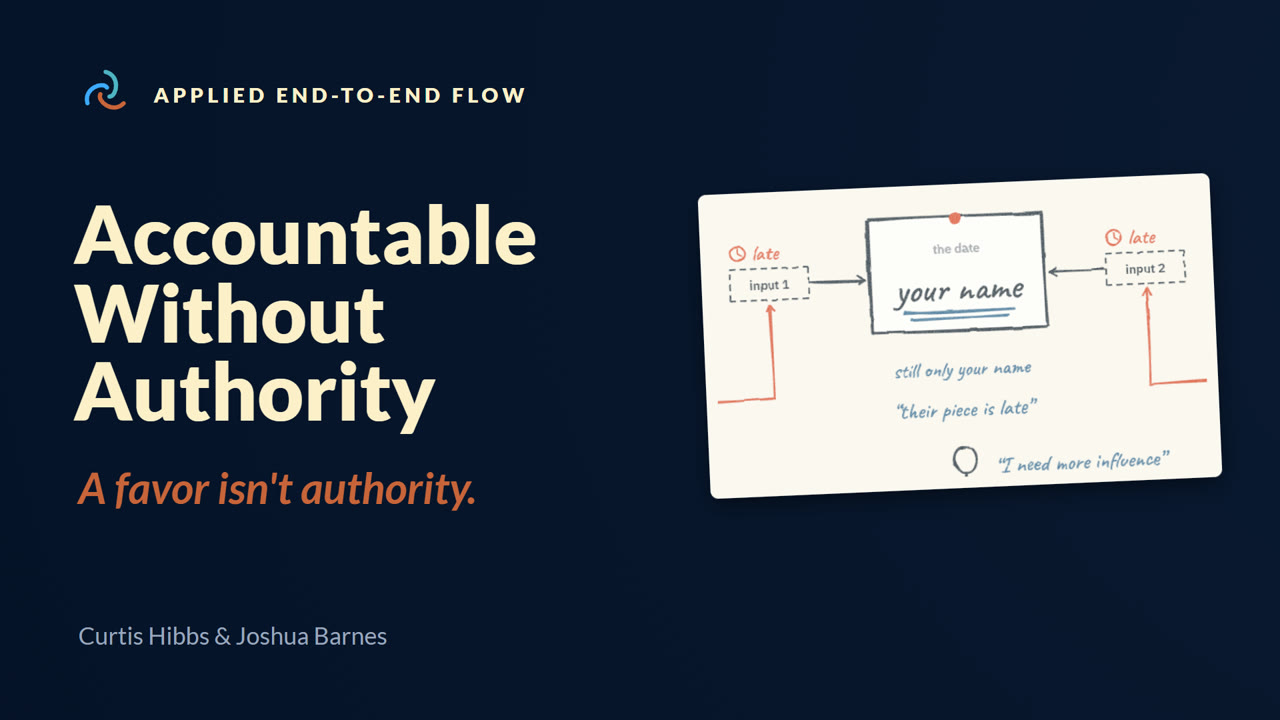
In the status meeting, you explain why someone else's piece of the work is late. But your name is on the date it's delaying, so you make up the lost days.
Definition
Accountable Without Authority means you answer for a result that depends on inputs and decisions you don’t control.
Depending on other people is ordinary. It becomes this dysfunction when you can neither decide what the result needs nor get dates you can plan on: ones the people who decide commit to, early enough for your result.
The mismatch can come with a single assignment or be built into the role. Either way, it lands on particular occasions with dates you can name.
The recognition pattern
Look at your latest result:
- Your name is on the date, and the inputs sit with people whose priorities you can’t set.
- You send a reminder, then follow up on it.
- You apologize for delays on work you had no power to direct.
- An input lands late, so you rush to make up the days, and errors you’d usually catch get through.
- Someone with the authority you lack reopens a choice you thought was closed, or commits you to something and tells you later.
Each sign on its own can have another cause.
How the mechanism works: a favor isn’t authority
You answer for the date. Other people make the decisions it depends on, and they rank what you need against their own work. An input can come late with everyone doing their job well. Then you chase.
The usual diagnosis is “I need more influence,” or more assertiveness, or better stakeholder management. Building those skills helps: some inputs do arrive sooner.
But influence that moves the input you need up someone’s list, and changes nothing else, gets you a favor. A favor can stop when its giver’s priorities shift. Influence that wins you the right to decide, or a date you can plan on, is different: it changes the arrangement. With a favor, you are still the only person held to the date, and you still can’t decide anything it depends on. So treating favors as the fix covers the mismatch with your effort.
Jobs that give people little say over how their work gets done tend to lower motivation and performance, in Hackman and Oldham’s research on job design. Extending it to decisions other people make is our inference: the chasing comes with the seat, and while the arrangement stands, whoever sits there next would have the same inputs to chase.
What is yours, what is inherited
Before this result reached you, someone had already settled who decides what. You inherited that split.
Your chances to act came when you accepted the commitment or learned of it, and again whenever a dependency surfaced or an agreed date proved too late. Did you name who owned each piece the result depended on? Did you ask for the right to decide, or ask the people who decide for dates you could plan on? And when neither came, did you say the result was out of reach and ask to renegotiate the scope?
Your answers suggest a verdict, and your record tests it. Count a step as skipped only if it was open to you and safe to take.
- Mine: the inputs and decisions were there when needed, or would have been if you had asked, and what went wrong traces to a step you skipped.
- Mixed: the inputs or decisions weren’t there when needed, and a step you skipped also connects to what went wrong.
- System: the same shortfall, and you skipped no step.
If your name went on the result before anyone asked you, clarifying first wasn’t open, but naming the dependencies and asking may still have been.
What it costs
- Decisions that won’t stay closed. You have to defend them again each time someone reopens them.
- Errors in the rushed work. Rushing to make up the days can let errors through.
- Your name on the miss. The miss counts against you and makes “I need more influence” look right.
- A cost the reports don’t show. Your evenings absorb the late input, the date is met, and nothing in the reports prompts a change.
Chapter 6 of Applied End-to-End Flow: Personal follows costs like these further.
Boundaries and distinctions
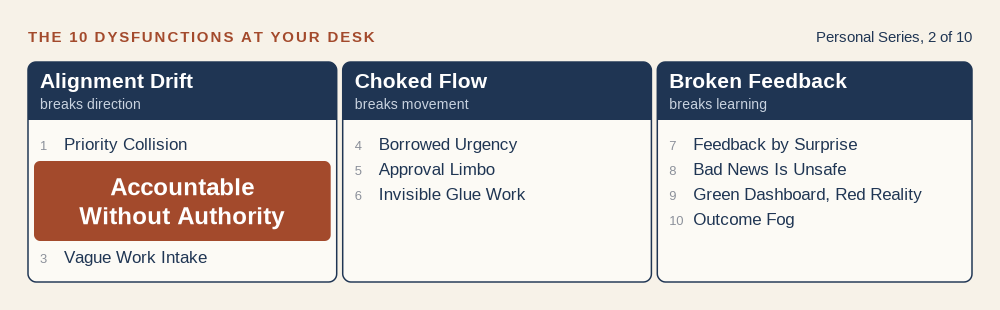
A Priority Collision can end in this dysfunction. The ask you ranked second misses its date, and you answer for a ranking that was never yours to make. But no collision is needed: a single manager can hold you to a result without the decisions it needs.
Under Borrowed Urgency, a late input shrinks the days you have. Here, others make the decisions and you answer for the result. The same late input can bring both; lateness alone doesn’t show this dysfunction.
Under Decision-Rights Fog, the enterprise gap, authority is unclear. Here, it can be clear and still not yours. Both can be true at once.
A dependency is not the dysfunction. The Definition says what else has to be true.
Example
An illustration, by construction. An events coordinator learns that a vice president has already announced the day that registration opens for the customer conference. Registration needs the marketing director to set ticket prices, then the web team to build the registration page. The next day, the coordinator asks for both and says when each is needed. The director agrees to February 24, a week after the prices are needed. From then, the coordinator can see that March 3 is out of reach, and the vice president could still move the opening or cut the scope. The coordinator doesn’t ask. Registration opens March 6, three days late.
The record:
- Ticket prices (marketing director): asked February 3, needed February 17, agreed February 24, arrived February 24.
- Registration page (web team): asked February 3, needed February 26, no date agreed, arrived March 5.
- Committed on the coordinator’s behalf: the March 3 opening, learned February 2; opened March 6.
- Who decides: prices, the marketing director; the web team’s order of work, its lead; the opening date, the vice president.
- Coordinator asked the vice president to move the date or cut the scope: no.
The prices met their agreed date and were still a week late, which a record of agreed dates alone would hide. The late inputs weren’t the coordinator’s doing. Leaving March 3 unchallenged was, so the record points to Mixed.
Applied Test: the record for your last result
Take the most recent result that you answered for and that depended on other people. For each input and decision you waited on, write down its owner and four dates:
- when you asked for it;
- when you needed it;
- the date its owner agreed to, if any;
- when it arrived, or that it never did.
Then add any commitment made on your behalf, with the date you learned of it. Beside the record, list who can decide what. Where you never asked, or can’t establish a date or who decides, write that down rather than guess. Add your answers to the three questions above.
Whether to raise the mismatch, with whom first and how directly, depends on Safety: what raising it would cost you where you work. Surfacing Moves by Posture and Applied End-to-End Flow: Personal, Chapters 7 and 8, cover what to do with each read of Safety.
When your read is that raising it directly is safe enough, ask the person who assigned you the result to choose among three workable answers. You’re asking which job they meant. For example:
“I’m held to the launch date, and I can’t set the order of the integration work it depends on. Should I decide that order? Should its owner commit to dates I can plan on? Or should I own my part and report the rest as a dependency?”
If the answer is to carry on as before, keep the record going, and report a late input as a late input, with its dates, as far as Safety allows.
Sources and lineage
Accountable Without Authority is one of the 10 dysfunctions in the Applied End-to-End Flow framework developed by Curtis Hibbs and Joshua Barnes. The complete treatment appears in Applied End-to-End Flow: Personal. The finding on job design is from J. Richard Hackman and Greg R. Oldham, “Motivation through the Design of Work: Test of a Theory” (Organizational Behavior and Human Performance, 1976).
Curtis Hibbs and Joshua Barnes are co-creators of Effective Enterprise AI and Applied End-to-End Flow, and co-authors of the Applied End-to-End Flow book series. Their work combines enterprise diagnosis, value-delivery mechanics, and practical intervention patterns across strategy, portfolios, value streams, and teams.